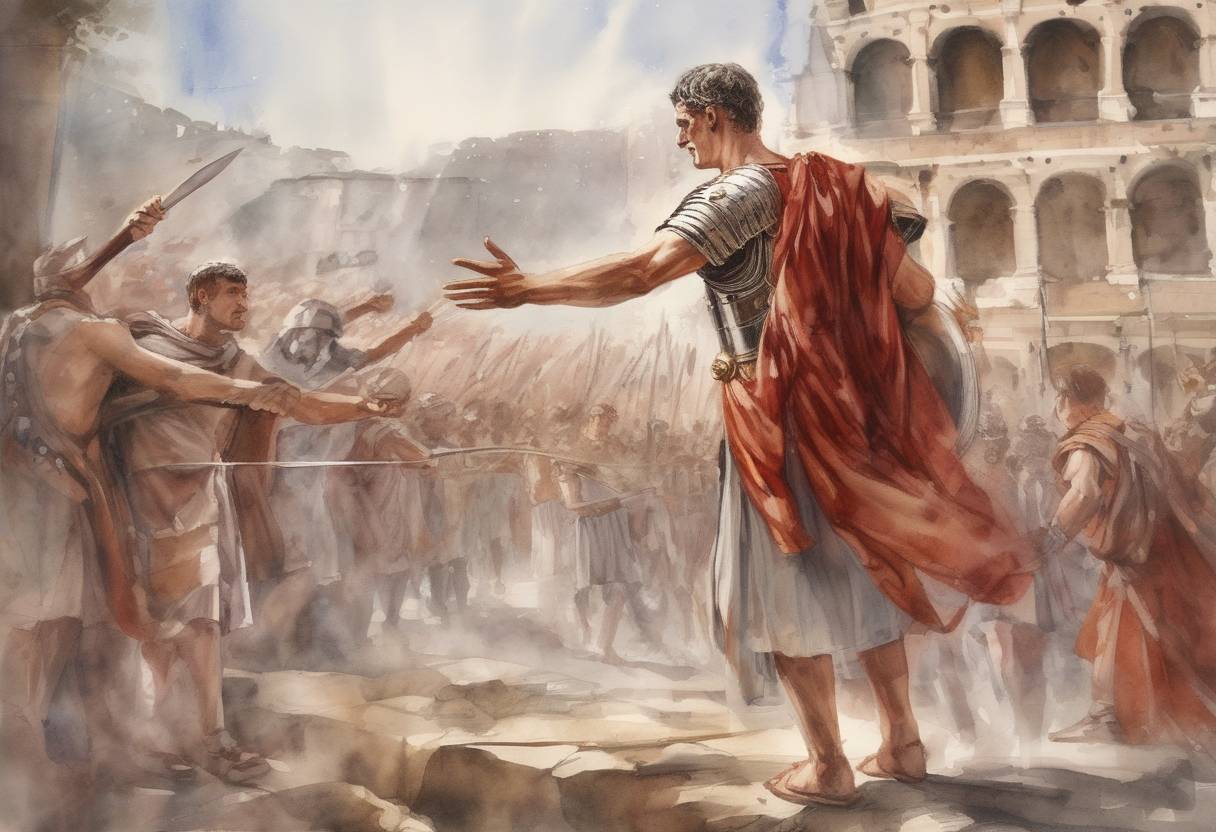
Germanicus’ Triumph in Rome - May 26, 17 AD
On May 26, 17 AD, Germanicus Julius Caesar, a prominent Roman general and a member of the Julio-Claudian dynasty, celebrated a grand triumph in Rome. This event marked his military successes against the Germanic tribes, particularly the Cherusci, Chatti, and other tribes across the Rhine.
Background
Germanicus was born in 15 BC into the Julio-Claudian dynasty, a lineage that would produce several Roman emperors. He was the son of Nero Claudius Drusus and Antonia Minor, making him the nephew of Emperor Tiberius and the father of the future Emperor Caligula. His marriage to Agrippina the Elder further solidified his standing within the imperial family.
Military Campaigns
Germanicus’ campaigns in Germania were part of Rome’s efforts to avenge the disastrous defeat at the Battle of the Teutoburg Forest in 9 AD, where three Roman legions were annihilated by an alliance of Germanic tribes led by Arminius. In 14 AD, Germanicus was given command of the Roman forces in Germania, tasked with restoring Roman prestige and securing the empire’s borders.
Over the next few years, Germanicus led several successful military campaigns. He achieved significant victories, including the recovery of two of the three lost legionary eagles from the Teutoburg defeat. His campaigns extended deep into Germanic territory, culminating in a decisive victory at the Battle of Idistaviso in 16 AD.
The Triumph
The triumph celebrated on May 26, 17 AD, was a lavish affair, showcasing Germanicus’ achievements and the spoils of war. It was a public spectacle that included parades of captured Germanic chieftains, displays of treasures, and the presentation of the recovered legionary standards. The event was not only a personal accolade for Germanicus but also a political statement reinforcing Roman dominance and the emperor’s favor.
Aftermath and Legacy
Despite his military success, Germanicus’ career was cut short. In 19 AD, he died under mysterious circumstances in Antioch, Syria, leading to suspicions of foul play, possibly involving Emperor Tiberius or his advisor Sejanus. His death was a significant blow to the Roman populace, who admired him for his charisma and military prowess.
Germanicus’ legacy endured through his descendants, most notably his son Caligula, who became emperor in 37 AD, and his grandson Nero, who ascended to the throne in 54 AD. His life and achievements were celebrated in Roman history and literature, cementing his status as one of Rome’s most revered military leaders.
In summary, the triumph of Germanicus on May 26, 17 AD, was a pivotal moment in Roman history, symbolizing both the might of the Roman military and the complex dynamics of imperial politics.