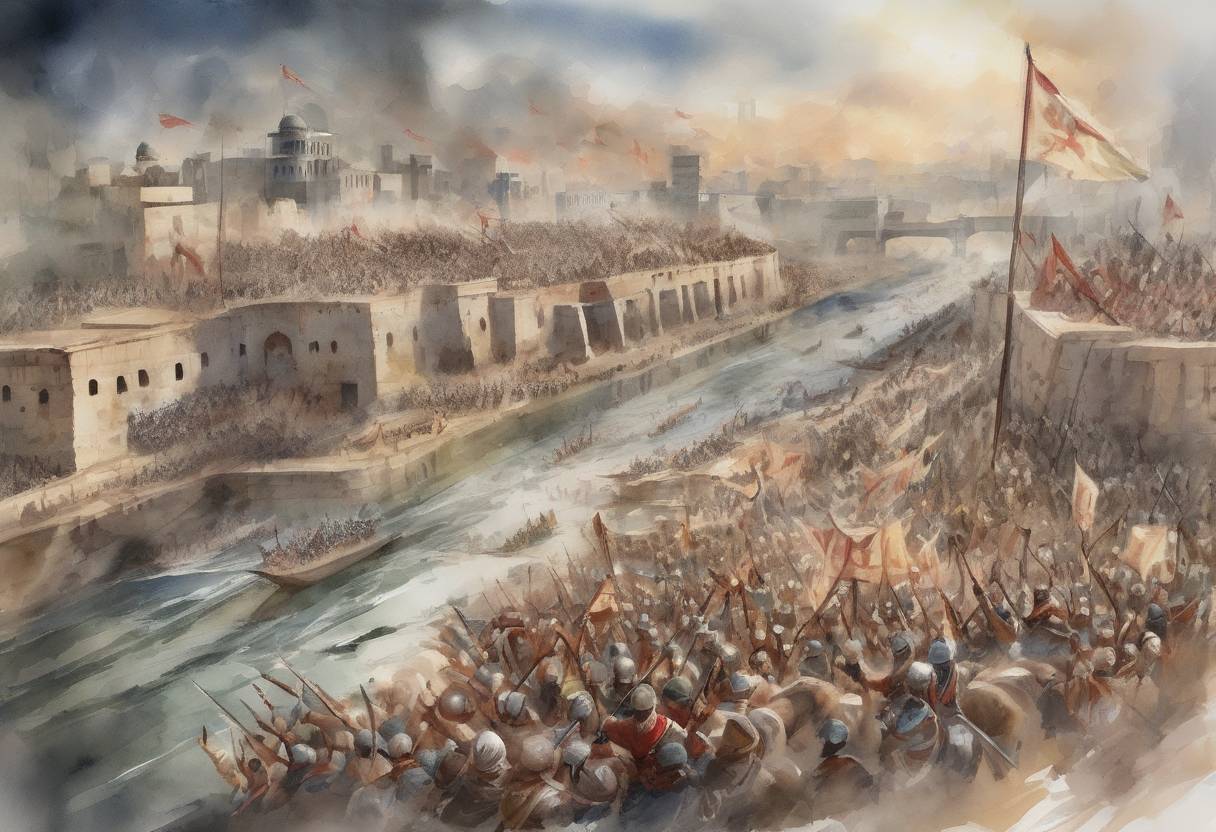
The Battle of Yarmouk Begins: August 15, 636
The Battle of Yarmouk, which commenced on August 15, 636, stands as a pivotal moment in the history of the early Islamic conquests. This battle was fought between the forces of the Byzantine Empire and the Rashidun Caliphate, marking a decisive victory for the Muslims and significantly altering the power dynamics in the Levant.
Context and Prelude
Byzantine Empire: At the time, the Byzantine Empire was one of the most powerful entities in the world, controlling vast territories across the Eastern Mediterranean. However, it was facing internal strife and external threats, including the rising power of the Rashidun Caliphate.
Rashidun Caliphate: Following the death of Prophet Muhammad in 632, the Rashidun Caliphate rapidly expanded under the leadership of the first four caliphs. By 636, the Caliphate had already made significant inroads into Byzantine territories.
Strategic Importance: The Levant was a crucial region due to its economic and strategic significance. Control over this area would provide the Rashidun Caliphate with a gateway to further expansion into Byzantine lands.
The Battle
Location: The battle took place near the Yarmouk River, which today forms part of the border between modern-day Syria and Jordan.
Forces Involved: The Byzantine army, commanded by General Vahan, was a formidable force, comprising various contingents from across the empire. The Rashidun army, led by Khalid ibn al-Walid, was smaller but highly mobile and motivated.
Tactics: The Rashidun forces employed superior tactics, including effective use of the terrain and strategic maneuvering to counter the Byzantine numerical advantage. Khalid ibn al-Walid’s leadership and the unity of the Muslim forces played a crucial role in their success.
Outcome and Significance
Decisive Victory: The battle concluded with a decisive victory for the Rashidun Caliphate. The Byzantine forces suffered heavy casualties, and their ability to defend the Levant was severely compromised.
Aftermath: The victory at Yarmouk paved the way for the Muslim conquest of the Levant, including the significant cities of Damascus and Jerusalem. It marked the beginning of a period of rapid Islamic expansion across the Middle East.
Historical Impact: The Battle of Yarmouk is often regarded as one of the most significant military engagements in history. It not only facilitated the spread of Islam but also marked the decline of Byzantine influence in the region.
In conclusion, the Battle of Yarmouk was a turning point that reshaped the political and cultural landscape of the Middle East. It exemplified the strategic acumen of the Rashidun Caliphate and set the stage for centuries of Islamic influence in the region.