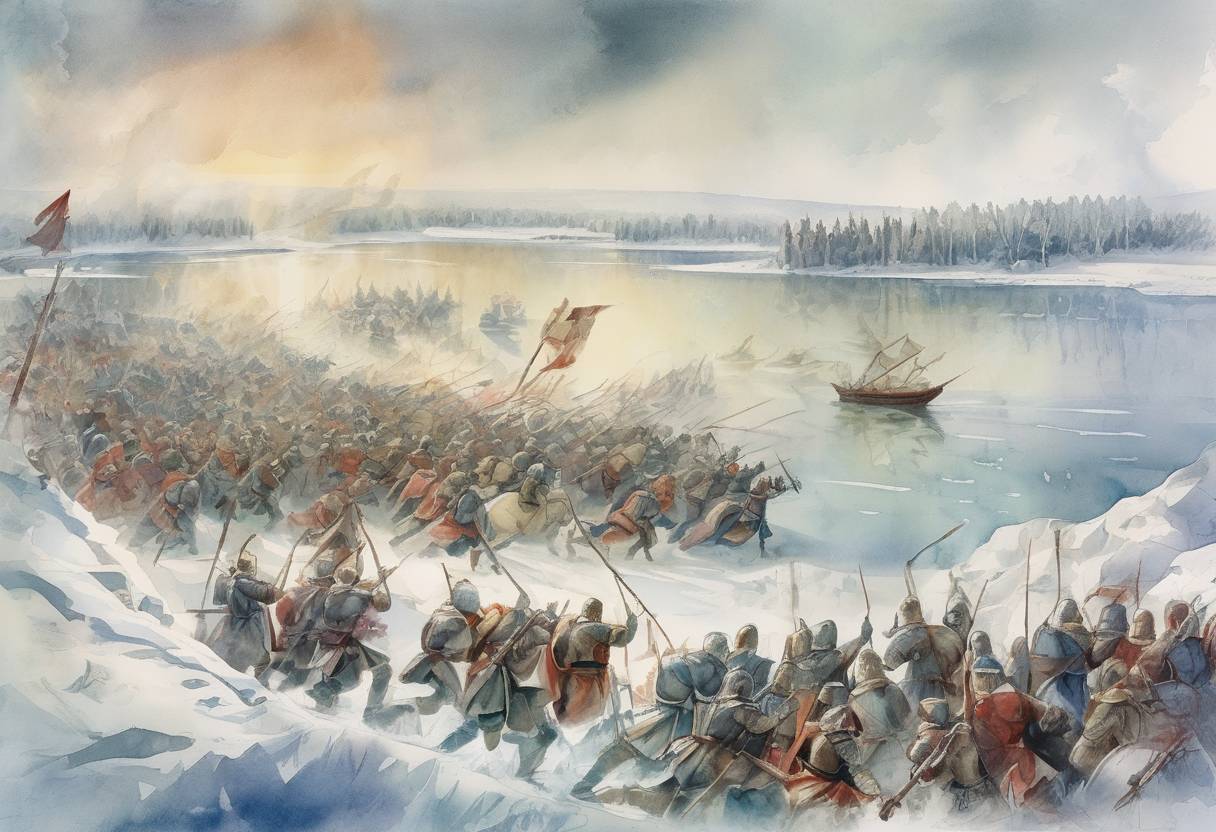
The Battle of the Ice: April 5, 1242
The Battle of the Ice, fought on April 5, 1242, was a significant military engagement between the forces of the Republic of Novgorod, led by Prince Alexander Nevsky, and the Teutonic Knights, a Catholic military order. This battle took place on the frozen Lake Peipus, which lies on the present-day border between Estonia and Russia.
Historical Context
Background: During the early 13th century, the Baltic region was a focal point of conflict between expanding Christian powers and the pagan and Orthodox Christian territories. The Teutonic Knights, a German Catholic military order, sought to expand their influence eastward, aiming to convert the Orthodox Christian and pagan populations to Catholicism.
Alexander Nevsky: Prince Alexander Nevsky was a prominent Russian leader known for his military acumen and diplomatic skills. He was appointed Prince of Novgorod, a key Russian principality, and became a symbol of resistance against foreign domination.
Prelude to Battle: The Teutonic Knights, having already established a foothold in the Baltic region, launched incursions into Russian territories. In 1240, they captured the city of Pskov, posing a direct threat to Novgorod. In response, Alexander Nevsky organized a campaign to repel the invaders.
The Battle
Location: The battle occurred on the frozen surface of Lake Peipus, a strategic location that played a crucial role in the outcome. The icy terrain was unfamiliar to the heavily armored Teutonic Knights but advantageous for the lighter, more mobile Russian forces.
Forces Involved: Alexander Nevsky commanded a diverse coalition of Russian troops, including infantry and cavalry. The Teutonic Knights, led by Hermann of Dorpat, were supported by Danish and Estonian allies.
Tactics and Outcome: Nevsky employed a tactical feigned retreat, drawing the Knights onto the weaker ice. As the heavily armored knights advanced, the ice began to crack under their weight, causing chaos in their ranks. The Russian forces then launched a decisive counterattack, encircling and defeating the Knights.
Aftermath and Significance
Immediate Consequences: The victory at Lake Peipus halted the eastward expansion of the Teutonic Knights and secured the western borders of Novgorod. It also reinforced Alexander Nevsky’s reputation as a defender of Russian lands and Orthodoxy.
Long-term Impact: The battle is celebrated in Russian history as a symbol of resistance against foreign domination and religious conversion. It solidified Nevsky’s legacy, leading to his canonization as a saint in the Russian Orthodox Church.
Cultural Legacy: The Battle of the Ice has been immortalized in Russian culture, notably in Sergei Eisenstein’s 1938 film “Alexander Nevsky,” which highlights the battle’s significance in Russian national identity.
In summary, the Battle of the Ice was a pivotal moment in medieval European history, demonstrating the strategic prowess of Alexander Nevsky and marking a turning point in the struggle between Eastern Orthodoxy and Western Catholicism in the Baltic region.