André-Jacques Garnerin's First Recorded Parachute Jump
1797 · Paris, France
André-Jacques Garnerin makes the first recorded parachute jump from a hot air balloon over Paris.
November 21, 1783
The first untethered manned flight was made in a hot air balloon by Jean-François Pilâtre de Rozier and François Laurent d'Arlandes.
Paris, France | Montgolfier Brothers
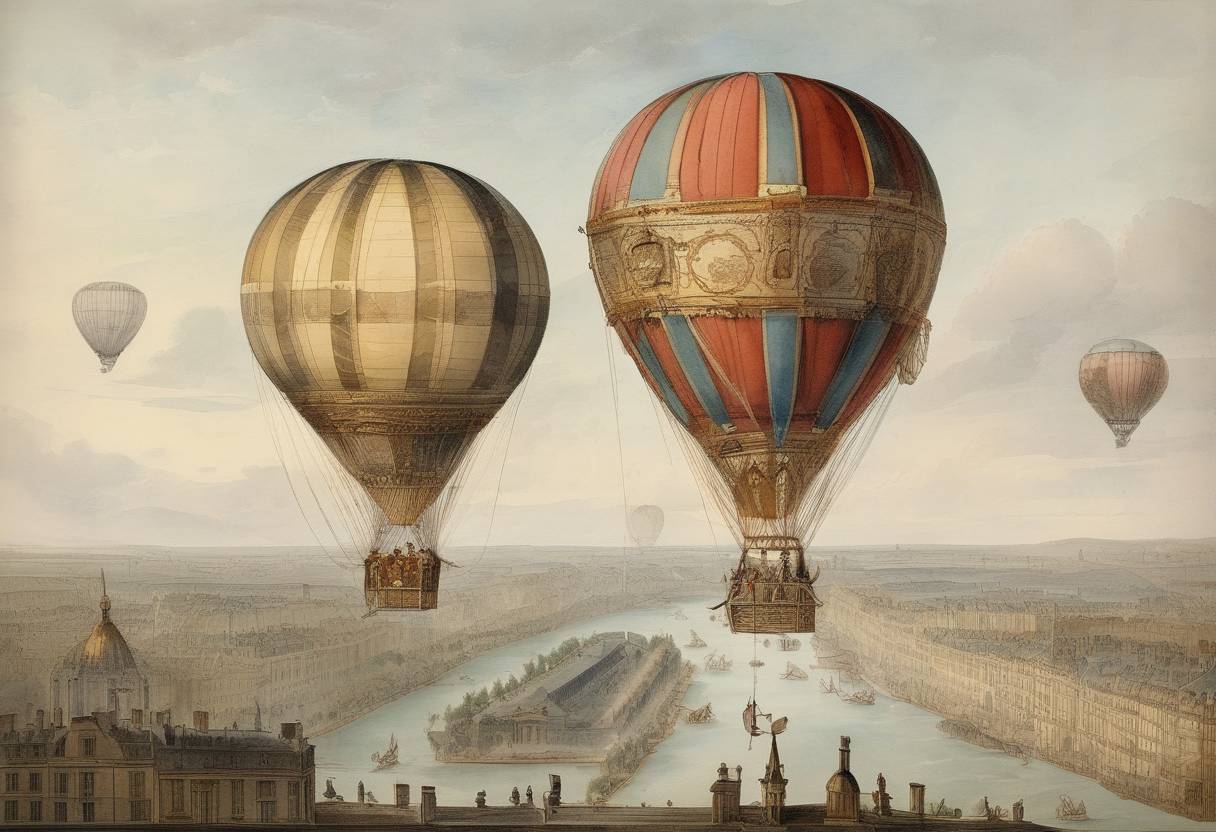
On November 21, 1783, a significant milestone in the history of aviation was achieved when Jean-François Pilâtre de Rozier and François Laurent d’Arlandes conducted the first untethered manned flight in a hot air balloon. This event marked the dawn of human flight and was a pivotal moment in the exploration of the skies.
The concept of ballooning was pioneered by the Montgolfier brothers, Joseph-Michel and Jacques-Étienne, who were paper manufacturers from Annonay, France. Inspired by the rising smoke from a fire, they hypothesized that heated air could lift a balloon. Their initial experiments with unmanned balloons in 1782 were successful, leading to further developments.
On June 4, 1783, the Montgolfiers demonstrated a public flight of a large unmanned balloon in Annonay, which ascended to an altitude of about 6,000 feet. This demonstration captured the imagination of the public and the scientific community, setting the stage for manned flights.
The first manned flight took place in Paris, France. The balloon used for this flight was constructed by the Montgolfier brothers and was made of taffeta coated with a fireproofing solution of alum. It was approximately 75 feet tall and 48 feet in diameter.
During the flight, Pilâtre de Rozier and d’Arlandes managed the fire that heated the air inside the balloon, maintaining its buoyancy. They navigated over the rooftops of Paris, witnessing the city from a perspective never before seen by humans.
The successful flight of Pilâtre de Rozier and d’Arlandes demonstrated the potential of human flight and inspired further advancements in aviation. It was a testament to human ingenuity and the spirit of exploration. The event was celebrated across Europe and laid the groundwork for future aeronautical developments.
The achievement also sparked a wave of ballooning experiments and competitions, leading to rapid advancements in balloon design and technology. It was a crucial step in the journey towards powered flight, which would eventually culminate in the invention of the airplane in the early 20th century.
In summary, the first untethered manned flight in a hot air balloon on November 21, 1783, was a landmark event that opened the skies to human exploration and set the stage for the future of aviation.
Source: en.wikipedia.org