Operation Linebacker II: The Commencement on December 18, 1972
1972 · Hanoi, Vietnam
The United States begins Operation Linebacker II, a massive bombing campaign against North Vietnam during the Vietnam War.
March 2, 1965
The US and South Vietnamese Air Force begin Operation Rolling Thunder, a sustained bombing campaign against North Vietnam.
, Vietnam | United States Air Force
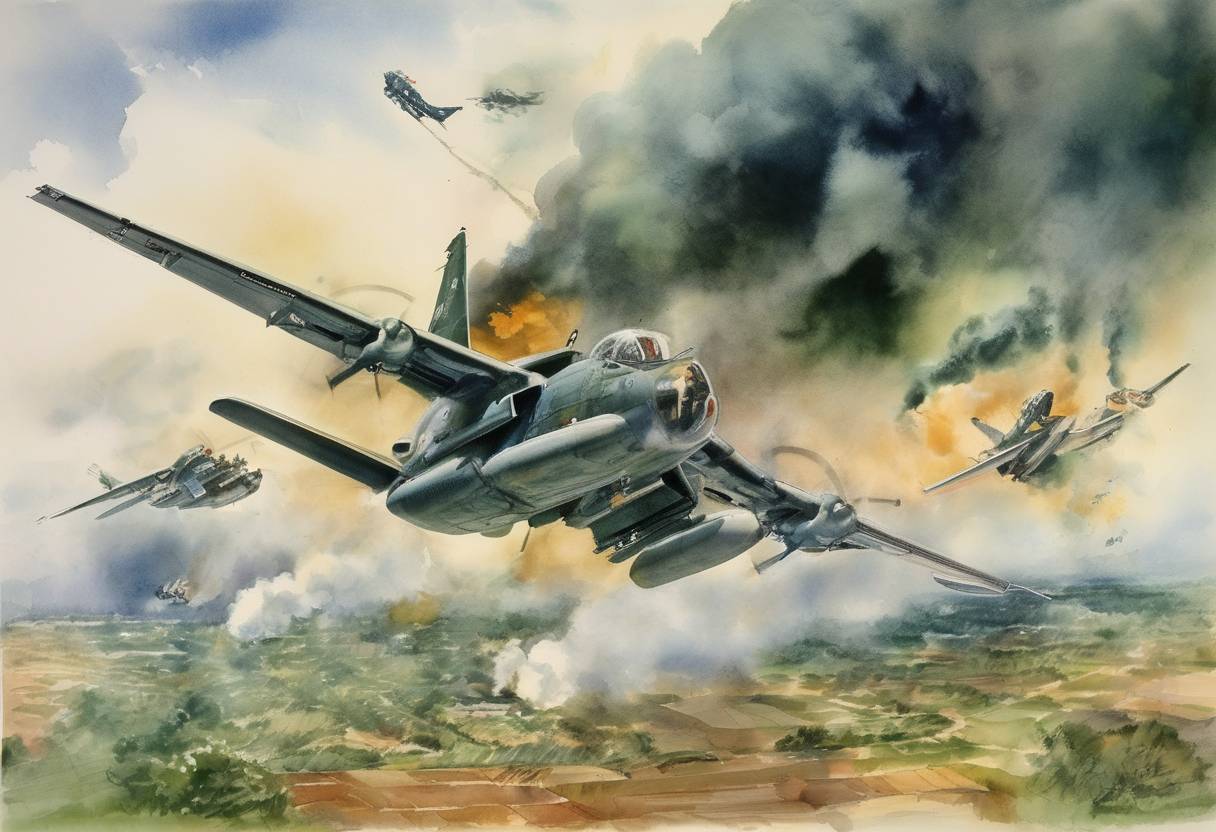
On March 2, 1965, the United States and the South Vietnamese Air Force initiated Operation Rolling Thunder, marking the beginning of a sustained bombing campaign against North Vietnam. This operation was a significant escalation in the Vietnam War, reflecting the United States’ commitment to a more aggressive military strategy.
The Vietnam War, a conflict rooted in the Cold War dynamics, saw North Vietnam, supported by communist allies, fighting against South Vietnam, backed by the United States and other anti-communist nations. By the early 1960s, the situation in South Vietnam was deteriorating, with the Viet Cong, a communist insurgency, gaining strength.
President Lyndon B. Johnson, who succeeded John F. Kennedy, faced increasing pressure to prevent the fall of South Vietnam to communism. The Gulf of Tonkin Incident in August 1964, where North Vietnamese forces allegedly attacked U.S. naval vessels, led to the Gulf of Tonkin Resolution, granting Johnson broad military powers in Vietnam.
Operation Rolling Thunder aimed to achieve several strategic objectives:
The operation began with a series of airstrikes targeting military installations, transportation networks, and industrial sites in North Vietnam. Initially planned as a short-term campaign, Operation Rolling Thunder extended over three years, involving thousands of sorties and dropping millions of tons of bombs.
Escalation of the War: Rather than achieving its objectives, the operation led to a significant escalation of the conflict. North Vietnam, with support from the Soviet Union and China, increased its military efforts.
Civilian Impact: The bombing campaign resulted in substantial civilian casualties and destruction, leading to international criticism and raising ethical concerns about the conduct of the war.
Limited Military Success: Despite the extensive bombing, the operation failed to achieve its strategic goals. North Vietnam’s resolve remained unbroken, and the Viet Cong continued their insurgency.
Domestic Opposition: The prolonged conflict and rising American casualties fueled anti-war sentiment in the United States, contributing to widespread protests and political pressure on the Johnson administration.
Operation Rolling Thunder is often cited as a pivotal moment in the Vietnam War, illustrating the complexities and challenges of military intervention in a protracted conflict. Its legacy underscores the difficulties of achieving strategic objectives through aerial bombardment alone and highlights the broader geopolitical tensions of the Cold War era.
Source: en.wikipedia.org