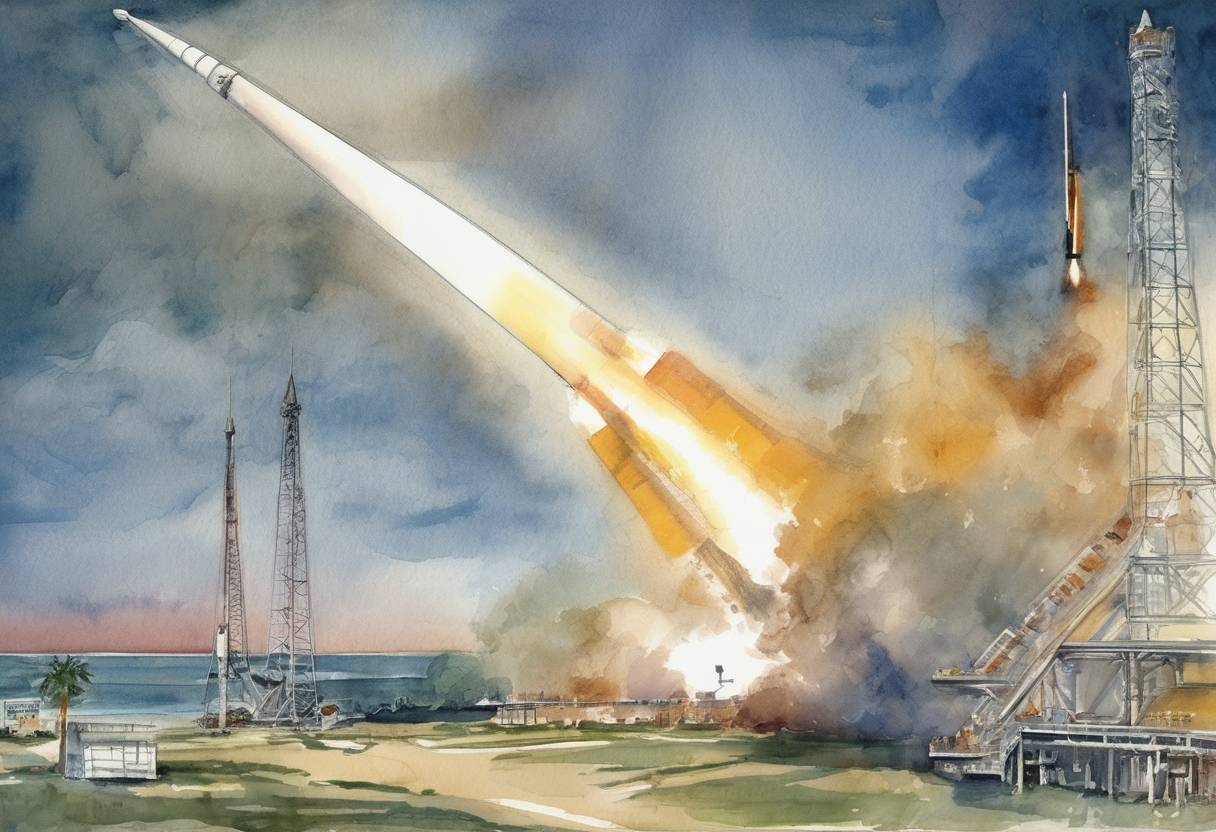
The First Saturn I Rocket Launch: October 27, 1961
On October 27, 1961, the United States marked a significant milestone in its space exploration efforts with the successful launch of the first Saturn I rocket from Cape Canaveral, Florida. This event was a pivotal moment in the U.S. space program, laying the groundwork for future manned space missions and the eventual moon landing.
Background
The Saturn I rocket was part of the larger Saturn rocket family, developed by NASA to support the Apollo program. The development of the Saturn I was spearheaded by Wernher von Braun and his team at the Marshall Space Flight Center. The rocket was designed to be a heavy-lift launch vehicle, capable of carrying large payloads into orbit, which was essential for the ambitious goals of the U.S. space program during the Cold War era.
Key Features of the Saturn I
- Height: Approximately 162 feet (49 meters).
- Stages: Two-stage rocket, with the first stage powered by a cluster of eight H-1 engines.
- Payload Capacity: Designed to carry payloads of up to 20,000 pounds (9,072 kg) to low Earth orbit.
The Launch
The launch on October 27, 1961, was designated as SA-1 (Saturn-Apollo 1). It was primarily a test flight to validate the design and performance of the Saturn I’s first stage. The mission objectives included:
- Testing the structural integrity of the rocket.
- Evaluating the performance of the H-1 engines.
- Assessing the guidance and control systems.
The launch was a success, with the rocket reaching an altitude of approximately 84.8 miles (136.5 kilometers) and traveling a distance of 214 miles (344 kilometers) downrange. The mission lasted about 15 minutes, and all primary objectives were met.
Significance and Aftermath
The successful launch of the Saturn I rocket was a crucial step in the U.S. space program, demonstrating the feasibility of using large rockets for space exploration. It provided valuable data that informed the development of subsequent Saturn rockets, including the Saturn V, which would eventually carry astronauts to the moon during the Apollo missions.
The Saturn I’s success also bolstered U.S. confidence in its space capabilities during a period of intense competition with the Soviet Union, known as the Space Race. It underscored the technological advancements being made by NASA and set the stage for more ambitious projects in the years to come.
In summary, the launch of the first Saturn I rocket on October 27, 1961, was a landmark achievement that played a vital role in advancing human space exploration and establishing the United States as a leader in space technology.