Anesthetic Ether Used for the First Time by Dr. William Morton
1846 · Boston, United States
Anesthetic ether is used for the first time by American dentist Dr. William Morton during a tooth extraction.
December 11, 1844
Dr. Horace Wells becomes the first person to have a tooth extracted using nitrous oxide as an anesthetic.
Hartford, United States | N/A
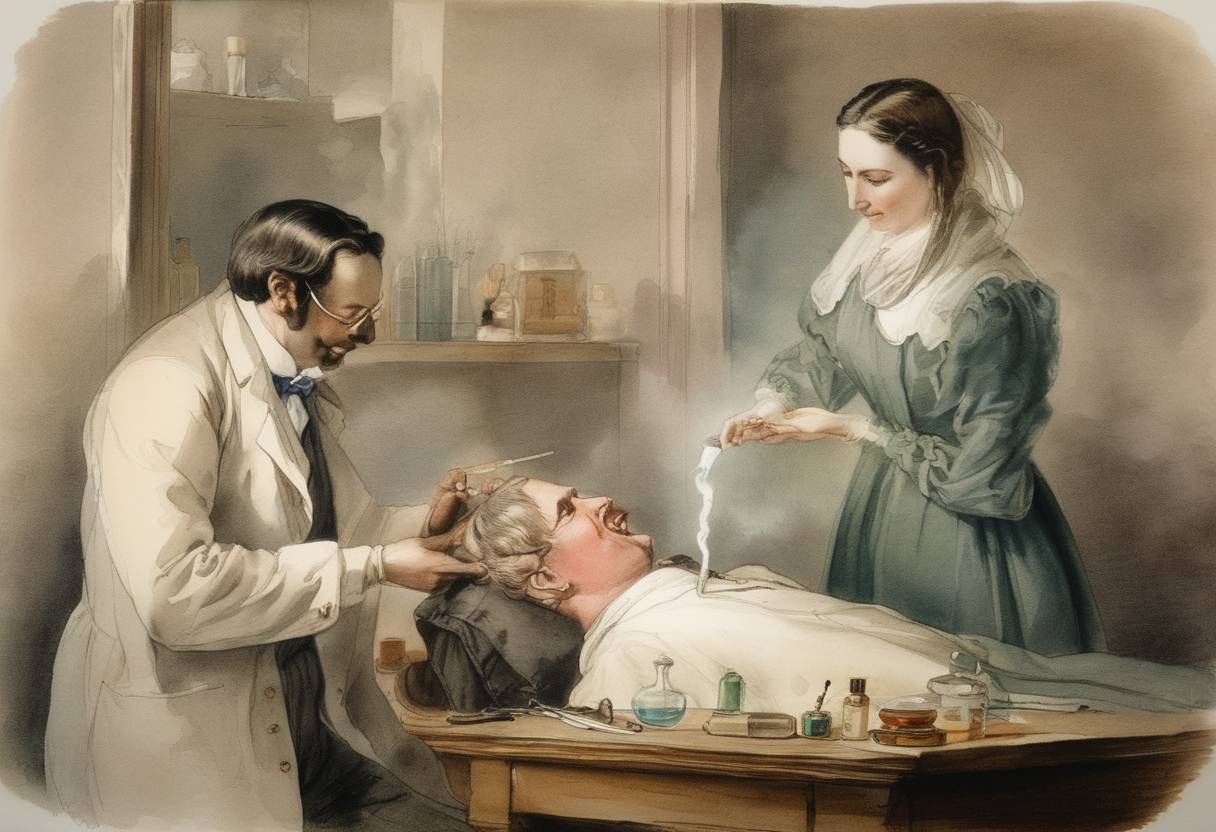
On December 11, 1844, Dr. Horace Wells, a dentist from Hartford, Connecticut, made a groundbreaking advancement in the field of dentistry and medicine as a whole by being the first person to demonstrate the use of nitrous oxide, commonly known as laughing gas, as an anesthetic for a dental procedure.
Prior to this event, dental extractions and other surgical procedures were conducted without pain relief, leading to traumatic experiences for patients. The concept of anesthesia in surgery was not yet realized, and practitioners often relied on methods such as alcohol or physical restraint to manage pain and keep patients still.
Horace Wells became interested in the potential of nitrous oxide after witnessing a public demonstration in Hartford by a traveling lecturer named Gardner Quincy Colton. During Colton’s demonstration, a participant under the effects of nitrous oxide injured himself but showed no signs of pain, which sparked Wells’ interest in the gas as an analgesic.
Determined to test the analgesic properties of nitrous oxide, Wells arranged for a dental extraction to be performed on himself. On December 11, 1844, with the help of his colleague Dr. John Riggs, Wells inhaled nitrous oxide and successfully underwent the extraction of one of his teeth without experiencing significant pain.
This event marked the first documented use of nitrous oxide as an anesthetic in dentistry, paving the way for safer and more humane surgical practices. Despite the success, Wells faced initial skepticism and struggled to gain acceptance from the medical community. His subsequent public demonstration in Boston in early 1845 was deemed a failure, further complicating efforts to secure scientific recognition.
Despite these early challenges, Wells’ pioneering use of nitrous oxide eventually gained traction and significantly influenced the development of modern anesthesia. His work contributed to the eventual widespread adoption of anesthetics in medical procedures, transforming both patient care and surgical methodology.
Dr. Horace Wells is remembered today as a pioneer in the field of anesthesiology, an honor that underscores his crucial contributions to medicine and patient comfort.
Source: en.wikipedia.org