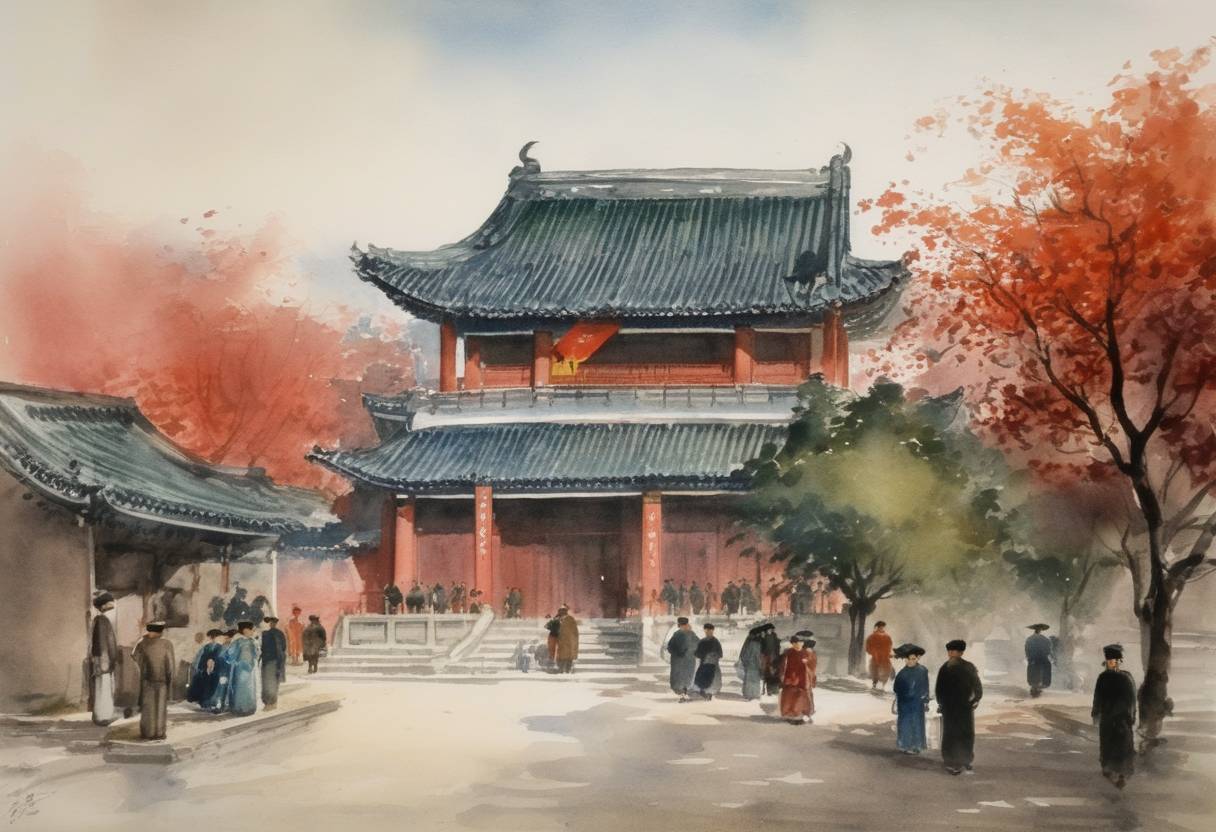
The First Legislative Yuan of the Republic of China
Overview
On May 18, 1948, the First Legislative Yuan of the Republic of China officially convened for its inaugural session in Nanking. This event marked a significant transition in the governance of China following the promulgation of the new Constitution in 1947, laying the groundwork for a more structured governmental framework under the leadership of Chiang Kai-shek and the Nationalist government.
Background
The establishment of the Legislative Yuan was part of a broader effort to implement constitutional democracy in China. The 1947 Constitution aimed to replace the earlier provisional governance under the KMT (Kuomintang) with a more democratic process, including the establishment of five branches of government as theorized by Sun Yat-sen: Executive, Legislative, Judicial, Examination, and Control.
The 1947 Constitution
Promulgated on December 25, 1947, the Constitution of the Republic of China outlined the fundamental principles for governance, intending to stabilize China after decades of internal strife and foreign occupation. This Constitution was perceived as a step toward modernizing the political system and transitioning from a wartime regime to a peacetime constitutional government.
The Inaugural Session
The convening of the Legislative Yuan in Nanking symbolized the operationalization of this constitutional framework. A total of 760 delegates, elected to represent various parts of China and overseas Chinese communities, gathered to assume their legislative responsibilities. This institution was tasked with the creation of laws, decisions on fiscal policies, and a role in foreign policy oversight, effectively strengthening the legislative process in the nation.
Significance and Aftermath
The event signaled the beginning of a formal legislative process within the Republic of China. However, the ensuing Chinese Civil War between the Nationalists and Communists overshadowed these developments. Despite the establishment of these constitutional entities, the government was unable to consolidate control over mainland China, leading to the retreat of the KMT to Taiwan in 1949.
In Taiwan, the Legislative Yuan continued to function and remains a crucial component of Taiwan’s political system to this day, reflecting the enduring legacy of the 1947 Constitution despite later political shifts and challenges.