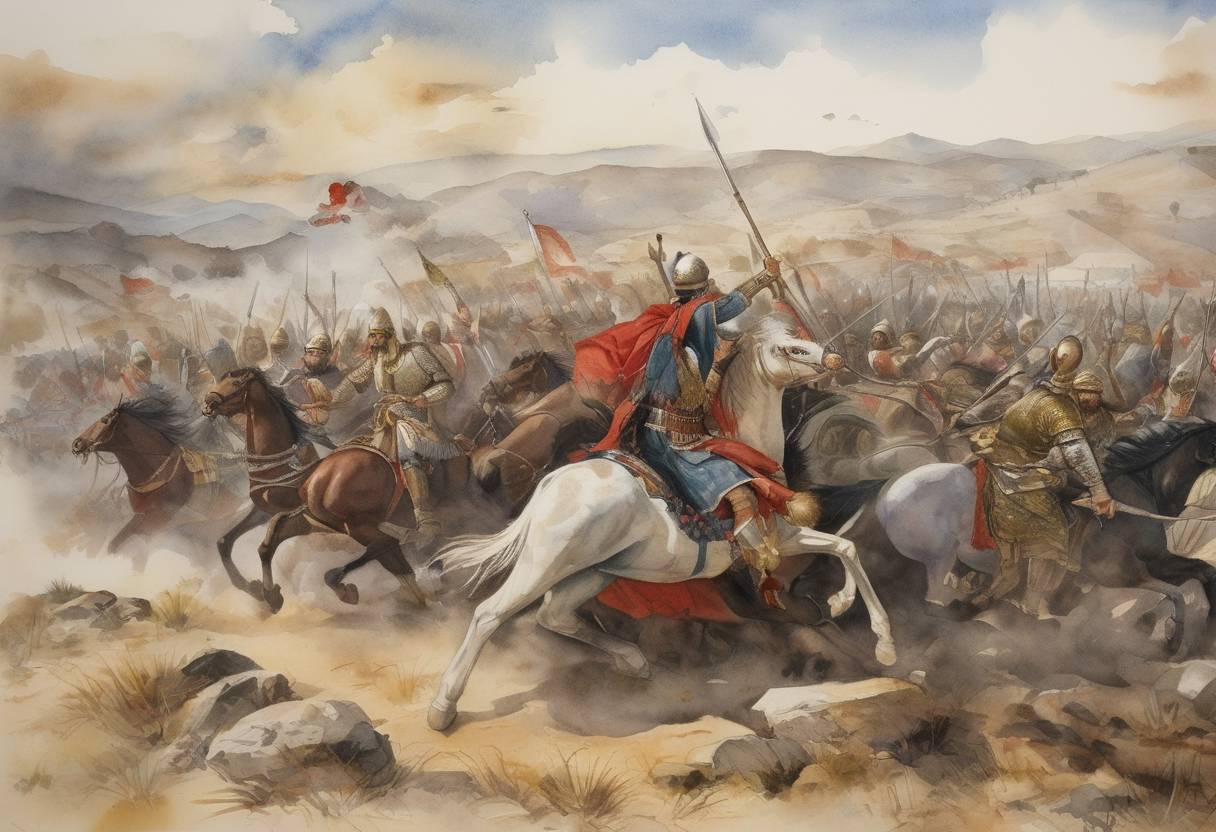
The Battle of Manzikert - August 19, 1071
The Battle of Manzikert was a pivotal conflict that occurred on August 19, 1071, between the Byzantine Empire and the Seljuk Turks. This battle marked a significant turning point in the history of the Byzantine Empire and had far-reaching consequences for the region of Anatolia.
Context and Prelude
In the years leading up to the battle, the Byzantine Empire was facing numerous challenges, including military threats from various fronts and internal political strife. To secure the eastern borders against the Seljuk Turks, Emperor Romanos IV Diogenes embarked on a military campaign to push back the Turkish incursions into Byzantine territory. He assembled a diverse army comprised of Byzantine troops and mercenaries from various regions, including Norman, Frankish, and Turkish forces.
Sultan Alp Arslan of the Seljuk Empire, on the other hand, was extending his domain into the Byzantine-controlled regions and was keen on consolidating Turkic control over Anatolia. His strategy involved rapid movement and a commitment to raiding Byzantine territories to weaken their hold over the region.
The Battle
On August 19, 1071, the two forces clashed near the town of Manzikert, located in present-day Turkey. The Byzantine army, led by Emperor Romanos IV Diogenes, initially had the advantage in terms of numbers but faced difficulties due to dissent and indiscipline within the ranks. The terrain favored the mobile cavalry tactics of the Seljuk Turks.
During the battle, the Seljuk forces employed hit-and-run tactics, using their cavalry archers to harry the Byzantine troops continually. A combination of strategic feints and quick attacks created chaos within the Byzantine lines.
A critical factor in the Byzantine defeat was the betrayal by a portion of Romanos’s army, led by Andronikos Doukas, who retreated from the battlefield at a crucial moment. This act of treachery left the Byzantine flanks vulnerable and contributed significantly to the collapse of their defenses.
Aftermath and Significance
The defeat at Manzikert was catastrophic for the Byzantine Empire. Emperor Romanos IV Diogenes was captured by Sultan Alp Arslan but was released soon after a negotiation. Despite the Emperor’s eventual return to Constantinople, the defeat weakened his authority, leading to a period of political instability within the Byzantine Empire.
The loss opened the door for further Turkish incursions into Anatolia, resulting in the gradual loss of Byzantine control over the region. This marked the beginning of the decline of Byzantine influence in the area and paved the way for the eventual rise of Turkish states in Anatolia, including the Ottoman Empire.
The Battle of Manzikert is often considered one of the key events leading up to the First Crusade, as it underscored the vulnerability of Byzantine territories and prompted Western European powers to respond to threats against Christendom in the East.