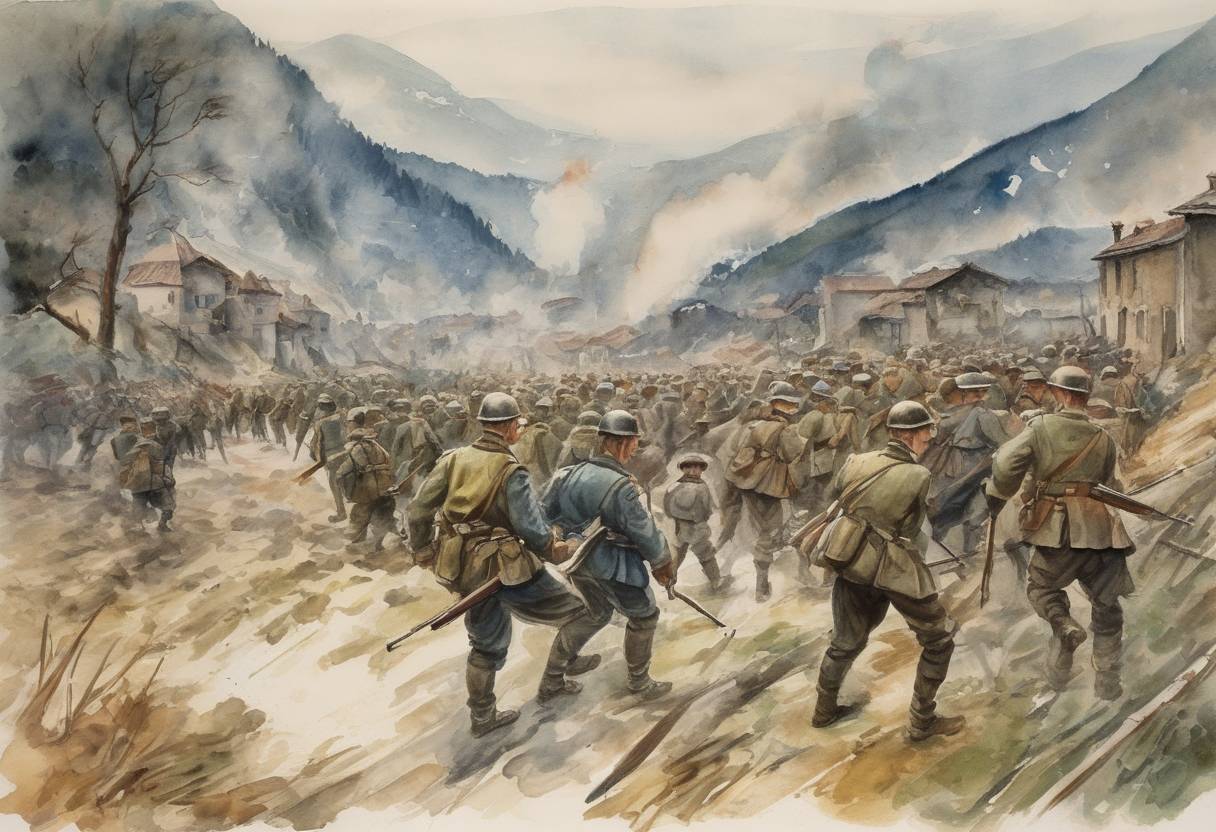
The Battle of Caporetto: October 26, 1917
The Battle of Caporetto, also known as the Twelfth Battle of the Isonzo, began on October 26, 1917, during World War I. This battle marked a significant turning point on the Italian Front, where Austro-Hungarian and German forces achieved a decisive victory over the Italian army.
Context and Prelude
Italian Front: By 1917, the Italian Front had been characterized by a series of battles along the Isonzo River, with Italy attempting to break through Austro-Hungarian defenses. The previous eleven battles had resulted in high casualties with minimal territorial gains for Italy.
Strategic Importance: The Isonzo River region was crucial for both sides. For Italy, it represented a gateway to the Austro-Hungarian heartland. For the Central Powers, holding the line was essential to prevent an Italian breakthrough.
Central Powers’ Strategy: The German High Command, seeking to relieve pressure on the Eastern Front and exploit Italian weaknesses, decided to support Austro-Hungarian forces with German troops and tactics. General Otto von Below was appointed to lead the combined forces.
The Battle
Initial Assault: On October 24, 1917, the Central Powers launched a surprise attack using innovative infiltration tactics, including the use of stormtroopers and poison gas. This marked a departure from traditional frontal assaults.
Breakthrough: By October 26, the Central Powers had successfully broken through the Italian lines at Caporetto (modern-day Kobarid, Slovenia). The Italian Second Army, unprepared for the new tactics and overwhelmed by the assault, began a chaotic retreat.
Italian Collapse: The breakthrough led to a rapid advance by the Central Powers, capturing large swathes of territory and taking thousands of Italian prisoners. The Italian army retreated over 100 kilometers to the Piave River, abandoning the strategic town of Udine.
Aftermath and Consequences
Italian Losses: The Italian army suffered approximately 300,000 casualties, including prisoners, wounded, and dead. The defeat led to a crisis in Italian military and political leadership.
Reorganization: In response to the disaster, Italy reorganized its military command, appointing General Armando Diaz to replace General Luigi Cadorna. The Italian government also sought increased support from its Allies.
Allied Support: The defeat at Caporetto prompted increased Allied support for Italy, including the dispatch of British and French troops to bolster Italian defenses.
Strategic Shift: The battle demonstrated the effectiveness of new military tactics, influencing future engagements on the Western Front. It also highlighted the importance of morale and preparedness in modern warfare.
Broader Historical Significance
The Battle of Caporetto was a stark reminder of the volatility of World War I fronts and the impact of tactical innovation. It underscored the necessity for adaptability in military strategy and had lasting effects on Italian military and political landscapes. The battle’s outcome also reinforced the importance of Allied cooperation, which would prove crucial in the final year of the war.