George Washington's Inauguration: April 30, 1789
1789 · New York City, United States
George Washington was inaugurated as the first President of the United States on the balcony of Federal Hall in New York City.
July 10, 1850
Millard Fillmore is sworn in as the 13th President of the United States following the death of President Zachary Taylor.
Washington, D.C., United States | United States government
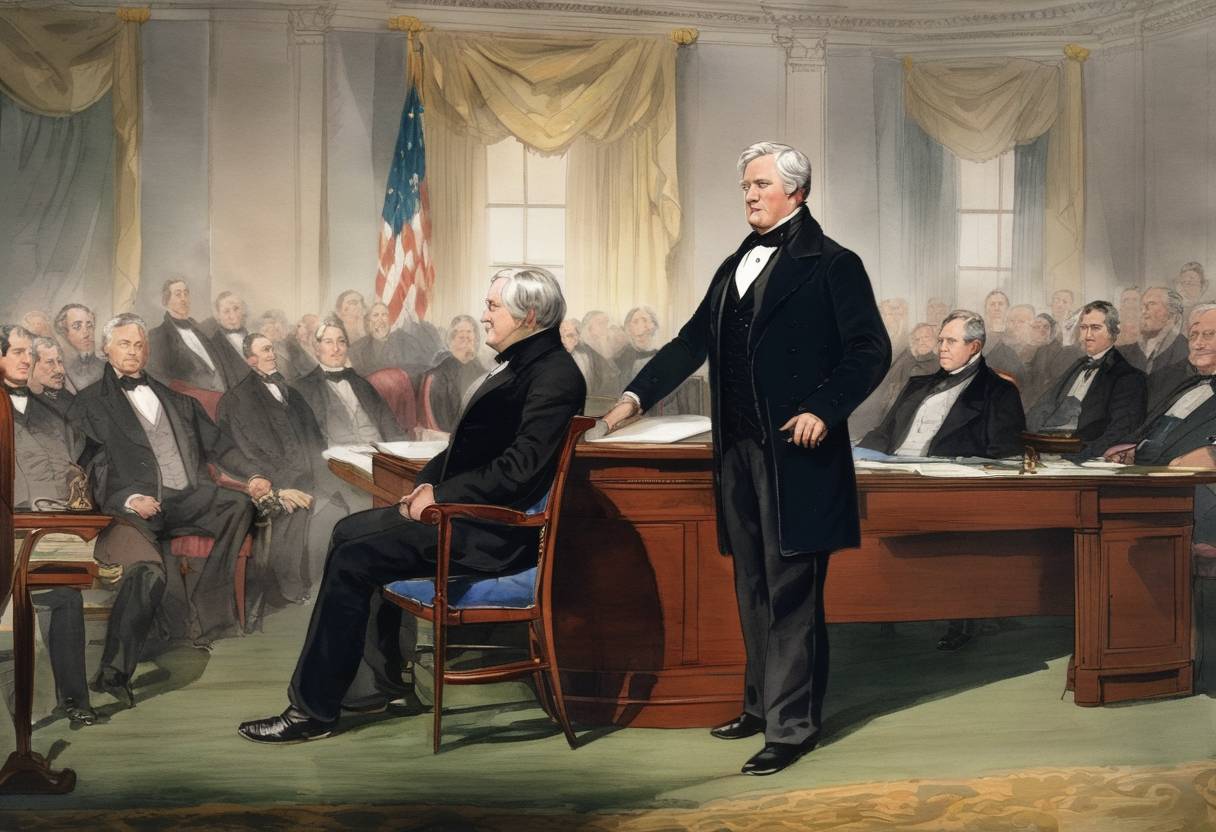
On July 10, 1850, Millard Fillmore was sworn in as the 13th President of the United States following the death of President Zachary Taylor. Taylor, who had been suffering from a gastroenteritis-like illness, passed away on July 9, 1850, at the age of 65. His sudden death placed Vice President Fillmore next in line for the presidency.
Zachary Taylor’s Presidency: Taylor, a hero of the Mexican-American War, had taken office on March 4, 1849. His presidency was marked by attempts to hold the Union together amidst rising tensions over slavery and territorial expansion following the Mexican-American War.
Compromise of 1850: At the time of Taylor’s death, the United States was embroiled in debates over the extension of slavery into territories acquired from Mexico. The Compromise of 1850, a set of legislative measures intended to deal with these issues, was at the forefront of political discourse.
Swearing-in Ceremony: On July 10, 1850, Fillmore took the presidential oath in the House of Representatives chamber. His assumption of office marked the nation’s second vice-presidential succession due to the death of a sitting president, the first being John Tyler following the death of William Henry Harrison in 1841.
Immediate Actions: Upon taking office, Fillmore moved to reshuffle his Cabinet. This included the resignation of all of Taylor’s Cabinet members, which was not uncommon during a change in administration, but was expedited due to the situation.
Support for the Compromise of 1850: Unlike Taylor, who had opposed parts of the Compromise, Fillmore supported it. This legislative package, championed by figures such as Henry Clay and Stephen A. Douglas, was largely aimed at averting a civil division by addressing sectional tensions over slavery.
Presidency Overview: Fillmore’s presidency is most noted for the passage of the Compromise of 1850, which included controversial elements like the Fugitive Slave Act. His enforcement of this act was instrumental in his later political alienation and his failure to secure the Whig nomination for the 1852 presidential election.
Fillmore’s tenure was marked by his efforts to maintain the Union amidst sectional conflict, but his support for certain aspects of the Compromise eventually contributed to the fracturing of the Whig Party. His presidency highlighted the deepening divisions that would ultimately lead to the American Civil War in the following decade.
Source: www.whitehouse.gov