The Capture of Pyongyang: The First Sino-Japanese War
1894 · Pyongyang, Korea (present-day North Korea)
The first Sino-Japanese War: Japanese forces captured the port city of Pyongyang from China.
August 1, 1894
The First Sino-Japanese War officially began as China declared war on Japan, marking the start of military conflict over influence in Korea.
Peking (now Beijing), China | Chinese Imperial Government
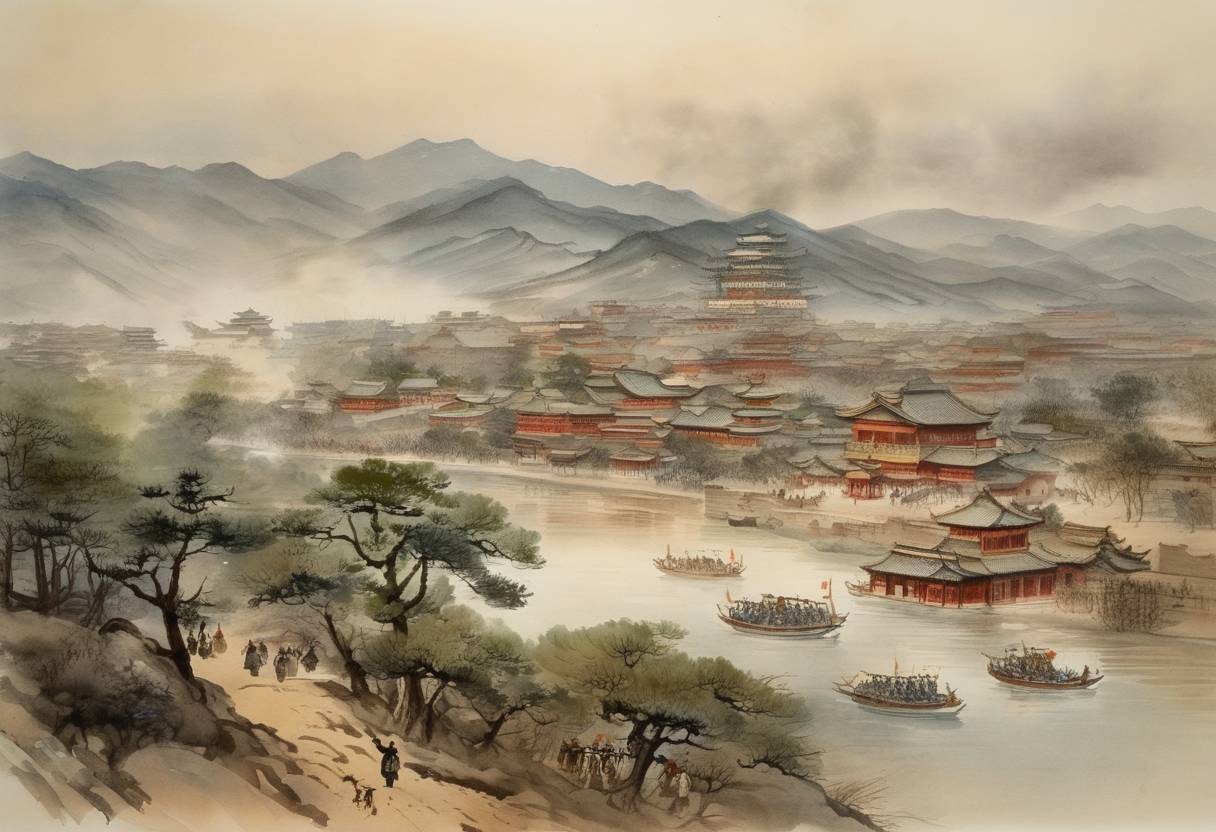
The First Sino-Japanese War, a significant military conflict between the Qing Dynasty of China and Meiji Japan, officially began on August 1, 1894, when China declared war on Japan. The roots of the conflict were deeply entwined with the struggle for influence over Korea, a strategic and economically significant peninsula both nations had interests in.
The situation in Korea had been tense for years, as both China and Japan sought to assert dominance. Korea had long been considered a tributary state of China, while Japan, undergoing modernization and viewing itself as a burgeoning regional power, saw Korea as crucial for its security and economic interests. The tensions escalated when internal instability in Korea led to the Donghak Peasant Revolution in 1894. The Korean monarchy requested Chinese assistance to suppress the uprising, which China provided in the form of troop deployments.
Japan perceived China’s military action as a violation of the Convention of Tientsin signed in 1885, which stipulated that neither country would send troops to Korea without prior notification. In response, Japan dispatched its forces to Korea, leading to an inevitable military confrontation.
July 25, 1894: The Battle of Pungdo marked one of the early naval confrontations between Chinese and Japanese naval forces. The engagement, which resulted in a Japanese victory, intensified hostilities.
July 29, 1894: The Battle of Seonghwan occurred on Korean soil, leading to further Japanese advances. The Japanese troops, utilizing their well-equipped and modernized military, proved successful against the Qing forces.
On August 1, 1894, in the wake of mounting skirmishes and Japan’s continued military engagements, China formally declared war on Japan. This declaration marked the official start of the First Sino-Japanese War, setting the stage for a series of battles both on land and at sea. The war was characterized by Japan’s decisive victories, due in part to superior military tactics and equipment, as well as better logistical support.
The First Sino-Japanese War had profound consequences for East Asia. Japan’s victory signaled a shift in regional power, as it emerged from the conflict with increased influence over Korea and a newly acquired foothold in the Liaodong Peninsula. The Treaty of Shimonoseki, signed in 1895, officially ended the war, ceding Taiwan and the Pescadores Islands to Japan, and marking the decline of Qing’s influence.
This conflict not only altered geopolitical dynamics but also demonstrated the impact of Western-style modernization and industrialization, as seen in Japan’s military effectiveness. It paved the way for Japan’s imperial expansion and foreshadowed further international conflicts in the region.
Source: www.britannica.com