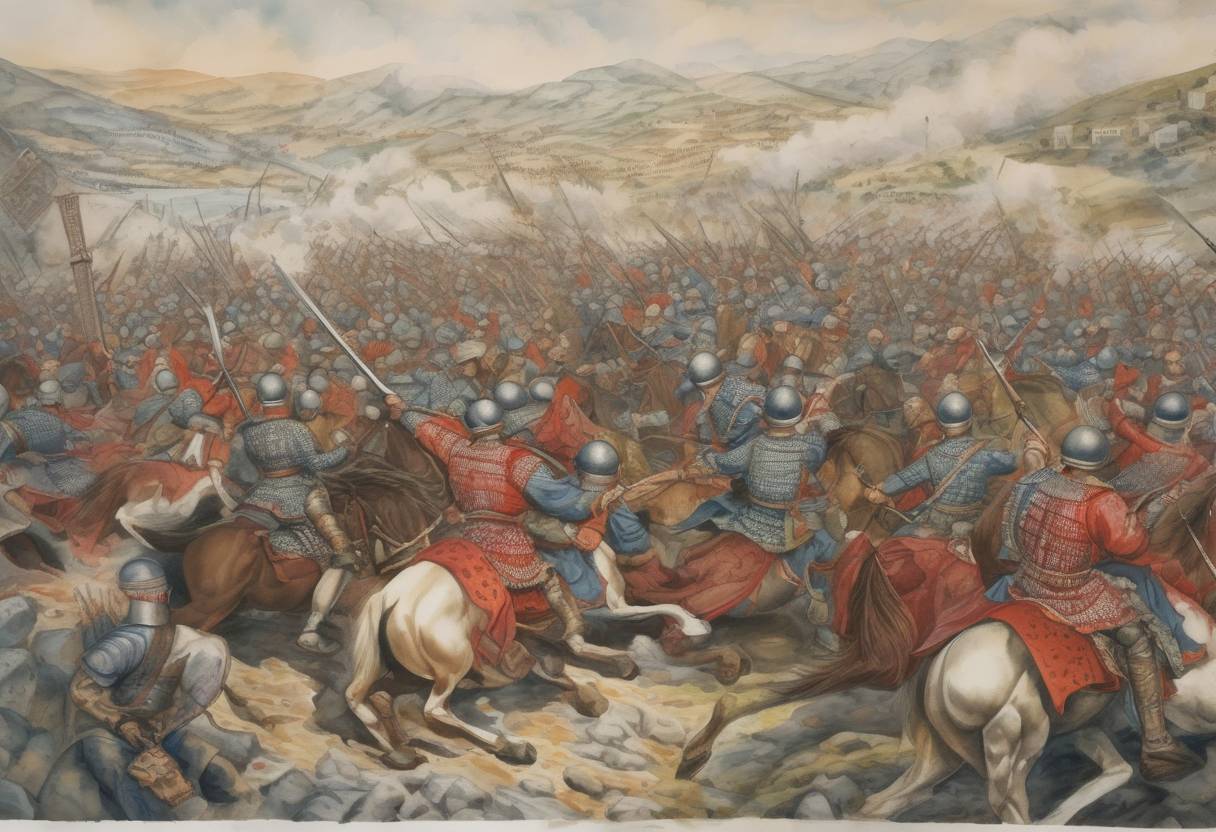
The Second Battle of Kosovo: October 17, 1448
The Second Battle of Kosovo, which began on October 17, 1448, was a significant conflict between the Ottoman Empire and a coalition of Hungarian and Wallachian forces. This battle was part of the broader struggle between Christian European states and the expanding Ottoman Empire during the 15th century.
Context and Background
Ottoman Expansion: By the mid-15th century, the Ottoman Empire was rapidly expanding its territories in the Balkans, posing a significant threat to European powers. The fall of Constantinople in 1453 was still a few years away, but the Ottomans were already a formidable force in the region.
Christian Coalition: The Christian forces were led by John Hunyadi, the Regent-Governor of Hungary, who was determined to halt the Ottoman advance into Europe. Hunyadi was a seasoned military leader known for his previous campaigns against the Ottomans.
Strategic Importance: The Kosovo region was strategically significant as it served as a gateway for Ottoman expansion into Central Europe. The battle was fought on the same plains where the First Battle of Kosovo had taken place in 1389, another pivotal conflict between the Ottomans and a Serbian-led coalition.
The Battle
Forces Involved: The Ottoman forces were commanded by Sultan Murad II, who had a well-organized and disciplined army. The Christian coalition, primarily composed of Hungarian and Wallachian troops, was led by John Hunyadi.
Battle Commencement: The battle began on October 17, 1448, and lasted for three days. It was characterized by intense and brutal fighting, with both sides employing cavalry, infantry, and artillery.
Tactics and Strategy: Hunyadi attempted to use his forces’ mobility to outmaneuver the Ottomans, but the Ottomans’ superior numbers and strategic positioning proved decisive. The Ottomans effectively utilized their Janissaries and artillery to break the coalition’s lines.
Outcome and Consequences
Ottoman Victory: The battle concluded with a decisive victory for the Ottoman Empire. The defeat weakened the Christian coalition and solidified Ottoman control over the Balkans.
Impact on Europe: The victory at Kosovo allowed the Ottomans to continue their expansion into Europe, eventually leading to the fall of Constantinople in 1453. It marked a significant step in the Ottoman Empire’s rise as a dominant power in Southeast Europe.
Legacy: The Second Battle of Kosovo is remembered as a critical moment in the Ottoman-Hungarian wars and a testament to the shifting power dynamics in Europe during the 15th century. It underscored the challenges faced by European states in uniting against the Ottoman threat.
In summary, the Second Battle of Kosovo was a pivotal conflict that highlighted the Ottoman Empire’s growing influence in Europe and the challenges faced by Christian states in resisting their expansion. The battle’s outcome had lasting implications for the balance of power in the region.