The Battle of Quebec: December 31, 1775
1775 · Quebec City, Canada
The Battle of Quebec took place during the American Revolutionary War, where British forces successfully defended the city against an American attack.
September 13, 1759
The Battle of the Plains of Abraham took place during the Seven Years' War, leading to the British capture of Quebec City from the French.
Quebec City, Canada | British Army
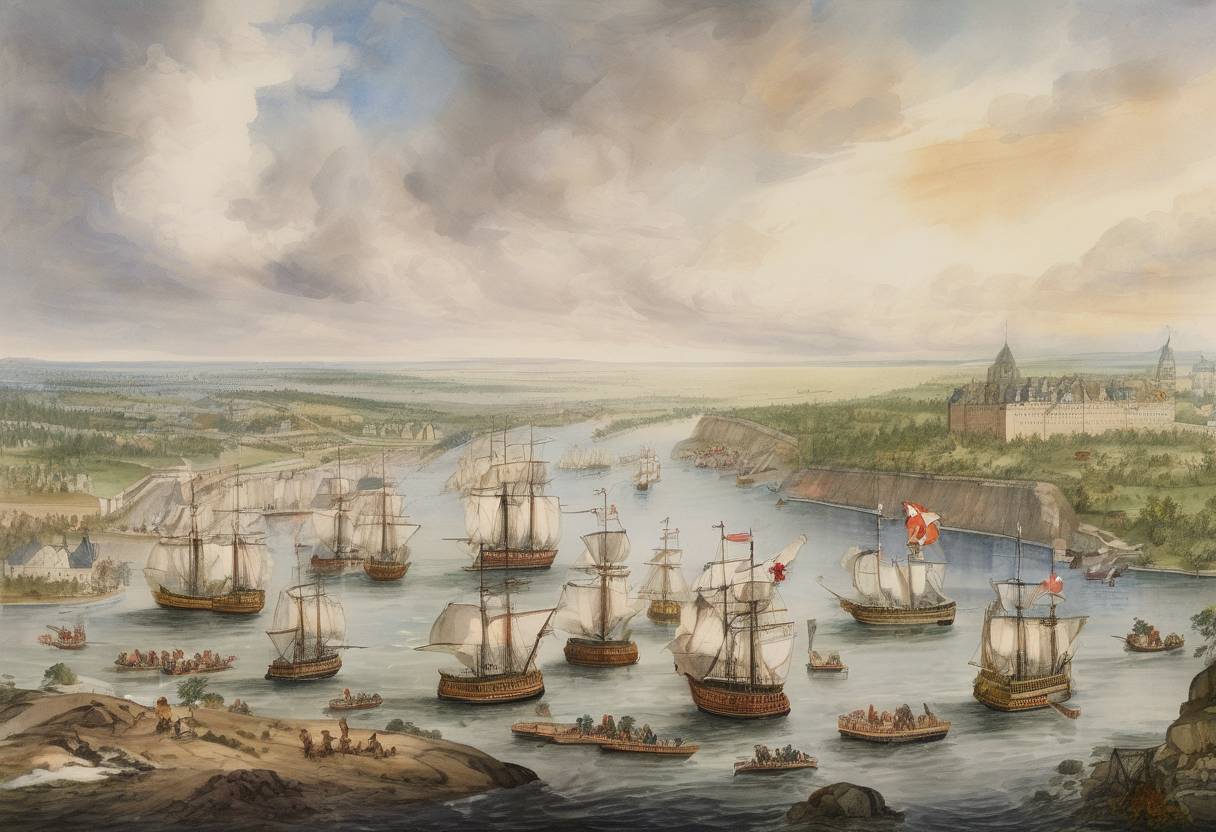
The Battle of the Plains of Abraham, fought on September 13, 1759, was a pivotal engagement during the Seven Years’ War, which is often referred to as the French and Indian War in the North American context. This conflict was part of a larger global struggle between Britain and France for imperial dominance. The battle took place just outside the walls of Quebec City, the capital of New France, and was crucial in determining the fate of French colonial ambitions in North America.
Strategic Importance of Quebec: Quebec City was a vital stronghold for the French, serving as a key defensive position along the St. Lawrence River. Its capture was essential for the British to gain control over New France.
British Campaign: Under the command of Major General James Wolfe, the British launched a campaign to capture Quebec. Wolfe’s forces had been engaged in a prolonged siege of the city throughout the summer of 1759.
French Defense: The French, led by the Marquis de Montcalm, were determined to defend the city. Montcalm’s forces were entrenched in strong defensive positions, making a direct assault challenging for the British.
Surprise Maneuver: Wolfe executed a daring and risky maneuver by landing his troops at Anse-au-Foulon, a cove located about 3 kilometers upstream from Quebec. Under the cover of darkness, British forces scaled the cliffs leading to the Plains of Abraham, a flat expanse of land west of the city.
Engagement: The battle commenced in the early morning hours. Despite being outnumbered, Wolfe’s troops formed a disciplined line and engaged the French forces who had hastily assembled to meet the unexpected British advance.
Outcome: The battle was short, lasting only about 15 minutes. The British forces, utilizing superior tactics and firepower, decisively defeated the French. Both Wolfe and Montcalm were mortally wounded during the engagement.
British Victory: The British victory at the Plains of Abraham led to the surrender of Quebec City on September 18, 1759. This victory was a turning point in the North American theater of the Seven Years’ War.
Fall of New France: The fall of Quebec effectively marked the beginning of the end for French colonial rule in North America. The Treaty of Paris in 1763 would later formalize British control over Canada.
Legacy: The battle is remembered for its strategic brilliance and the bravery of the soldiers on both sides. It significantly altered the balance of power in North America, paving the way for British dominance in the region.
The Battle of the Plains of Abraham remains a significant event in Canadian history, symbolizing the clash of empires and the complex legacy of colonialism in North America.
Source: en.wikipedia.org