Hijacking of Air France Flight 8969
1994 · Algiers, Algeria
Air France Flight 8969 is hijacked by the Armed Islamic Group in Algiers, Algeria.
June 27, 1976
Air France Flight 139 was hijacked by two members of the Popular Front for the Liberation of Palestine - External Operations and two members of the German Revolutionary Cells, leading to the Entebbe hostage crisis.
Entebbe, Uganda | Popular Front for the Liberation of Palestine
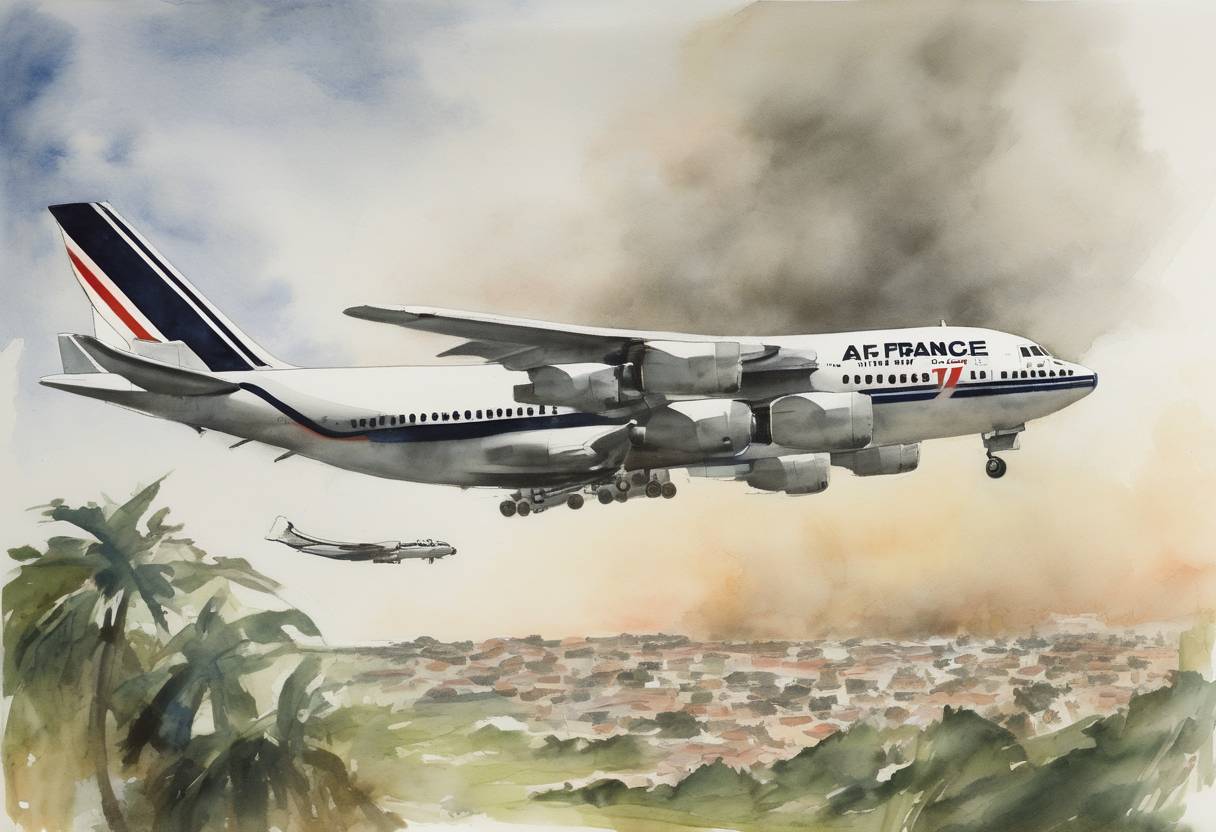
On June 27, 1976, Air France Flight 139, an Airbus A300, was hijacked shortly after taking off from Athens, Greece. The flight was en route from Tel Aviv, Israel, to Paris, France, with a stopover in Athens. The aircraft was carrying 248 passengers and 12 crew members.
The hijackers consisted of two members of the Popular Front for the Liberation of Palestine - External Operations (PFLP-EO) and two members of the German Revolutionary Cells. The hijackers were:
Once the plane was airborne, the hijackers took control and diverted the flight to Benghazi, Libya, where it refueled and stayed for several hours. The plane then continued to Entebbe, Uganda, arriving on June 28.
Upon arrival in Entebbe, the hijackers were joined by additional accomplices and received support from Ugandan dictator Idi Amin. The hostages were held in the old terminal of Entebbe Airport. The hijackers demanded the release of 40 Palestinians held in Israel and 13 other detainees imprisoned in Kenya, France, Switzerland, and Germany. They set a deadline of July 1, 1976, for their demands to be met, threatening to kill the hostages if their demands were not fulfilled.
The hijacking and hostage situation drew international attention and condemnation. Israel, known for its policy of not negotiating with terrorists, began planning a rescue operation. Meanwhile, diplomatic efforts were made to resolve the crisis peacefully.
On July 4, 1976, the Israeli Defense Forces (IDF) launched a daring rescue mission, known as Operation Entebbe or Operation Thunderbolt. The operation involved flying over 2,500 miles to Uganda and was executed with precision:
Preparation: Israeli intelligence gathered detailed information about the layout of the airport and the positions of the hostages and hijackers.
Execution: A team of approximately 100 commandos, led by Brigadier General Dan Shomron, landed at Entebbe Airport under the cover of night. The operation lasted 90 minutes.
Outcome: All seven hijackers and 45 Ugandan soldiers were killed. Three hostages died during the rescue, and one Israeli commando, Yonatan Netanyahu, was also killed. The remaining hostages were safely evacuated and flown back to Israel.
Operation Entebbe was hailed as a remarkable success and demonstrated Israel’s commitment to protecting its citizens. The operation had several significant consequences:
The Entebbe hostage crisis remains a significant event in the history of counter-terrorism operations and is often studied for its strategic and tactical execution.
Source: en.wikipedia.org