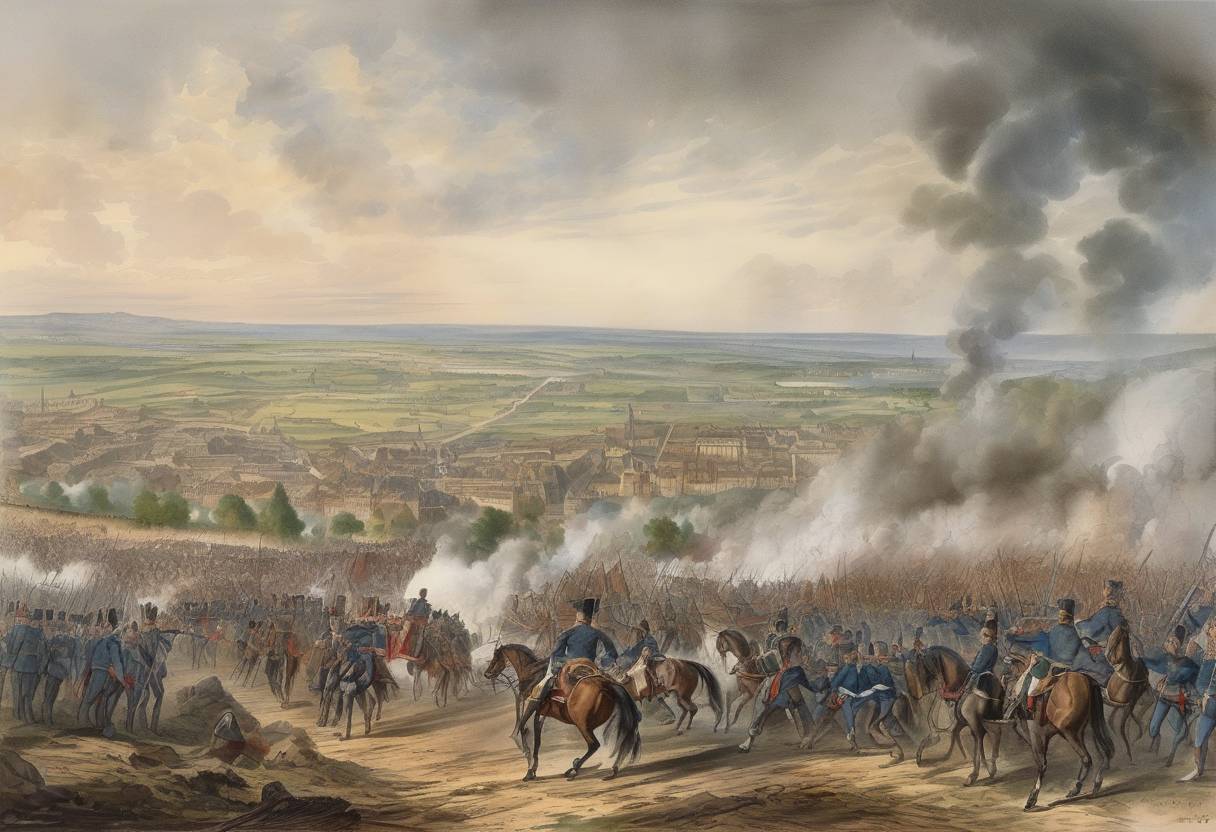
The Battle of Sedan: September 1, 1870
The Battle of Sedan, a pivotal engagement during the Franco-Prussian War, commenced on September 1, 1870. This battle marked a decisive moment in the conflict, leading to the capture of French Emperor Napoleon III and the subsequent collapse of the Second French Empire.
Context and Prelude
The Franco-Prussian War, which began in July 1870, was primarily instigated by tensions between the French Empire, led by Napoleon III, and the Kingdom of Prussia, under Chancellor Otto von Bismarck. The war was part of Bismarck’s broader strategy to unify the German states under Prussian leadership, while France sought to maintain its dominance in continental Europe.
In the weeks leading up to the Battle of Sedan, the French army suffered several defeats, including the significant loss at the Battle of Gravelotte. The French forces, under Marshal Patrice de MacMahon, attempted to relieve the besieged city of Metz but were intercepted by the Prussian army, commanded by General Helmuth von Moltke.
The Battle
The Battle of Sedan unfolded as the French army, numbering approximately 120,000 troops, found itself encircled by a larger Prussian force of about 200,000 soldiers. The Prussians executed a well-coordinated attack, utilizing superior artillery and strategic positioning to their advantage.
Throughout the day, the French forces were subjected to relentless artillery bombardment and infantry assaults. Despite attempts to break through the encirclement, the French were unable to overcome the Prussian military’s tactical superiority.
Capture of Napoleon III
By the end of the day, the French army was in disarray, suffering heavy casualties and lacking effective leadership. Recognizing the hopelessness of the situation, Napoleon III, who was present on the battlefield, decided to surrender to the Prussians. On September 2, 1870, he was taken prisoner, marking a significant turning point in the war.
Aftermath and Consequences
The capture of Napoleon III and the defeat at Sedan had profound consequences:
Collapse of the Second French Empire: The fall of Napoleon III led to the collapse of the Second French Empire. On September 4, 1870, the Third Republic was proclaimed in Paris, marking a significant political shift in France.
German Unification: The victory at Sedan paved the way for the unification of Germany. In January 1871, the German Empire was proclaimed in the Hall of Mirrors at the Palace of Versailles, with King Wilhelm I of Prussia crowned as the German Emperor.
Treaty of Frankfurt: The war officially ended with the Treaty of Frankfurt in May 1871. France was forced to cede the territories of Alsace and Lorraine to Germany, a loss that would fuel Franco-German animosity for decades.
The Battle of Sedan remains a critical event in European history, illustrating the shifting balance of power and the emergence of Germany as a dominant continental force.