Richard Nixon's Resignation: August 9, 1974
1974 · Washington, D.C., United States
Richard Nixon became the first U.S. president to resign from office, following the Watergate scandal.
November 16, 1973
U.S. President Richard Nixon signs the Trans-Alaska Pipeline Authorization Act into law, authorizing the construction of the Alaska Pipeline.
Washington, D.C., United States | U.S. Government
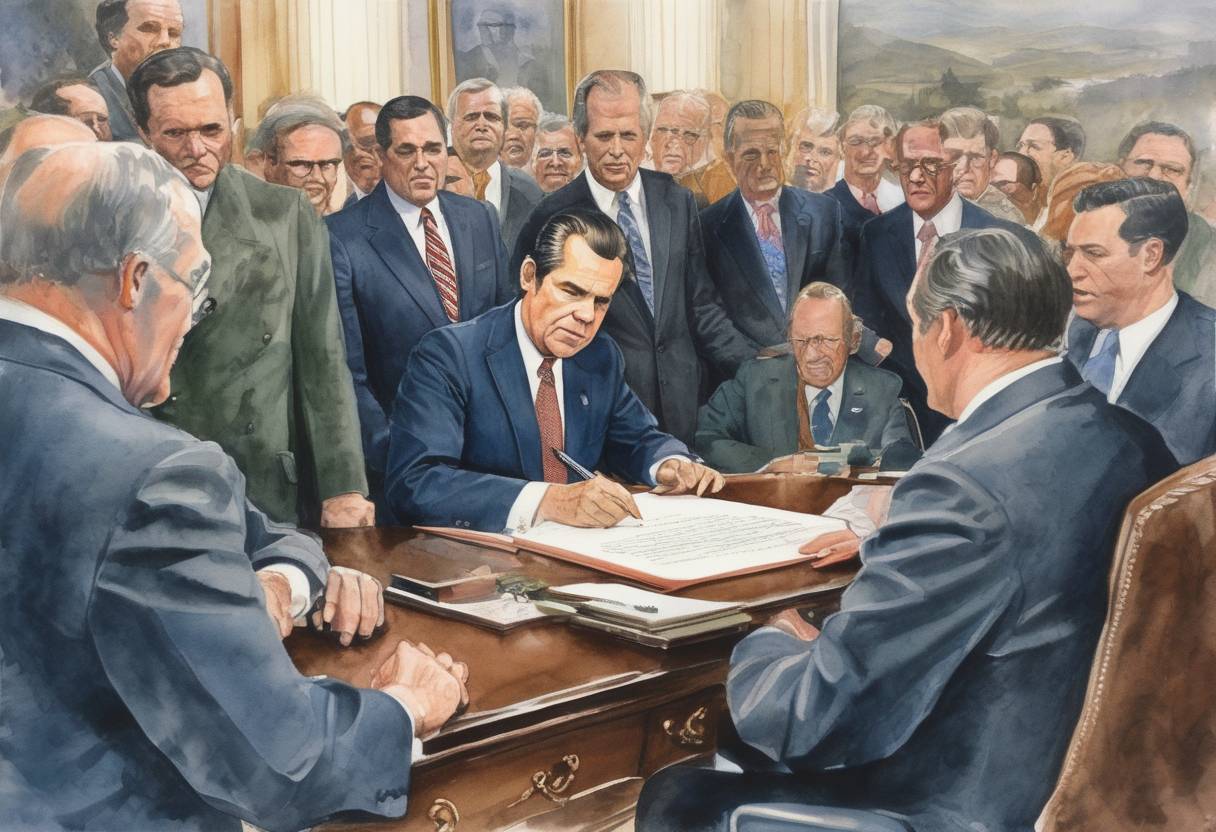
On November 16, 1973, U.S. President Richard Nixon signed the Trans-Alaska Pipeline Authorization Act into law, a pivotal moment in American energy policy and infrastructure development. This legislation authorized the construction of the Trans-Alaska Pipeline System (TAPS), a major engineering project designed to transport oil from the North Slope of Alaska to the northernmost ice-free port in Valdez, Alaska.
The discovery of oil in Prudhoe Bay in 1968 set the stage for the pipeline’s construction. The Prudhoe Bay Oil Field, located on Alaska’s North Slope, was one of the largest oil fields in North America. However, the remote location posed significant logistical challenges for transporting the oil to markets.
The urgency for the pipeline was further amplified by the 1973 oil crisis, triggered by an oil embargo imposed by the Organization of Arab Petroleum Exporting Countries (OAPEC). This crisis highlighted the United States’ dependence on foreign oil and underscored the need for domestic energy sources.
The Trans-Alaska Pipeline Authorization Act was designed to expedite the construction of the pipeline by:
The construction of the Trans-Alaska Pipeline began in 1974 and was completed in 1977. The pipeline spans approximately 800 miles and includes several engineering feats, such as elevated sections to prevent permafrost melting and a zigzag design to accommodate thermal expansion.
The pipeline had significant economic and geopolitical impacts:
The Trans-Alaska Pipeline Authorization Act marked a turning point in U.S. energy policy, reflecting a shift towards exploiting domestic energy resources. It also set a precedent for balancing economic development with environmental protection, a theme that continues to resonate in contemporary energy debates.
Overall, the signing of this Act by President Nixon was a decisive step in addressing the energy challenges of the 1970s and reshaping the American energy landscape.
Source: en.wikipedia.org