Discovery of Radium by Marie and Pierre Curie
1898 · Paris, France
French scientist Marie and Pierre Curie discovered the radioactive element radium.
December 26, 1898
Marie and Pierre Curie announced the discovery of radium, a significant milestone in the field of radioactivity.
Paris, France | University of Paris
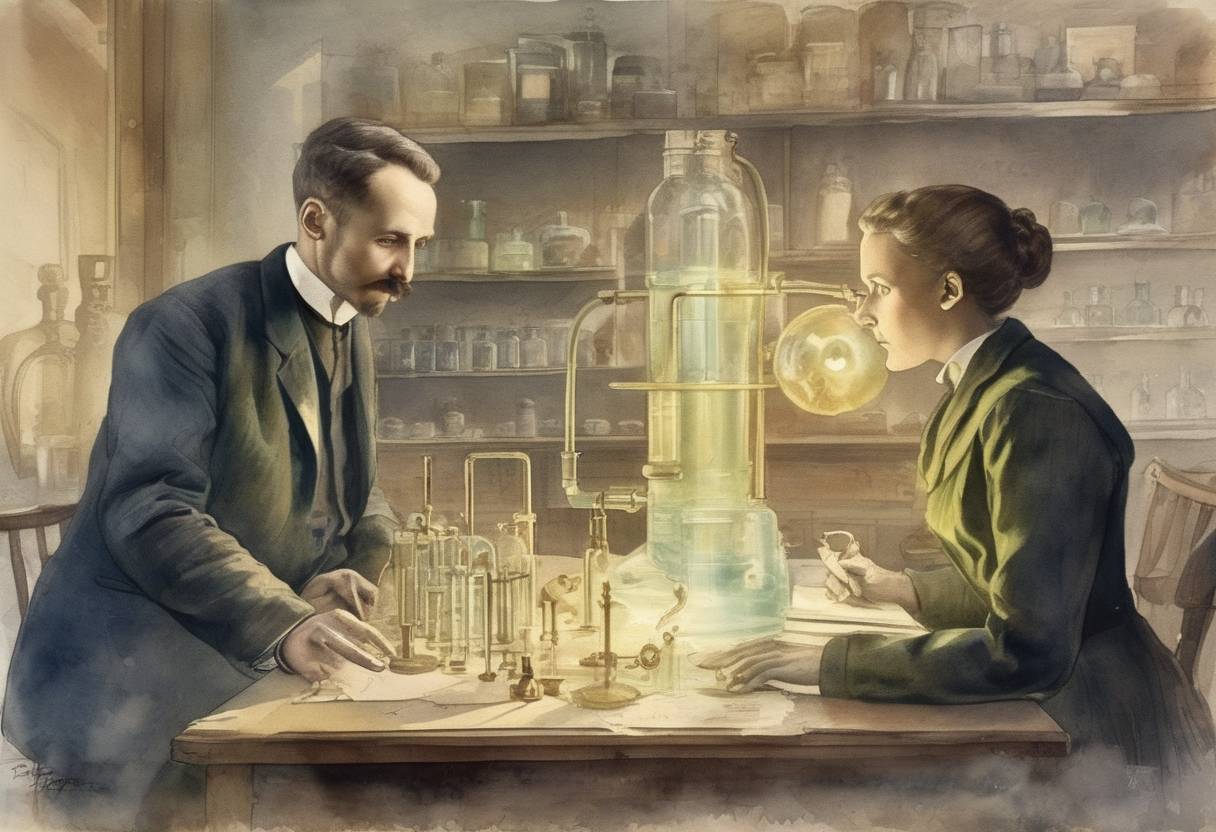
On December 26, 1898, Marie and Pierre Curie announced the discovery of radium, marking a pivotal moment in the field of radioactivity and the broader scientific community. This discovery was a result of their extensive research into radioactive elements, which began with their investigation of uranium and thorium.
Marie Curie, born Maria Skłodowska in Poland, moved to Paris to study at the Sorbonne, where she met Pierre Curie, a physicist. The couple married in 1895 and began collaborating on research. Their work was inspired by Henri Becquerel’s discovery of radioactivity in uranium salts in 1896.
Initial Research: The Curies initially focused on uranium, noting that its compounds emitted rays that could fog photographic plates, a phenomenon discovered by Becquerel.
Isolation of Polonium: In July 1898, the Curies announced the discovery of polonium, named after Marie’s native Poland. This was the first new element they isolated from the mineral pitchblende, which was known to be more radioactive than pure uranium.
Discovery of Radium: Continuing their work with pitchblende, the Curies isolated another highly radioactive element, which they named radium. They identified its unique properties, including its intense radioactivity and the ability to emit heat and light.
Advancement in Science: The discovery of radium was crucial in advancing the understanding of atomic physics and chemistry. It provided a new perspective on the structure of the atom and the potential energy contained within it.
Medical Applications: Radium’s radioactive properties led to its use in medical treatments, particularly in cancer therapy, where it was used to shrink tumors.
Further Research: The discovery spurred further research into radioactivity, leading to the development of nuclear physics and the eventual discovery of other radioactive elements.
The Curies’ work on radioactivity earned them significant recognition. In 1903, Marie and Pierre Curie, along with Henri Becquerel, were awarded the Nobel Prize in Physics for their collective research on radiation phenomena. Marie Curie later won a second Nobel Prize in Chemistry in 1911 for her services to the advancement of chemistry by the discovery of radium and polonium, and the isolation of radium.
The discovery of radium not only cemented the Curies’ legacy in the annals of science but also laid the groundwork for future innovations in both scientific theory and practical applications. Their pioneering work continues to influence the fields of physics, chemistry, and medicine to this day.
Source: www.nobelprize.org