Uruguay Declares Independence from Brazil - August 25, 1825
1825 · Montevideo, Uruguay
Uruguay declares its independence from Brazil.
December 1, 1821
The Dominican Republic declared independence from Spain.
Santo Domingo, Dominican Republic
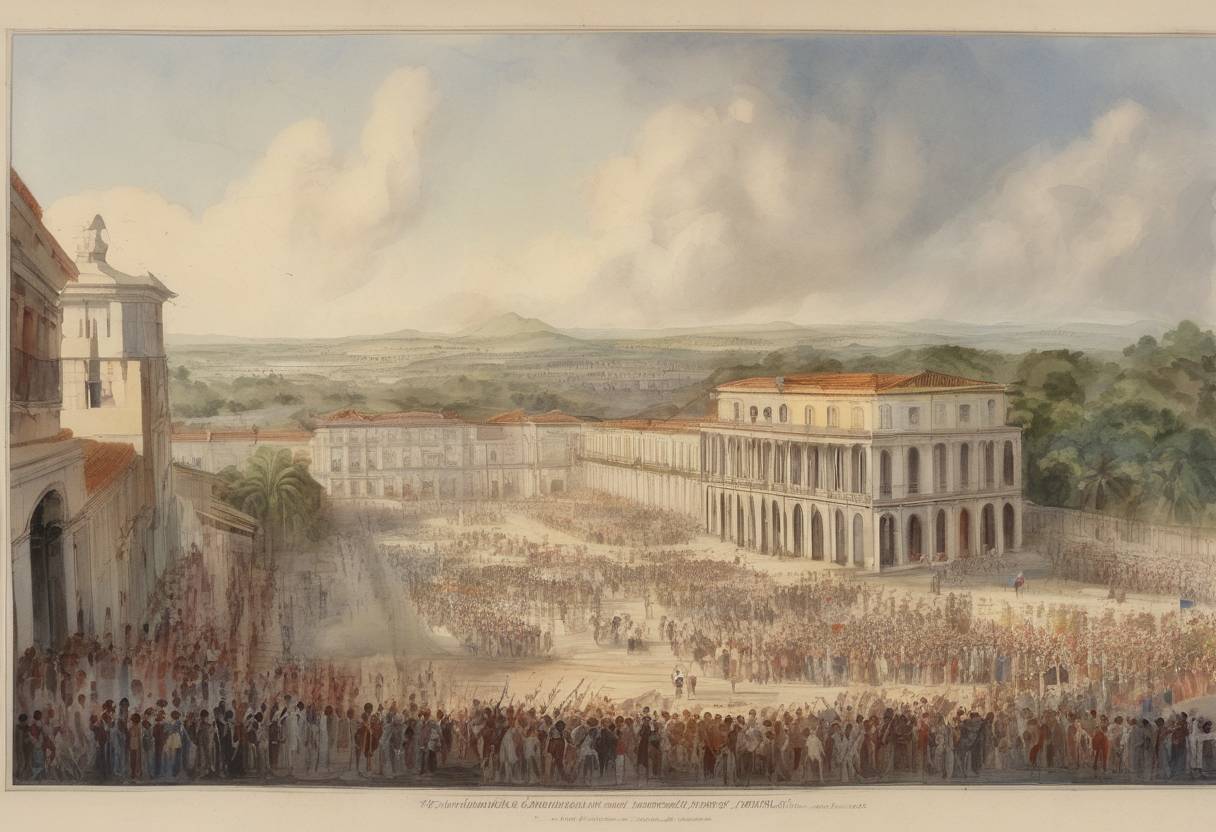
On December 1, 1821, the Dominican Republic declared its independence from Spanish rule, marking a significant moment in the nation’s history. This event is often referred to as the “Ephemeral Independence” due to its short-lived nature, as the country was soon annexed by Haiti in 1822.
The early 19th century was a period of upheaval and change in Latin America, with many colonies seeking independence from European powers. The island of Hispaniola, which comprises present-day Haiti and the Dominican Republic, was no exception. The eastern part of the island, known as Santo Domingo, had been under Spanish control since the late 15th century.
Haitian Revolution (1791-1804): The successful slave revolt in the western part of Hispaniola led to the establishment of Haiti as an independent nation in 1804. This revolution significantly influenced the political landscape of the island.
Spanish Decline: By the early 19th century, Spain’s influence in the Caribbean was waning due to internal conflicts and the rise of independence movements across Latin America.
Internal Discontent: The people of Santo Domingo were increasingly dissatisfied with Spanish colonial rule, which was characterized by neglect and economic stagnation.
The movement for independence in Santo Domingo was led by José Núñez de Cáceres, a prominent intellectual and politician. On December 1, 1821, Núñez de Cáceres proclaimed the independence of the eastern part of Hispaniola from Spain, establishing the short-lived state known as the “Independent State of Spanish Haiti.”
Provisional Government: Núñez de Cáceres established a provisional government and sought to align the new state with Gran Colombia, a union of several South American countries led by Simón Bolívar.
Challenges: The new government faced significant challenges, including a lack of military power and economic resources, as well as internal divisions among the population.
The independence declared on December 1, 1821, was short-lived. In February 1822, Haitian forces, led by President Jean-Pierre Boyer, invaded and annexed the eastern part of the island. This annexation was partly motivated by Haiti’s desire to prevent European powers from re-establishing control over the island.
Haitian Occupation (1822-1844): The Dominican Republic remained under Haitian control for 22 years, a period marked by efforts to unify the island under Haitian governance.
Dominican Independence (1844): The Dominican Republic eventually achieved lasting independence from Haiti on February 27, 1844, following a successful revolt led by Juan Pablo Duarte and the Trinitarios.
The declaration of independence on December 1, 1821, is a testament to the Dominican Republic’s enduring struggle for sovereignty and self-determination. It highlights the complex interplay of colonial powers, regional politics, and the aspirations of local populations in shaping the history of the Caribbean.
This event, though ephemeral, set the stage for future efforts to establish a distinct Dominican identity and governance, ultimately leading to the nation’s permanent independence in 1844.
Source: en.wikipedia.org