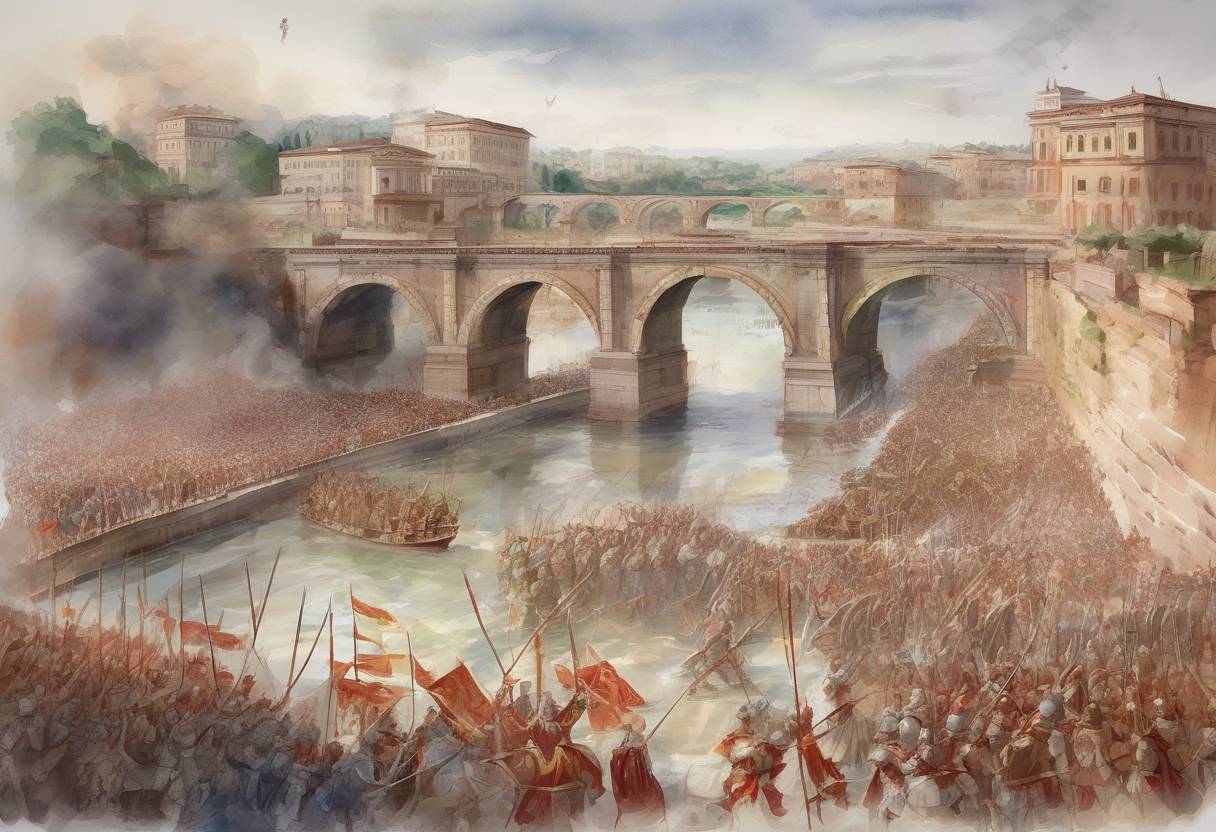
The Battle of the Milvian Bridge: October 28, 312
The Battle of the Milvian Bridge was a pivotal moment in Roman history, taking place on October 28, 312. This battle marked a significant turning point in the power dynamics of the Roman Empire and had lasting implications for the spread of Christianity.
Context and Prelude
- Roman Tetrarchy: The Roman Empire was divided into a tetrarchy, a system established by Emperor Diocletian, where power was shared among four rulers. By 312, this system was under strain, leading to conflicts among the tetrarchs.
- Rival Claimants: Constantine I and Maxentius were two of the key figures vying for control. Constantine was the son of Constantius Chlorus, a former Augustus, while Maxentius was the son of Maximian, another former emperor.
- Political Tensions: Maxentius had declared himself emperor in Rome in 306, challenging the authority of the tetrarchy. Constantine, ruling from Gaul, sought to consolidate his power and saw Maxentius as a direct threat.
The Battle
- Location: The battle took place near the Milvian Bridge, an important crossing over the Tiber River, just north of Rome.
- Forces: Constantine’s army was smaller but well-disciplined, while Maxentius commanded a larger force, including the Praetorian Guard and other units loyal to him.
- Vision and Strategy: According to historical accounts, Constantine experienced a vision the night before the battle, seeing a symbol in the sky with the words “In this sign, you will conquer” (Latin: “In hoc signo vinces”). This symbol, often interpreted as the Christian Chi-Rho, was reportedly adopted by Constantine’s troops.
- Outcome: Constantine’s forces decisively defeated Maxentius’s army. Maxentius himself drowned in the Tiber River during the chaotic retreat, solidifying Constantine’s victory.
Aftermath and Significance
- Consolidation of Power: With Maxentius defeated, Constantine became the uncontested ruler of the western half of the Roman Empire.
- Religious Impact: The battle is often seen as a catalyst for Constantine’s conversion to Christianity. In 313, he issued the Edict of Milan, granting religious tolerance throughout the empire and ending the persecution of Christians.
- Legacy: Constantine’s victory and subsequent policies laid the groundwork for the Christianization of the Roman Empire, profoundly influencing the religious landscape of Europe.
The Battle of the Milvian Bridge remains a significant event in history, symbolizing the intersection of military power, political ambition, and religious transformation.