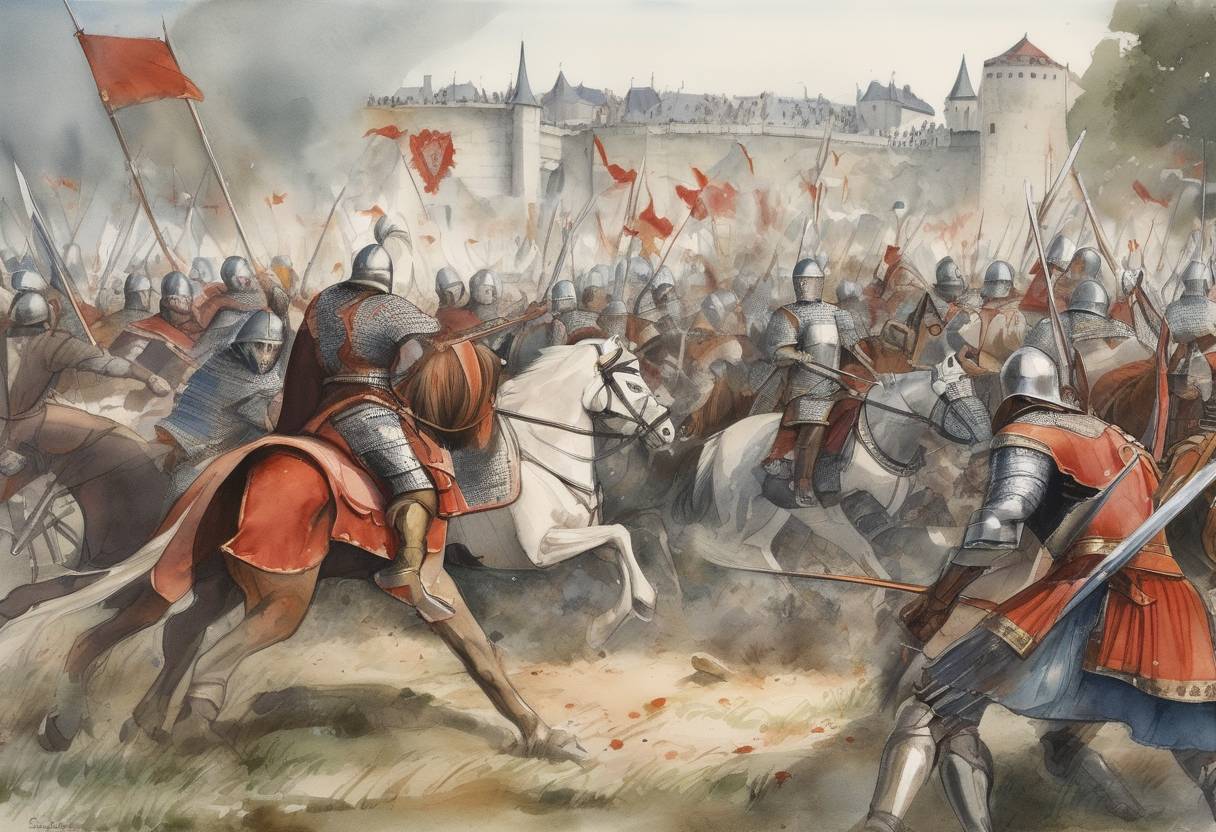
The Battle of Tours (Battle of Poitiers) - October 10, 732
The Battle of Tours, also known as the Battle of Poitiers, was a significant military engagement that took place on October 10, 732. This battle is renowned for its pivotal role in halting the northward expansion of Islam into Western Europe from the Iberian Peninsula. The confrontation occurred between the forces of the Frankish leader Charles Martel and an invading Muslim army led by Abdul Rahman Al Ghafiqi, the governor of Al-Andalus.
Context and Background
- Islamic Expansion: By the early 8th century, the Umayyad Caliphate had rapidly expanded across North Africa and into the Iberian Peninsula (modern-day Spain and Portugal), establishing a significant Muslim presence in Europe.
- Frankish Kingdom: The Frankish Kingdom, under the leadership of the Merovingian dynasty, was experiencing internal strife and fragmentation. Charles Martel, the Mayor of the Palace, effectively held power and sought to consolidate and strengthen the Frankish territories.
Key Events Leading to the Battle
- Muslim Incursions: In the years leading up to the battle, Muslim forces had conducted raids into Frankish territories, seeking to expand their influence and acquire wealth.
- Charles Martel’s Preparations: Understanding the threat posed by the Muslim incursions, Charles Martel spent years building a strong, disciplined Frankish army. He emphasized the use of heavy infantry, which would play a crucial role in the upcoming battle.
The Battle
- Location: The battle took place near the city of Tours, close to Poitiers, in present-day France.
- Tactics: Charles Martel employed a defensive strategy, positioning his troops on high ground and forming a solid phalanx. This formation was designed to withstand cavalry charges, which were a key component of the Muslim army’s tactics.
- Outcome: After a day of intense fighting, the Frankish forces successfully repelled the Muslim cavalry. Abdul Rahman Al Ghafiqi was killed during the battle, leading to the retreat of the Muslim forces.
Aftermath and Significance
- Frankish Victory: The victory at Tours solidified Charles Martel’s power and reputation, earning him the nickname “The Hammer” for his decisive leadership.
- Halt of Islamic Expansion: The battle is often credited with halting the northward advance of Islam into Western Europe, preserving the Christian character of the region.
- Long-term Impact: The success at Tours laid the groundwork for the Carolingian Empire, which would later be established by Charles Martel’s grandson, Charlemagne.
Broader Historical Significance
The Battle of Tours is considered a turning point in European history. It marked the beginning of the Carolingian Renaissance and the eventual rise of the Holy Roman Empire. The battle’s outcome also reinforced the cultural and religious boundaries between the Islamic and Christian worlds, shaping the future of European civilization.
In summary, the Battle of Tours was a decisive moment in the history of Europe, with far-reaching consequences for the continent’s political and religious landscape.