Execution of King Louis XVI of France
1793 · Paris, France
King Louis XVI of France was executed by guillotine in Paris, marking a pivotal moment in the French Revolution.
October 1, 1791
The first session of the French Legislative Assembly was held, following the French Revolution's National Constituent Assembly.
Paris, France | French Legislative Assembly
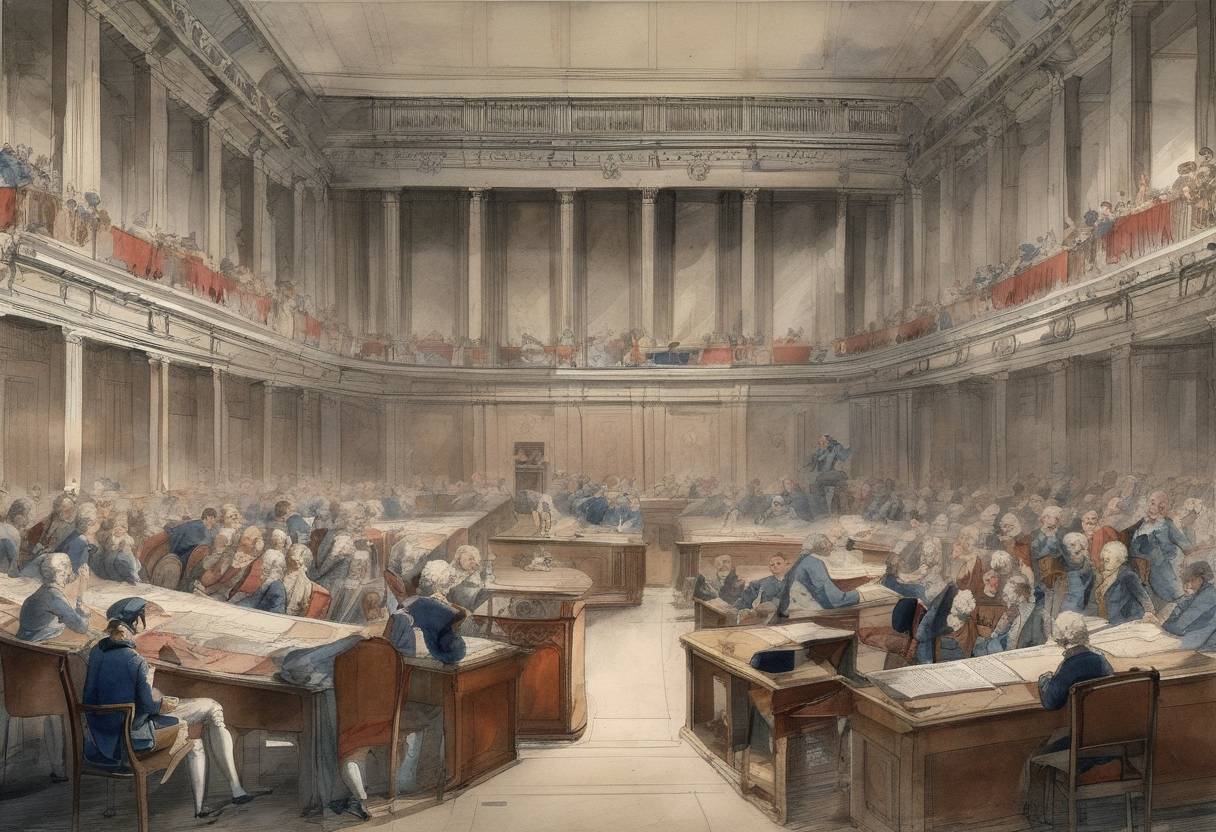
The first session of the French Legislative Assembly on October 1, 1791, marked a significant transition in the political landscape of France during the revolutionary period. This event followed the dissolution of the National Constituent Assembly, which had been instrumental in drafting the Constitution of 1791. The Legislative Assembly was established as part of the new constitutional framework, aiming to implement and uphold the principles of the revolution.
The French Revolution (1789-1799): The revolution began in 1789, driven by widespread discontent with the monarchy, economic hardship, and demands for political reform. It led to the establishment of the National Constituent Assembly, which sought to create a constitutional monarchy.
The Constitution of 1791: Adopted on September 3, 1791, this constitution was a pivotal document that transformed France from an absolute monarchy to a constitutional monarchy. It established a separation of powers, with the king retaining executive power but subject to the laws passed by the Legislative Assembly.
Dissolution of the National Constituent Assembly: On September 30, 1791, the National Constituent Assembly dissolved itself, having completed its primary task of drafting the new constitution.
Composition: The Legislative Assembly consisted of 745 members, elected by a system of indirect voting. It was characterized by a lack of experienced politicians, as a self-denying ordinance prevented members of the National Constituent Assembly from serving in the new body.
Political Factions: The Assembly was divided into several factions, including the Feuillants, who supported a constitutional monarchy, and the more radical Jacobins and Girondins, who pushed for further revolutionary changes.
Challenges and Objectives: The Assembly faced numerous challenges, including economic instability, internal dissent, and external threats from monarchies opposed to the revolution. Its primary objectives were to stabilize the nation, implement the new constitution, and address the grievances that had fueled the revolution.
Legislative Actions: The Assembly’s early sessions focused on addressing France’s financial crisis, reforming the legal system, and managing the growing tensions with neighboring countries.
War and Conflict: The Assembly’s tenure was marked by increasing hostility with European monarchies, leading to the declaration of war against Austria in April 1792. This conflict would escalate into the broader Revolutionary Wars.
End of the Monarchy: The Legislative Assembly’s efforts to maintain a constitutional monarchy were ultimately unsuccessful. The continued unrest and the king’s perceived betrayal led to the monarchy’s downfall and the establishment of the First French Republic in September 1792.
The first session of the French Legislative Assembly was a crucial moment in the revolutionary era, representing both the aspirations and challenges of implementing democratic governance in a nation transitioning from absolute monarchy. It set the stage for the radical phase of the revolution, highlighting the complexities of balancing revolutionary ideals with practical governance and external pressures.
Source: en.wikipedia.org