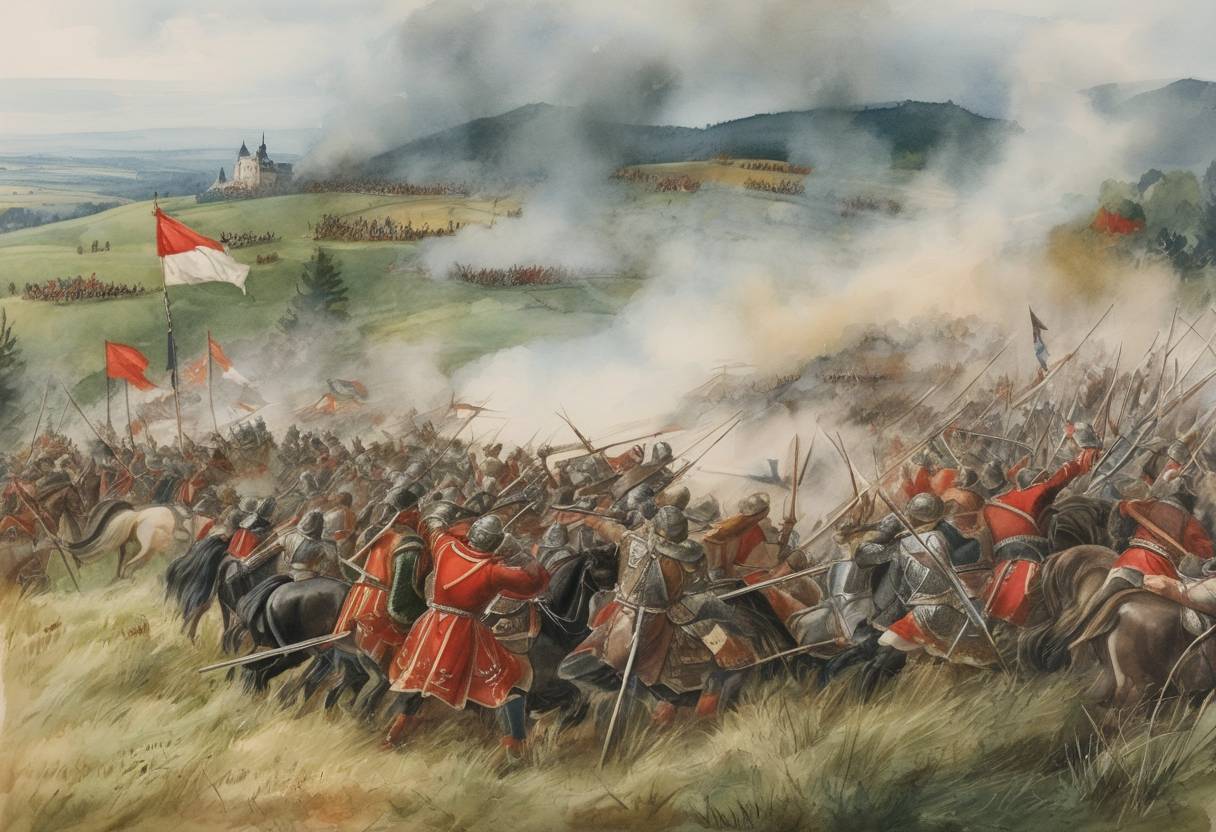
Correction on Date: The Battle on the Marchfeld
The Battle on the Marchfeld did not occur on November 17, 1278, but on August 26, 1278. This pivotal battle was fought near Dürnkrut and Jedenspeigen in present-day Austria.
Context and Background
- Territorial and Dynastic Conflicts: This battle occurred during a period of intense territorial disputes and power struggles in Central Europe, following the death of the Holy Roman Emperor Frederick II. The conflict principally arose over claims to the Duchy of Austria and the independence of various principalities.
- Principal Figures: The primary figures were King Rudolf I of Germany from the Habsburg dynasty and King Ottokar II of Bohemia. Ottokar had acquired many territories, expanding his influence significantly, which threatened the stability and balance of power in the region.
The Events Leading Up to the Battle
- Contest Over Austria: Ottokar had previously acquired control over Austria, Styria, Carinthia, and Carniola. However, Rudolf of Habsburg, elected as King of the Romans in 1273, sought to reclaim these lands as part of the reassertion of imperial authority.
- Rejection and Conflict: Efforts at peaceful negotiations failed when Ottokar refused to recognize Rudolf’s election. Consequently, the dispute escalated into armed conflict.
The Battle
- Forces and Strategy: Rudolf allied with several German princes and King Ladislaus IV of Hungary. The combined forces of Rudolf and Ladislaus outnumbered Ottokar’s army.
- Details of the Battle: The battle involved a two-pronged attack where Rudolf’s cavalry played a crucial role. The Hungarians were instrumental in flanking and pressing Ottokar’s forces, undermining their formation.
Outcomes and Consequences
- Victory and Death: Rudolf’s forces emerged victorious, and Ottokar II was killed in the battle. His death marked a decisive turn in Central European politics.
- Habsburg Ascendency: The victory established Habsburg control over Austria. Rudolf installed his son, Albert I, as Duke of Austria, initiating the long tenure of the Habsburg dynasty in the region.
- Historical Significance: The battle firmly positioned the Habsburgs as a dominant power, shaping the political landscape of Central Europe for centuries. It also marked the decline of Bohemian influence over Austrian territories.
The Battle on the Marchfeld not only altered the trajectory of the Habsburg dynasty but also had lasting implications for European territorial and dynastic politics.