Discovery of Shoichi Yokoi: January 24, 1972
1972 · Guam, United States
Japanese soldier Shoichi Yokoi was discovered in Guam, having spent 28 years hiding in the jungle, unaware that World War II had ended.
August 10, 1944
The Battle of Guam ends in an American victory during the Pacific campaign of World War II. The recapture of Guam was part of the Allies' island-hopping strategy to advance towards Japan.
Guam, United States territories | United States military
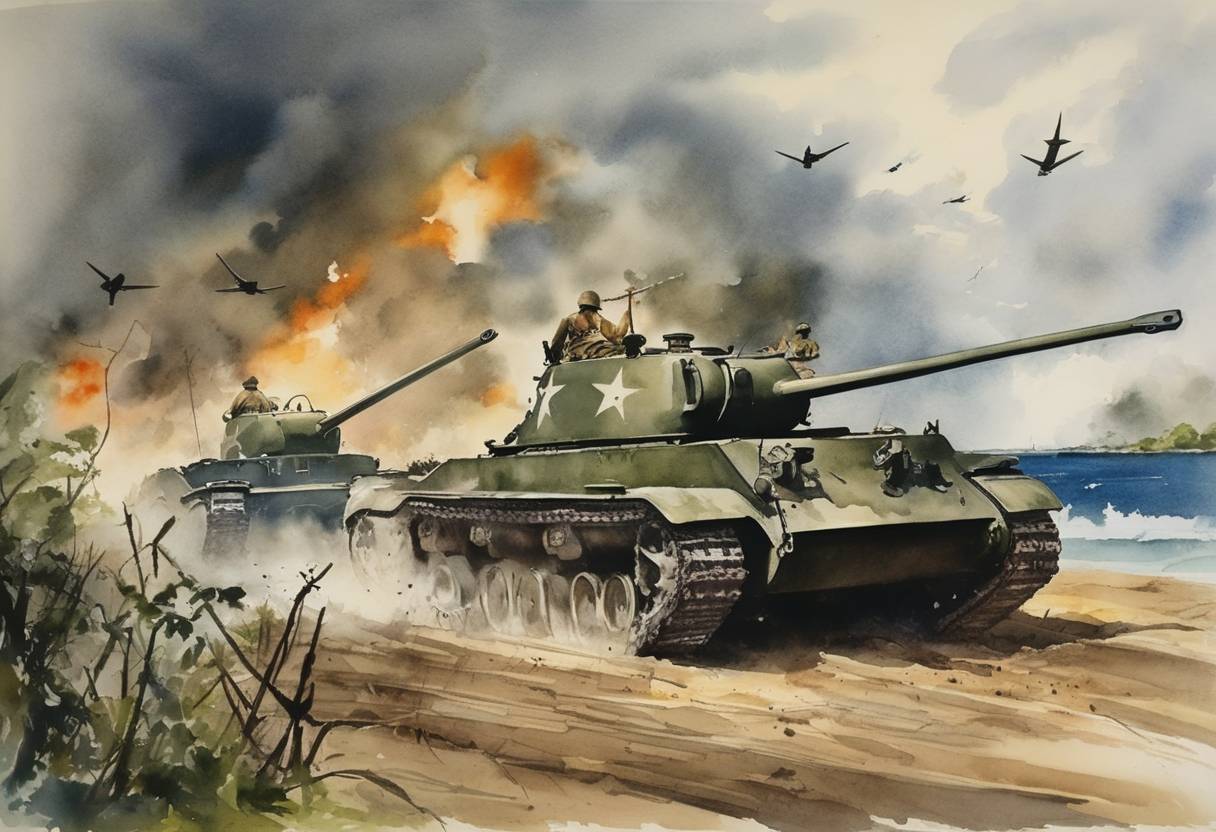
On August 10, 1944, the Battle of Guam concluded with an American victory, marking a pivotal moment in the Pacific campaign of World War II. The operation was crucial to the Allies’ broader island-hopping strategy, which sought to capture strategically significant islands to facilitate an eventual advance on Japan.
Guam, the largest island in the Mariana archipelago, had been under Japanese occupation since December 1941 following the attack on Pearl Harbor. Its strategic location made it a prime target for the United States in their campaign to establish airbases from which they could launch attacks on the Japanese mainland and other occupied territories.
The recapture of Guam was part of a broader offensive in the Marianas, which included assaults on Saipan and Tinian. These operations aimed to disable Japan’s defensive perimeter and secure airfields for the American B-29 bombers.
The American forces launched the assault on Guam on July 21, 1944. The initial landings involved the III Amphibious Corps, consisting of the 3rd Marine Division, the 77th Infantry Division, and the 1st Provisional Marine Brigade. Overcoming strong Japanese resistance, particularly in the form of fortified positions and persistent counterattacks, required intense combat efforts.
The terrain of Guam—characterized by dense jungles, rugged mountains, and coastal cliffs—posed significant challenges to the advancing troops. Despite these difficulties, American forces gradually pushed northwards, systematically dismantling Japanese defensive positions.
By August 10, 1944, after weeks of fierce fighting and heavy casualties on both sides, American forces successfully secured the island. The capture of Guam allowed the United States to establish an additional strategic base for operations in the Pacific, significantly enhancing their ability to launch bombing campaigns against Japan.
The victory at Guam, coupled with the successes at Saipan and Tinian, marked a turning point in the Pacific War. It severely weakened the Japanese hold on the Marianas and underscored the effectiveness of the island-hopping strategy. The fall of Guam, along with other key victories in the region, expedited the Allied advance towards the Japanese home islands, setting the stage for further offensives that would eventually lead to Japan’s surrender in 1945.
Source: en.wikipedia.org