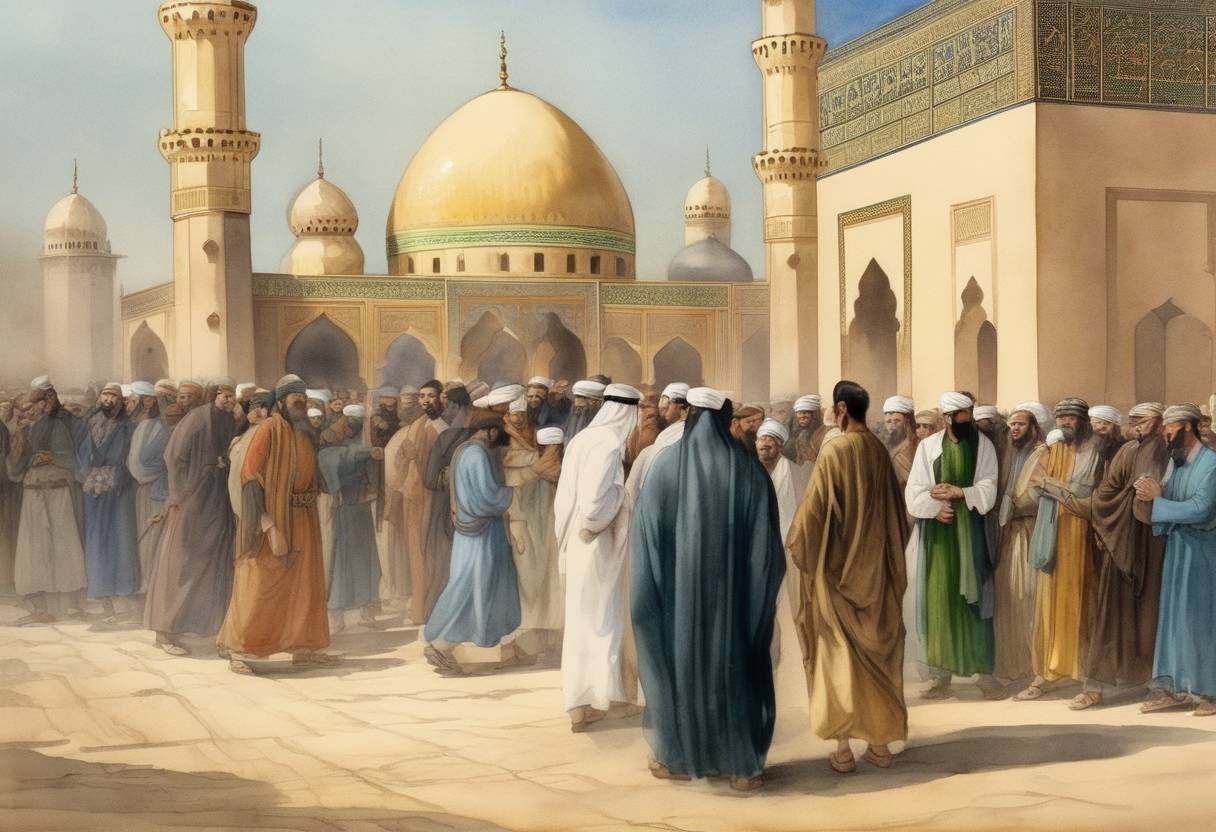
Assassination of Ali ibn Abi Talib
On January 26, 661 CE, Ali ibn Abi Talib, the fourth caliph of Islam and a significant figure in Islamic history, was fatally attacked. The assassination took place in the Great Mosque of Kufa, located in present-day Iraq, marking a pivotal moment in Islamic history with long-lasting implications.
Context and Background
Ali ibn Abi Talib was a cousin and son-in-law of the Prophet Muhammad, revered in Islamic tradition for his early conversion to Islam and close association with the Prophet. Following the assassination of the third caliph, Uthman ibn Affan, in 656 CE, Ali became the fourth caliph. His caliphate was marred by internal conflicts and civil wars, particularly the First Fitna, a civil war within the Islamic community.
Ali faced stiff opposition from various factions, most notably the Umayyads, who challenged his legitimacy as caliph. The political turmoil included the Battle of the Camel and the Battle of Siffin, which highlighted the tensions within the Muslim community over issues of leadership and governance.
The Assassination
The assassination of Ali was orchestrated by a faction known as the Kharijites, who opposed Ali’s caliphate due to ideological and political disagreements. The Kharijites had initially supported Ali but turned against him following the arbitration between Ali and Muawiya after the inconclusive Battle of Siffin.
On the morning of January 26, 661 CE, while Ali was engaged in prayer at the Great Mosque of Kufa, a Kharijite named Abd al-Rahman ibn Muljam attacked him with a poisoned sword. Ali succumbed to his injuries two days later, on January 28, 661 CE.
Aftermath and Consequences
The assassination of Ali had far-reaching effects on the course of Islamic history. His death led to significant consolidation of power by the Umayyad Caliphate under Muawiya, marking the beginning of Umayyad rule. The schism between the followers of Ali (later known as Shi’a Muslims) and other Muslim factions widened, establishing a sectarian divide that persists to this day.
Ali’s legacy as a paragon of piety, justice, and resilience continues to influence Islamic thought and spirituality. His life and death remain pivotal in understanding the complex dynamics of early Islamic history and the evolution of the Muslim community.