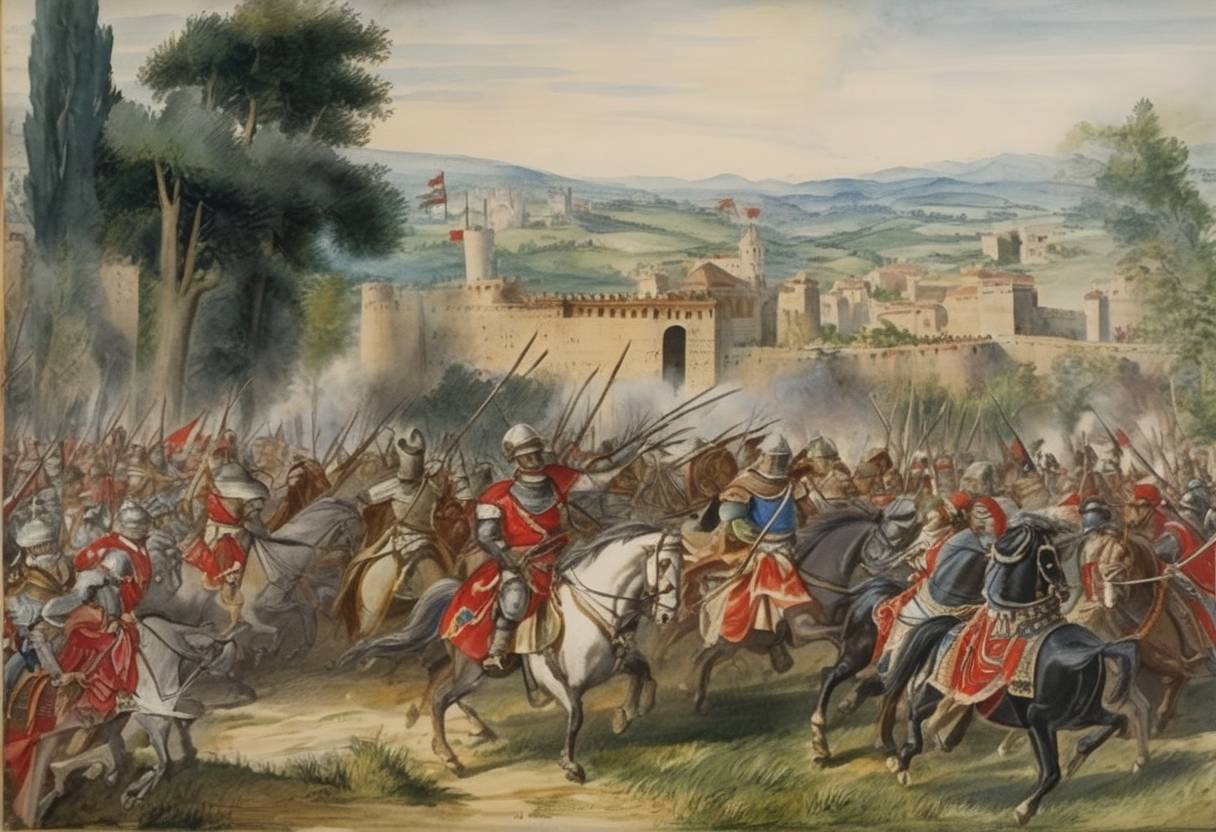
Battle of Montichiari: March 31, 1359
Context and Background
The Battle of Montichiari occurred during the tumultuous period of Italian city-state conflicts in the 14th century, marking a significant moment in the power struggles between rival factions in Northern Italy. The two primary factions were the Guelphs, who generally supported the Papacy, and the Ghibellines, who were aligned with the Holy Roman Empire.
Bernabò Visconti, the Lord of Milan at the time, had established himself as a formidable power in Lombardy. The Visconti family, often siding with the Ghibellines, sought to expand and consolidate its control over Northern Italian territories. However, internal conflicts among the Ghibellines and pressure from Guelph-aligned forces continued to spark military confrontations.
The Battle
The specific engagement on March 31, 1359, near Montichiari, was a pivotal clash. Bernabò Visconti faced an invasion attempt led by Pandolfo II Malatesta, a notable condottiero (mercenary leader) of the time. Malatesta, with his ties to the Guelphs, aimed to challenge Visconti’s influence and sought to exploit the regional instability.
The forces of Bernabò Visconti, leveraging both strategic acumen and military might, were able to repel Malatesta’s invasion effectively. This conflict demonstrated Visconti’s capability to marshal resources and defenses, maintaining his territories despite the persistent threats from his adversaries.
Aftermath and Significance
The defeat of Pandolfo II Malatesta at Montichiari solidified Bernabò Visconti’s dominance over Milan and its surrounding regions. This victory reinforced the Visconti’s hold and allowed them to continue exerting influence across Northern Italy, countering both Guelph opposition and rival Ghibelline forces.
The battle exemplifies the era’s complex dynamics, where shifting alliances and the prowess of individual leaders often shaped the political landscape. It also underscored the importance of militarized city-states and mercenary forces in the Italian pre-Renaissance period. The outcome at Montichiari would contribute to the longer narrative of Milanese ascendancy under Visconti’s rule, setting the stage for future territorial expansion and conflicts that characterized the late medieval era in Italy.