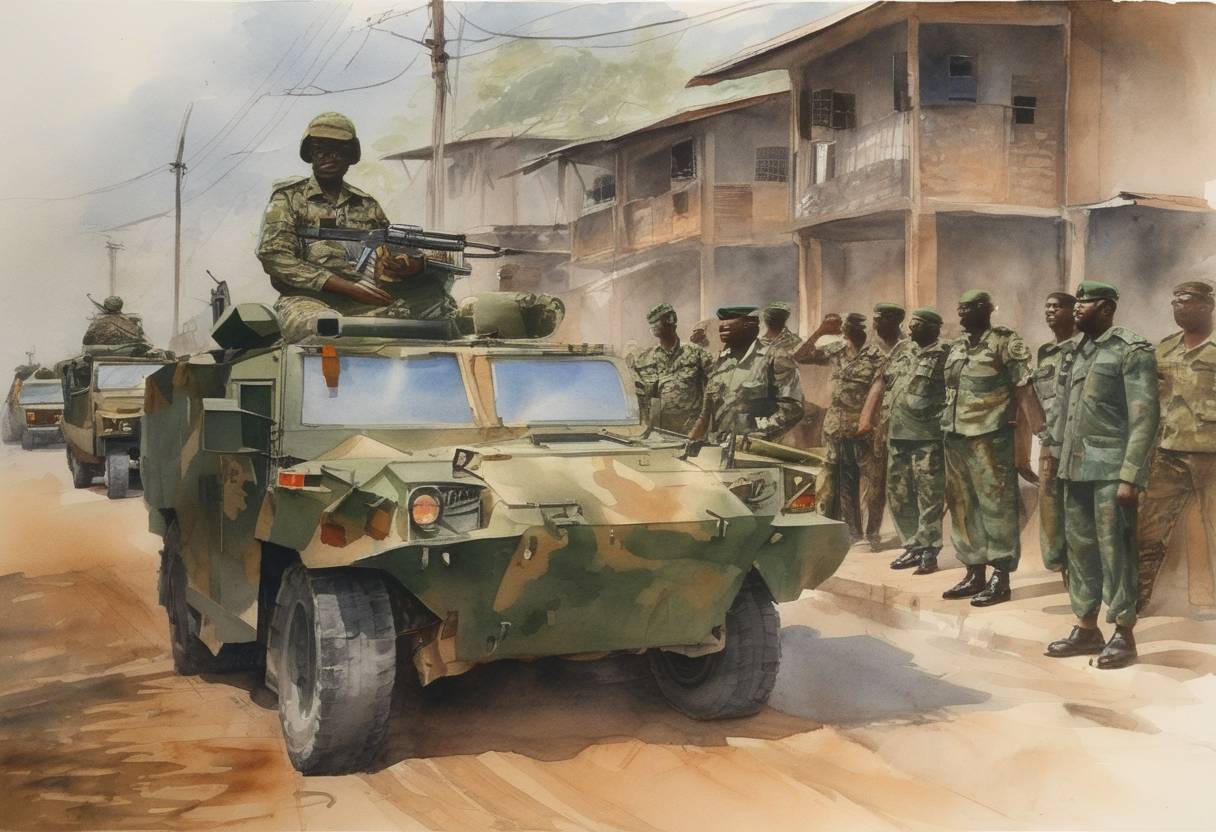
Military Coup in Sierra Leone - May 25, 1997
On May 25, 1997, a military coup d’état occurred in Sierra Leone, leading to the ousting of President Ahmad Tejan Kabbah. The event marked a significant turning point in the country’s turbulent political landscape.
Context and Background
Sierra Leone, in the late 1990s, was embroiled in a brutal civil war that began in 1991. The conflict primarily involved government forces and the Revolutionary United Front (RUF), a rebel group known for its violent tactics and significant human rights violations. Despite attempts at peace and stabilization, the nation remained in a state of political and economic instability.
Ahmad Tejan Kabbah, who was elected president in 1996, had been striving to bring peace to the war-torn country. His government was engaged in peace talks with the RUF in an effort to end the ongoing civil conflict.
Events of May 25, 1997
The coup was orchestrated by a group of disgruntled soldiers led by Major Johnny Paul Koroma. This faction, known as the Armed Forces Revolutionary Council (AFRC), seized control of the government, claiming dissatisfaction with Kabbah’s rule and accusing him of failing to adequately address the needs of the military.
As the coup unfolded, the AFRC quickly allied itself with the RUF, further complicating the political and military landscape of Sierra Leone. Major Koroma declared himself head of state, and the coalition of soldiers and rebels soon controlled the capital, Freetown.
Aftermath and Consequences
Following the coup, President Kabbah fled to Guinea, where he established a government-in-exile. The international community, including the United Nations, the African Union, and the Economic Community of West African States (ECOWAS), condemned the coup and called for the restoration of democratic governance.
In response, ECOWAS imposed sanctions and eventually deployed the ECOWAS Monitoring Group (ECOMOG) to the region. Their efforts, alongside diplomatic negotiations, were instrumental in reinstating Kabbah in March 1998.
The short-lived junta, rife with internal strife and opposition from local and international entities, heightened the civil unrest and humanitarian crisis within Sierra Leone, exacerbating the already dire situation.
Broader Historical Significance
The 1997 coup added to the complexity of Sierra Leone’s civil war, signaling the frailty of nascent democratic structures in post-colonial African nations plagued by conflict. It underscored the need for robust international intervention strategies to help stabilize such regions, focusing on addressing not only political grievances but also socio-economic inequalities that fuel discontentment.
The events of May 25, 1997, remain a critical point in Sierra Leone’s history, shaping subsequent peace processes and informing international diplomacy strategies concerning conflict resolution in Africa.