The Treaty of Edinburgh: August 21, 1560
1560 · Edinburgh, Scotland
The Treaty of Edinburgh, aimed at ending the fighting between Scotland, France, and England, was signed and required French and English troops to withdraw from Scotland.
May 2, 1559
Scotland ratified the Treaty of Cateau-Cambrésis, ending wars with France. This marked the conclusion of the Italian Wars that had embroiled various European powers.
, Scotland
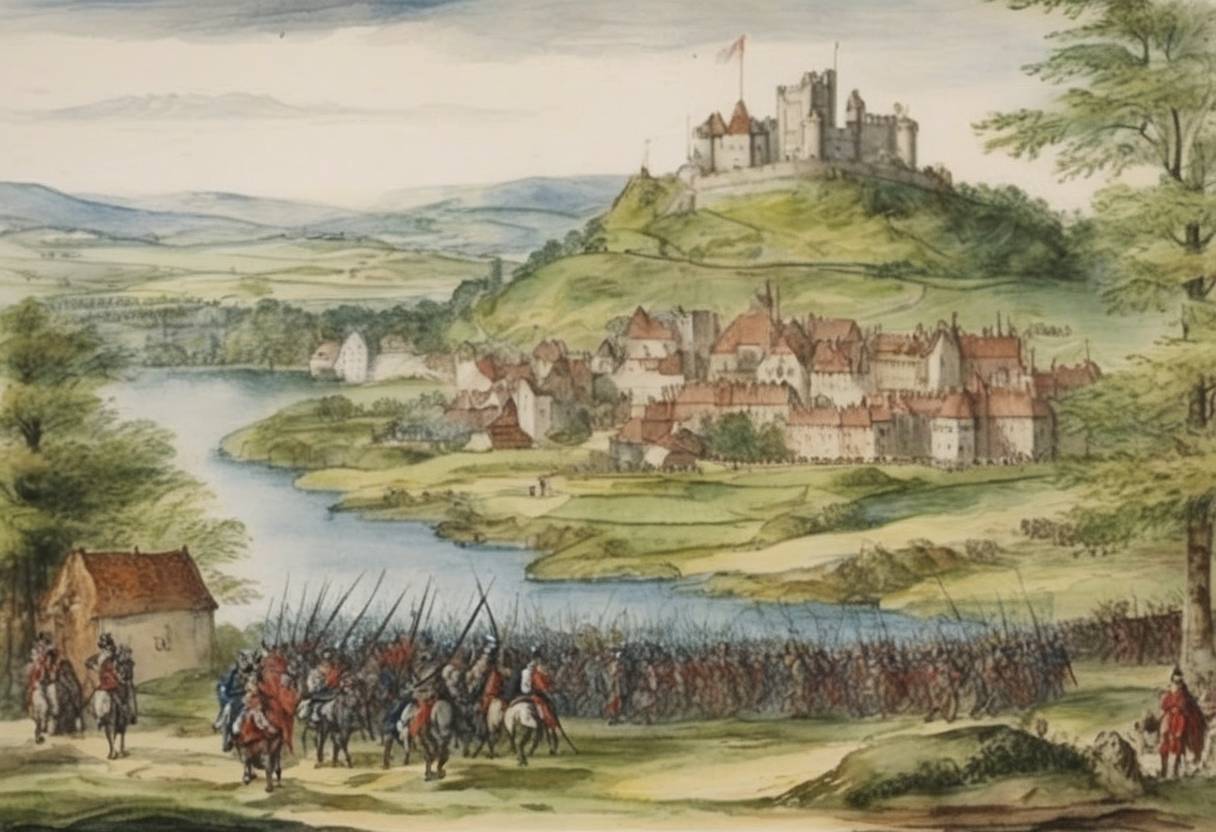
On May 2, 1559, Scotland ratified the Treaty of Cateau-Cambrésis, a pivotal agreement that marked the end of hostilities between Scotland and France, as well as the broader conclusion of the Italian Wars. The Italian Wars, a series of conflicts from 1494 to 1559, had embroiled major European powers, including France, the Holy Roman Empire, Spain, and England, primarily fought over control of territories in Italy.
The Italian Wars began as a series of dynastic disputes and territorial ambitions among Europe’s major powers. Initially triggered by the French invasion of Italy in 1494 under Charles VIII, these conflicts saw shifting alliances and numerous battles across the Italian peninsula and beyond. Key players included France, the Spanish Empire, the Holy Roman Empire, and varying Italian states such as the Papal States, Venice, and Milan.
Negotiations for the Treaty of Cateau-Cambrésis took place in the town of Cateau-Cambrésis, situated in northern France. It resulted in two main agreements, one between Spain and France, finalized on April 3, 1559, and another between England and France, signed on April 2, and ratified by Scotland a month later on May 2, 1559. The treaty effectively ended the territorial disputes in Italy and restored several territories to their original sovereigns.
For Scotland, the treaty meant the cessation of its involvement in continental conflicts that had entangled the country due to its traditional Auld Alliance with France. The agreement helped stabilize Scotland’s political landscape, which was mired in religious and succession troubles at the time.
The ratification of the Treaty of Cateau-Cambrésis brought a period of relative peace to Europe’s western powers, shifting the focus from military engagements to internal affairs. For Scotland, it allowed the realm to concentrate on domestic governance issues and the growing influence of Protestant Reformation movements within the country.
On a broader scale, the treaty significantly diminished France’s influence in Italy, consolidating Spain’s dominance over the region. This laid the groundwork for future geopolitical dynamics in Europe, where Spain emerged as the preeminent continental power, a status it would hold until the late 16th century.
The conclusion of the Italian Wars with the Treaty of Cateau-Cambrésis marked the end of a significant era in European history, transforming the continent’s political landscape for generations to come.
Source: www.britannica.com