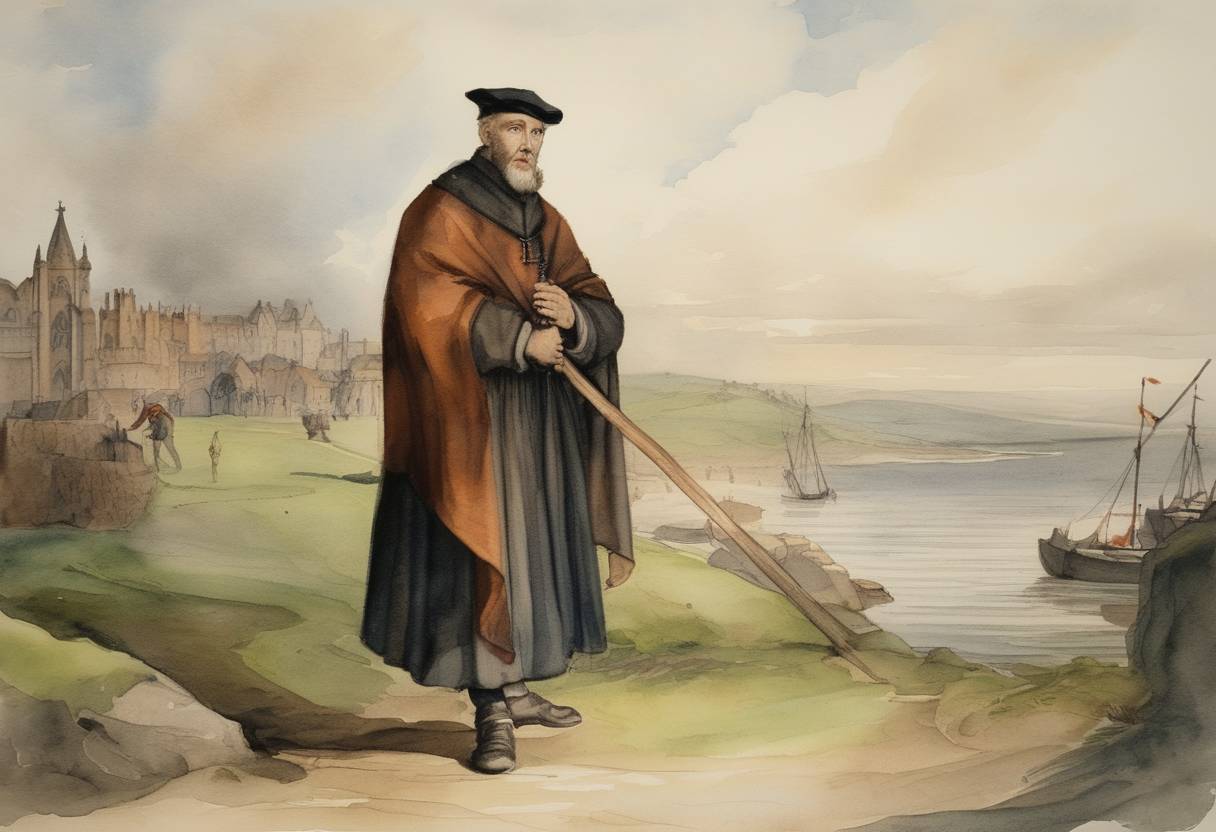
On March 1, 1546, George Wishart, an influential Scottish reformer and Protestant preacher, was executed by burning at the stake in St. Andrews, Scotland. His martyrdom became a pivotal moment in the Scottish Reformation, symbolizing the fierce resistance against Roman Catholic dominance in the region.
Background and Context
George Wishart was born around 1513 in Scotland and pursued education at the University of Aberdeen. After further studies at the University of Leuven and Cambridge, he returned to Scotland, where he became deeply involved in religious reform. Inspired by the teachings of Martin Luther and other reformers, Wishart began advocating for Protestant beliefs, challenging the doctrines of the Catholic Church.
Scotland during the early 16th century was a nation in religious and political turmoil. The Protestant Reformation, which had swept through much of Europe, was gaining ground, creating tension between reformers and the traditional Catholic establishment. Wishart emerged as a key figure among Scottish reformers, known for his persuasive oratory and commitment to the spread of Protestantism.
Events Leading to His Trial
Wishart’s activities caught the attention of the Catholic Church hierarchy in Scotland. He traveled throughout the country, preaching in defiance of Catholic authorities, which inevitably led to conflict. His sermons, often critical of the papacy and church corruption, inspired many Scots to embrace Protestantism.
Eventually, Cardinal David Beaton, the Archbishop of St. Andrews, saw Wishart’s influence as a direct threat to his authority. In 1546, Wishart was arrested and charged with heresy. The trial, presided over by Beaton, lacked fairness and was heavily biased against Wishart. Found guilty, Wishart was sentenced to death by burning.
Execution and Legacy
On the morning of March 1, 1546, George Wishart was executed outside the castle of St. Andrews. His calm demeanor and unwavering faith during the execution reportedly inspired onlookers and solidified his status as a Protestant martyr. Wishart’s death further fueled the growing discontent with Catholic rule in Scotland.
In the aftermath, his execution had significant repercussions. Just a few months later, in a dramatic turn of events, Cardinal Beaton was assassinated by Protestant conspirators, illustrating the deep-seated tensions and the resolve within the reformist community. Wishart’s martyrdom continued to inspire the Scottish Reformation, which gained momentum and ultimately led to the establishment of Protestantism as the dominant faith in Scotland.
Historical Significance
George Wishart’s life and death were crucial in the establishment of Protestantism in Scotland. His dedication to reform and the ultimate sacrifice he made highlighted the conflict between emerging Protestant ideologies and the established Catholic Church. Wishart’s legacy is reflected today in the Scottish Presbyterian tradition, and his story remains a testament to the power of faith and conviction in the face of persecution.