Battle of Montichiari: March 31, 1359
1359 · Montichiari, Italy
At the Battle of Montichiari, Bernabò Visconti, Lord of Milan, repels the invasion of the Ghibellines and defeats the forces led by Pandolfo II Malatesta.
August 13, 1315
The Battle of Montecatini occurred during the Wars of the Guelphs and Ghibellines as a part of the larger struggles between the Holy Roman Empire and the Papacy. Troops from Pisa and the Holy Roman Empire, led by Uguccione della Faggiuola, defeated a coalition of Florentine and Neapolitan forces.
Montecatini Terme, Italy
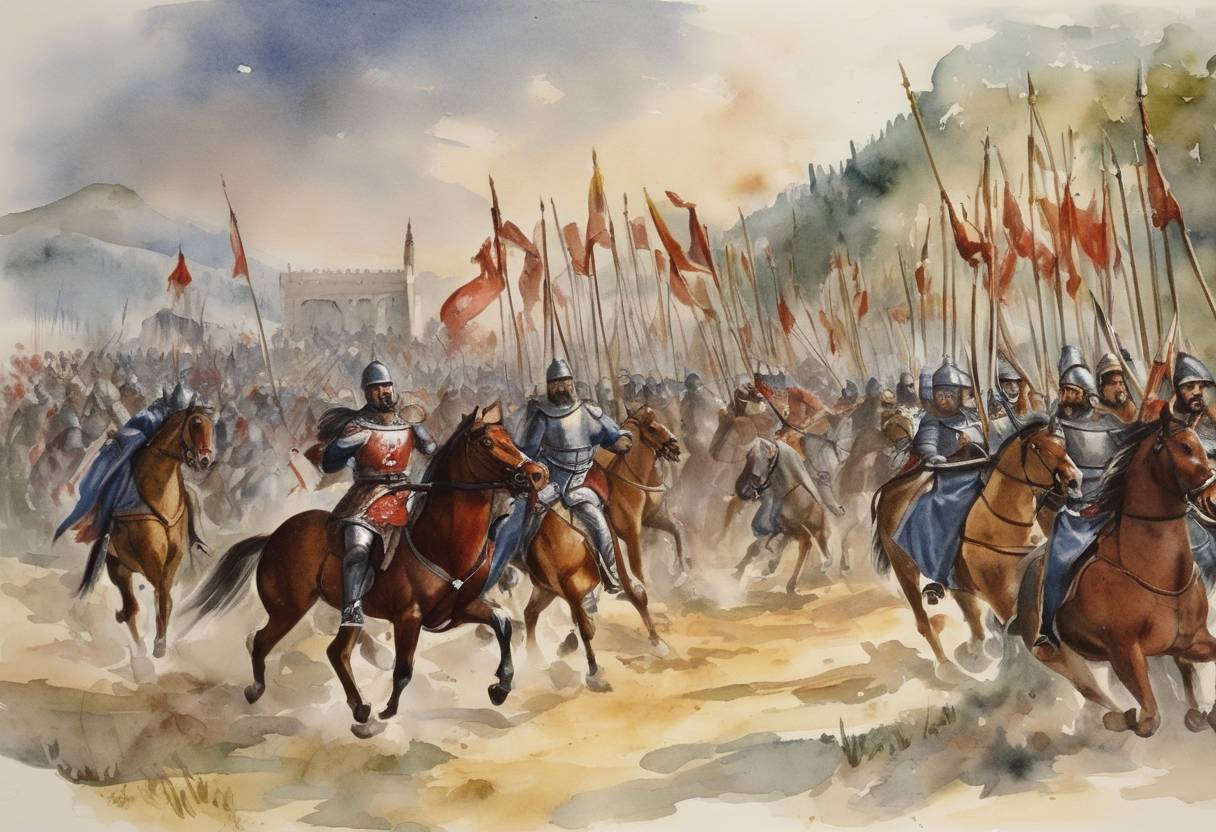
The Battle of Montecatini took place on August 29, 1315, and was a pivotal engagement within the complex Wars of the Guelphs and Ghibellines. These wars were essentially a manifestation of the extended conflicts between the Papacy and the Holy Roman Empire. The battle was indicative of the broader struggle for power in Italy during the Middle Ages.
The battle occurred near Montecatini, a strategic location within Tuscany. The Ghibelline forces were led by the seasoned commander Uguccione della Faggiuola, who had extensive experience in Italian political and military affairs.
The Ghibellines were primarily drawn from Pisa and had the support of Holy Roman Emperor Henry VII, despite his death shortly before the battle. This support fortified their resolve against adversaries who were determined to curtail their power in Tuscany.
The Guelphs, on the other hand, comprised troops from Florence and Naples, each city harboring significant economic and political interests necessitating control over the region.
The Battle of Montecatini concluded with a definitive victory for the Ghibelline forces. Uguccione della Faggiuola’s strategy and leadership were instrumental in overcoming the numerically superior and better-equipped Guelph coalition. This victory had several effects:
The Battle of Montecatini exemplifies the intense factionalism and volatility of medieval Italy. This conflict is emblematic of the broader inter-city and intra-city conflicts that characterized the region. It also illustrates the enduring influence of the Holy Roman Empire in Italian affairs, despite Pascale opposition. This particular conflict left a lasting imprint on the regional politics of Tuscany and contributed towards shaping the trajectory of power dynamics in Italy during the Middle Ages.
Source: en.wikipedia.org