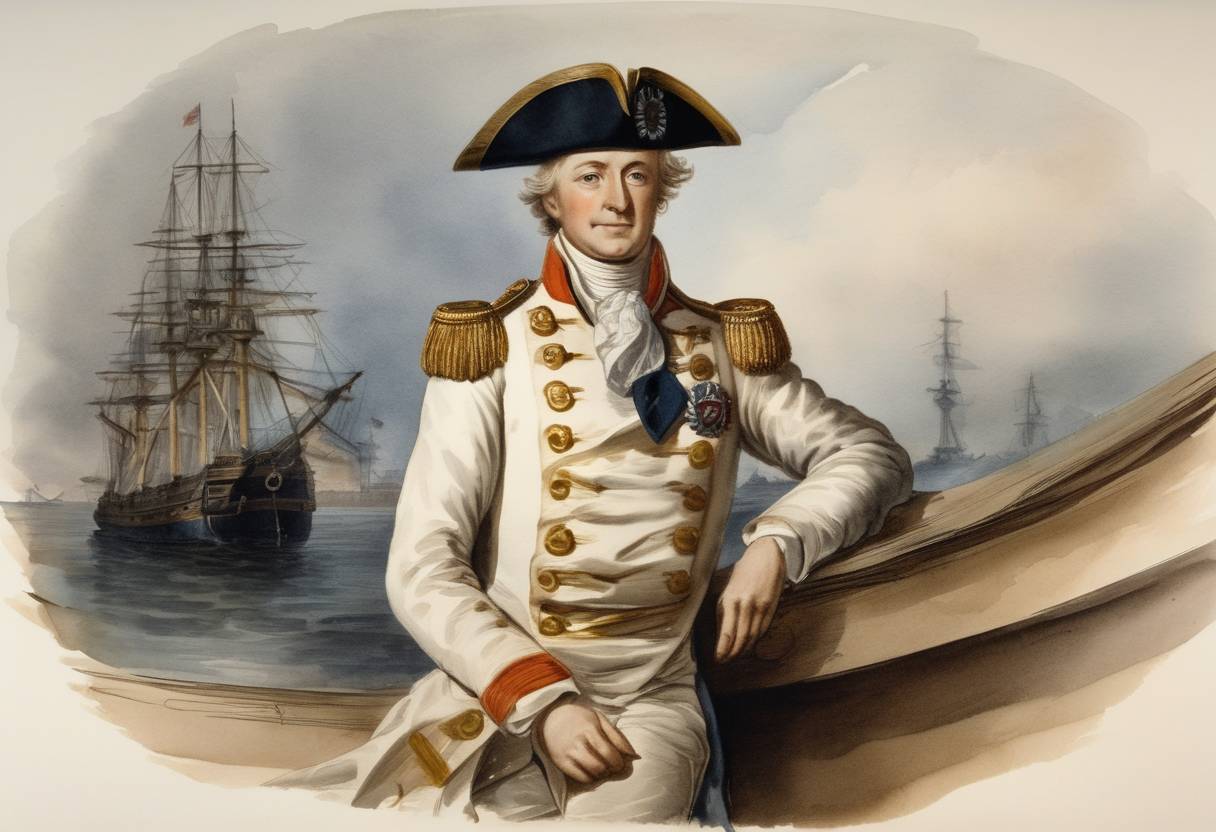
John Paul Jones Appointed Rear Admiral in the Russian Navy
On July 18, 1792, John Paul Jones, an esteemed naval commander of the American Revolutionary War, was appointed a rear admiral in the Russian Navy by Empress Catherine the Great. This appointment underscored his enduring influence in international naval affairs and his reputation as a formidable maritime strategist.
Background
John Paul Jones, originally from Scotland, rose to fame during the American Revolutionary War as an audacious and skilled naval commander. He is best known for his victory over HMS Serapis on September 23, 1779, while commanding the Bonhomme Richard, a defining moment that bolstered his legendary status.
Appointment to the Russian Navy
After the American Revolutionary War, Jones sought new challenges and opportunities. His reputation as a seasoned naval commander caught the attention of Empress Catherine the Great of Russia. The Empress sought to modernize and strengthen the Russian Navy and saw in Jones the exemplary leadership and innovative tactics needed for her naval expansion.
Appointed as a rear admiral, Jones was tasked with participating in the Russo-Turkish War (1787–1792), where his experience was expected to contribute significantly to Russia’s naval operations. His appointment was a testament to the international recognition of his naval prowess and strategic acumen.
Impact and Legacy
Jones’s service in the Russian Navy was a continuation of his influential military career. Although his time in the Russian service was relatively short, his appointment as a rear admiral reflected the high regard in which he was held beyond American shores.
John Paul Jones remains a celebrated figure in naval history, considered one of the founding figures of the United States Navy. His contributions to naval warfare tactics and his role in the development of international naval relations continue to be acknowledged and studied for their significant impact on maritime history.
Conclusion
The appointment of John Paul Jones as a rear admiral in the Russian Navy on July 18, 1792, signifies a critical recognition of his talents and achievements in naval warfare, indicating his broad-reaching influence that extended well beyond the American Revolutionary context. His legacy endures as a symbol of tenacity and tactical brilliance in the annals of naval history.