1835 · New Echota, United States
The Treaty of New Echota is signed, ceding Cherokee land to the United States in return for compensation, leading to the forced removal of the Cherokee people known as the Trail of Tears.
March 12, 1838
A portion of the Cherokee Nation began the forced journey known as the 'Trail of Tears'. The removal of the Cherokees was part of a series of relocations ordered by the U.S. government through policies like the Indian Removal Act of 1830. This tragic event resulted in the suffering and deaths of thousands of Cherokee.
New Echota, United States | United States government
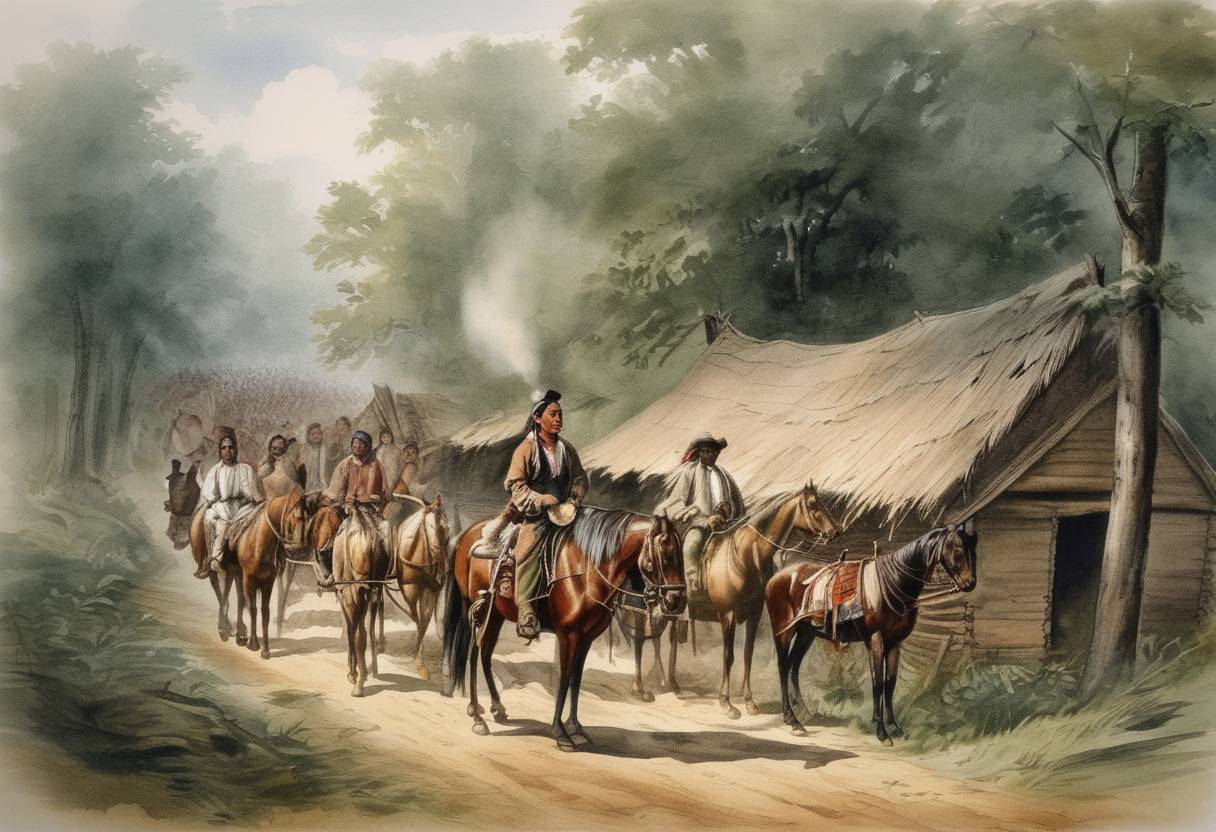
On March 12, 1838, a segment of the Cherokee Nation commenced the harrowing journey known as the Trail of Tears. This forced relocation was part of the U.S. government’s broader strategy to remove Indigenous peoples from their ancestral lands in the southeastern United States, aiming to open these territories to European-American settlement.
The Trail of Tears was a direct consequence of the Indian Removal Act passed by the U.S. Congress in 1830. Under President Andrew Jackson, the act granted the federal government the power to negotiate treaties to relocate Native American tribes to lands west of the Mississippi River. Despite legal challenges and the U.S. Supreme Court ruling in Worcester v. Georgia (1832), which recognized the sovereignty of the Cherokee Nation, the removal process pressed forward.
The signing of the Treaty of New Echota in 1835, which was not approved by the Cherokee National Council, legally provided for the cession of all Cherokee land east of the Mississippi River. This controversial treaty was ratified by a slim margin in the U.S. Senate, paving the way for the forced relocation.
By March 1838, the deadline for voluntary relocation under the terms of the treaty had passed. As a result, the U.S. government, under the administration of President Martin Van Buren, began preparations for the forcible removal of the Cherokee who had not yet relocated. On March 12, 1838, the initial groups of Cherokee began to be gathered into internment camps, where they faced poor conditions and inadequate supplies, exacerbating the suffering that lay ahead on their journey to designated lands in what is now Oklahoma.
The journey, covering roughly 1,200 miles, subjected the Cherokee to brutal conditions, including exposure to harsh weather, inadequate shelter, and a lack of food and water. Disease, starvation, and exhaustion claimed the lives of an estimated 4,000 Cherokee individuals.
The Trail of Tears became a powerful symbol of the injustices committed against Native American peoples and is remembered as one of the darkest episodes in American history. It highlights the impact of expansionist policies on Indigenous communities, the violation of treaties, and the broader struggles for sovereignty and justice for Indigenous peoples.
The legacy of the Trail of Tears remains a poignant reminder of the United States’ fraught history with its Indigenous population. It underscores the resilience of the Cherokee Nation, which has continued to thrive and preserve its cultural heritage despite such adversities. Commemorative efforts and historical education continue to honor the memory of this tragic chapter and its victims.
Source: www.britannica.com