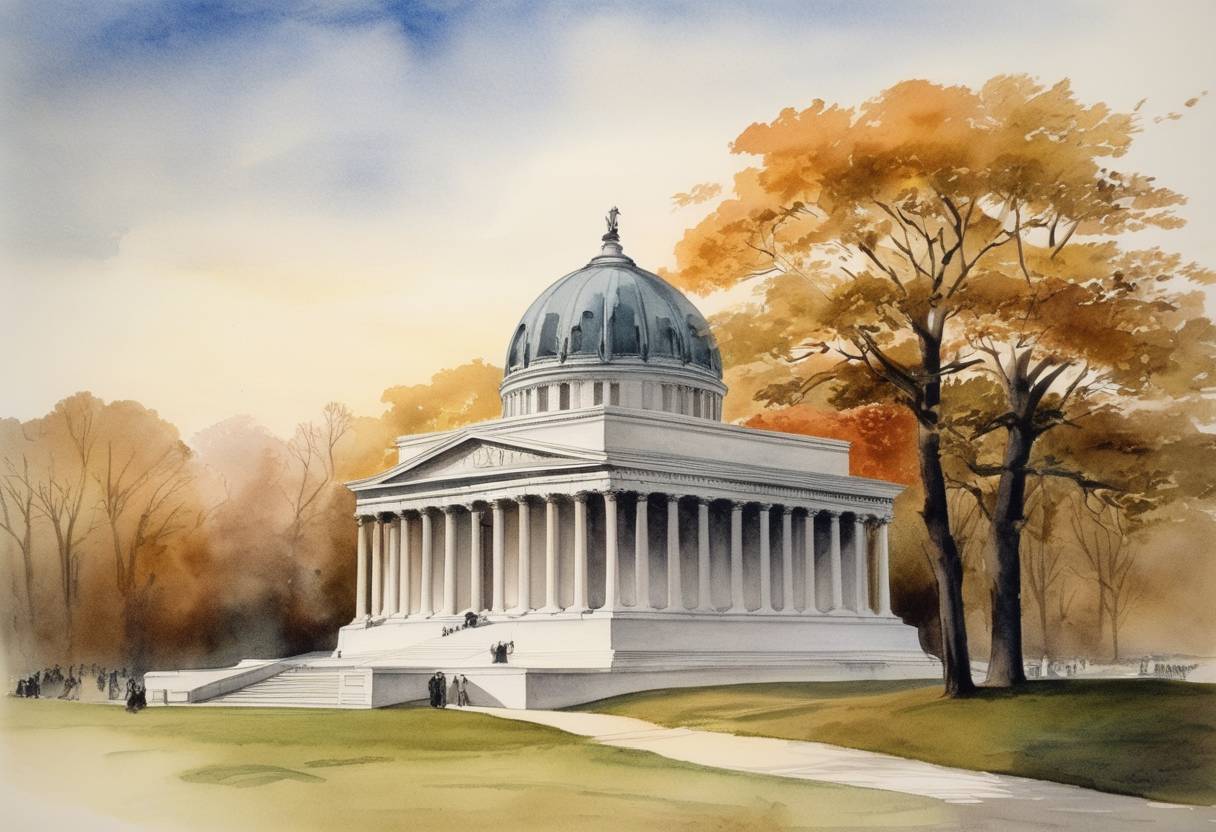
Dedication of Grant’s Tomb: April 27, 1897
On April 27, 1897, the imposing granite structure known as Grant’s Tomb was dedicated in New York City. This day marked the fulfillment of a national endeavor to honor Ulysses S. Grant, the 18th President of the United States and the commanding general who led the Union Army to victory during the American Civil War.
Ulysses S. Grant: A Brief Overview
Ulysses S. Grant rose to national prominence during the Civil War, first as a strategic leader and eventually as the commanding general of the United States Army. Known for his tenacity and innovative tactics, Grant became an emblematic figure of the Union’s triumph. Following the war, he served two terms as President from 1869 to 1877 during a period defined by Reconstruction and the attempted reinforcement of civil rights for African Americans in the south.
Planning and Construction
After Grant’s death on July 23, 1885, his widow, Julia Dent Grant, chose New York City as the final resting place for her husband because the city had shown great affection towards him. The decision to construct a grand mausoleum stemmed from a national fundraising campaign spearheaded by the Grant Monument Association, which raised the necessary funds through public donations. The renowned architect John Hemenway Duncan was chosen to design the tomb, with the construction work commencing in 1891.
Dedication Ceremony
The dedication ceremony itself was a monumental event, coinciding with what would have been Grant’s 75th birthday. President William McKinley presided over the ceremony, which drew notable military and political figures, along with an estimated crowd of one million spectators, who lined the streets of Manhattan to pay homage to Grant’s legacy. The occasion featured an impressive parade, speeches, and the presence of Civil War veterans, serving as a tribute to Grant’s impact on the nation.
Architectural Significance
The tomb is an outstanding example of American Beaux-Arts architecture. Initially inspired by the ancient Tomb of Mausolus at Halicarnassus and the domed Les Invalides in Paris, Grant’s Tomb reflects classical architectural traditions. It is regarded as the largest mausoleum in North America and stands prominently in Riverside Park, overlooking the Hudson River.
Historical Impact
Grant’s Tomb remains a symbol of national unity and commemoration of the sacrifices made during the Civil War. It highlights the complexities of post-war reconciliation in the United States and represents the enduring legacy of those who strive for equality and national unity. As one of New York City’s treasured landmarks, it continues to attract thousands of visitors each year, preserving the memory of one of the nation’s key historical figures.