Germany's Admission to the League of Nations
1925 · Geneva, Switzerland
Germany was admitted to the League of Nations.
June 27, 1923
The Treaty of Lausanne was signed, officially making Lausanne the seat of the League of Nations' Permanent Court of International Justice, following the dissolution of the Ottoman Empire.
Lausanne, Switzerland | League of Nations
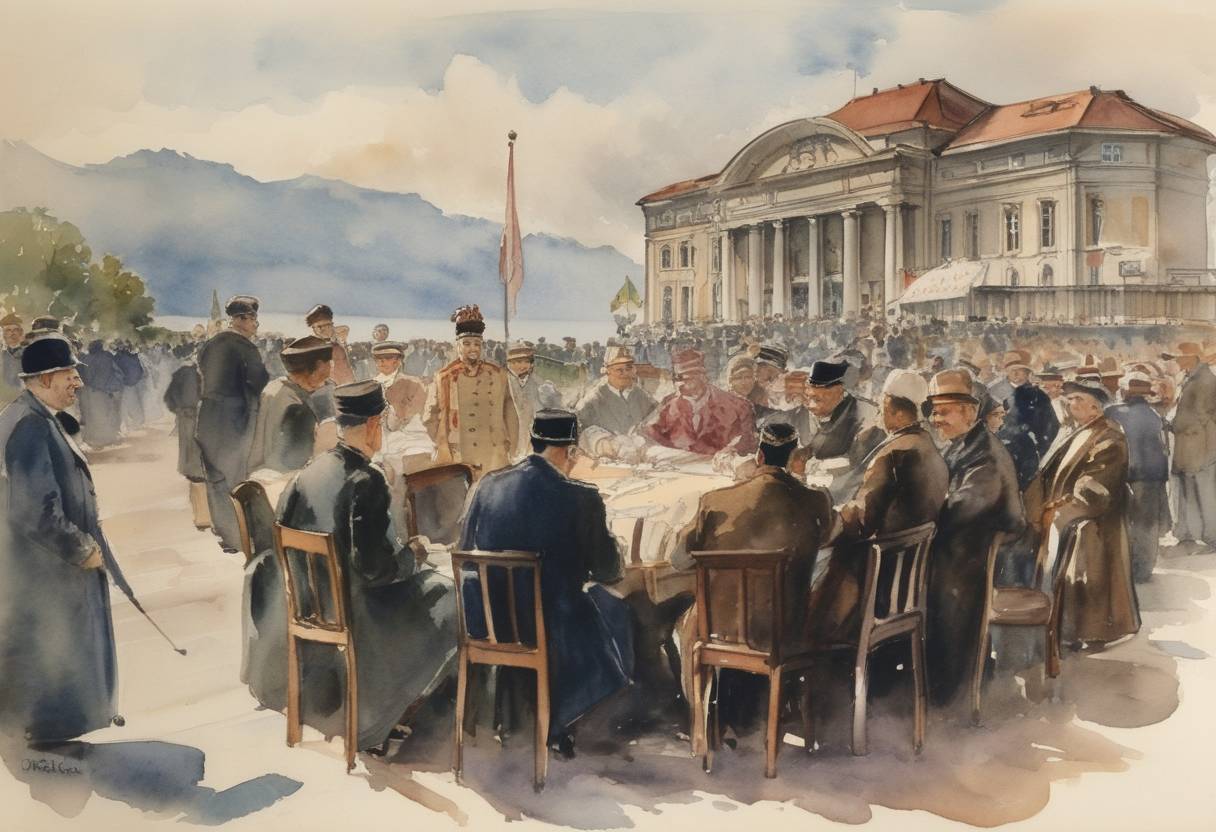
The Treaty of Lausanne, signed on July 24, 1923, not June 27, was a crucial diplomatic agreement marking the end of the conflict between the Allied Powers and Turkey following World War I. However, your statement contains an error regarding the establishment of Lausanne as the seat of the League of Nations’ Permanent Court of International Justice, as this was never the case.
After World War I, the Ottoman Empire faced substantial territorial losses. The earlier Treaty of Sèvres, signed in 1920, had attempted to partition the Ottoman Empire, but it was rejected by the Turkish national movement led by Mustafa Kemal Atatürk. The nationalist opposition prompted a series of military campaigns leading to the Turkish War of Independence.
The Lausanne Conference was convened in the city of Lausanne, Switzerland, aiming to renegotiate the terms of the Treaty of Sèvres. The main representatives involved were from Turkey, Britain, France, Italy, Japan, Greece, Romania, and Yugoslavia. The negotiations were complex, addressing territorial disputes, minority protections, and economic arrangements.
Territorial Adjustments: The Treaty recognized the boundaries of the modern Turkish state. It granted Turkey sovereignty over all its territory, including Eastern Thrace and some Aegean islands, while ceding other territories like Cyprus and the Dodecanese to the respective Allied powers.
Minority Rights: The treaty included provisions for the protection of minorities within Turkey but eliminated the earlier obligation to establish an Armenian state.
Economic and Military Clauses: The treaty annulled the capitulations that limited Turkish sovereignty in economic affairs, and also included terms regarding military disarmament and the control of the Straits.
The Treaty of Lausanne is considered a cornerstone in the foundation of the Republic of Turkey, establishing modern Turkey’s geographical and political framework. It effectively annulled the Treaty of Sèvres and is seen as a triumph of Turkish diplomacy under Mustafa Kemal Atatürk’s leadership. The treaty also marked the end of the Ottoman Empire, with the newly recognized Republic of Turkey succeeding it.
The League of Nations’ Permanent Court of International Justice was actually seated in The Hague, Netherlands, not Lausanne. The Treaty of Lausanne did not involve the creation or seating of this international court. Instead, the treaty primarily focused on settling territorial and political disputes arising from the dissolution of the Ottoman Empire.
This underscores the lasting impact of the Treaty of Lausanne in shaping modern Turkey and the political landscape of the Middle East following World War I.
Source: en.wikipedia.org