Napoleon's Arrival at Elba: May 4, 1814
1814 · Portoferraio, Elba
Emperor Napoleon I of France arrives at Portoferraio on the island of Elba to begin his exile.
February 26, 1815
Napoleon Bonaparte escaped from exile on the island of Elba, beginning his return to power known as the Hundred Days.
Elba, Italy | French Empire
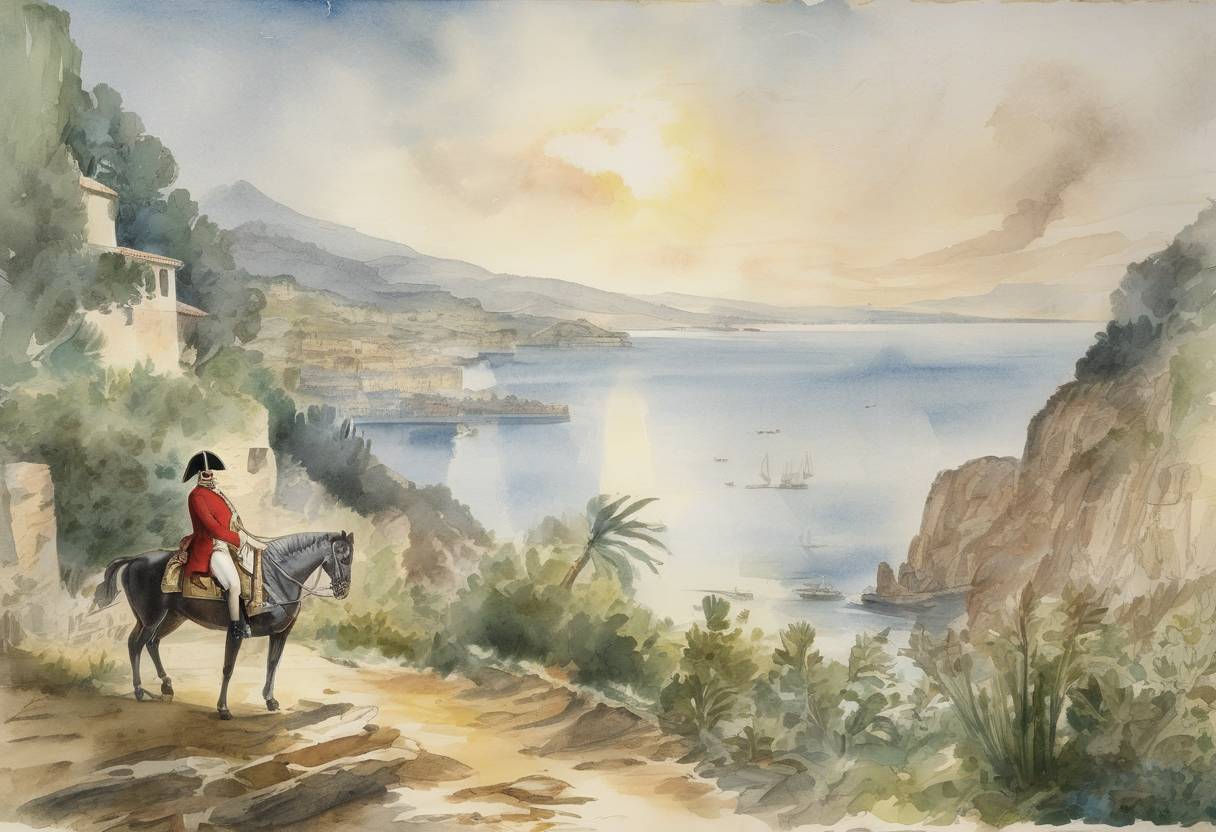
On February 26, 1815, Napoleon Bonaparte made a daring escape from his exile on the island of Elba, marking the beginning of a period known as the “Hundred Days.” This event set the stage for his brief return to power in France and had significant implications for European politics.
Exile to Elba: Following his abdication in April 1814, Napoleon was exiled to the island of Elba, located in the Mediterranean Sea off the coast of Italy. The Treaty of Fontainebleau allowed him to retain the title of Emperor and granted him sovereignty over Elba, where he was accompanied by a small contingent of guards and followers.
Dissatisfaction in France: During Napoleon’s exile, the Bourbon monarchy was restored under King Louis XVIII. However, the new regime struggled with political instability, economic difficulties, and widespread dissatisfaction among the French populace, particularly among former soldiers and Bonapartists.
Napoleon’s Ambitions: Despite his initial acceptance of exile, Napoleon remained ambitious and keenly aware of the political situation in France. Reports of unrest and the unpopularity of the Bourbon monarchy reached him, fueling his desire to return.
Planning the Escape: Napoleon meticulously planned his escape, taking advantage of lax security and the loyalty of his followers. He gathered a small force of around 1,000 men, including members of his Old Guard, and prepared for the journey back to France.
Execution: On the evening of February 26, 1815, Napoleon and his men boarded the brig Inconstant and several smaller vessels. They set sail from Elba, evading the British and French ships tasked with monitoring the island.
Landing in France: Napoleon landed on the French mainland at Golfe-Juan on March 1, 1815. From there, he began his march northward toward Paris, attracting support from the military and civilians alike.
The Hundred Days: As Napoleon advanced, his forces grew, and he faced little resistance. King Louis XVIII fled Paris, and on March 20, 1815, Napoleon entered the capital, marking the start of his second reign, known as the Hundred Days.
Waterloo and Final Defeat: Napoleon’s return to power was short-lived. The European powers, alarmed by his resurgence, formed the Seventh Coalition. This culminated in the Battle of Waterloo on June 18, 1815, where Napoleon was decisively defeated by the Duke of Wellington and Prussian forces led by Gebhard Leberecht von Blücher.
Second Exile: Following his defeat at Waterloo, Napoleon was forced to abdicate once more. He surrendered to the British and was exiled to the remote island of Saint Helena in the South Atlantic, where he spent the remainder of his life until his death in 1821.
Historical Impact: Napoleon’s escape and the subsequent Hundred Days had a profound impact on European politics. It led to the final defeat of Napoleon and the re-establishment of the Bourbon monarchy in France. The Congress of Vienna, which had been convened to redraw the map of Europe after the Napoleonic Wars, was forced to address the renewed instability caused by his return.
Napoleon’s escape from Elba remains a remarkable episode in history, illustrating his enduring influence and the volatile political landscape of early 19th-century Europe.
Source: en.wikipedia.org