The First Electric Telegraph: Samuel Morse's Historic Achievement
1844 · Washington, D.C., United States
The first electric telegram is sent by Samuel Morse from Washington, D.C., which is a critical advancement in communication technology.
June 20, 1840
Samuel Morse patents his telegraph system, a pivotal moment in the history of communication technology.
Washington D.C., United States | U.S. Patent Office
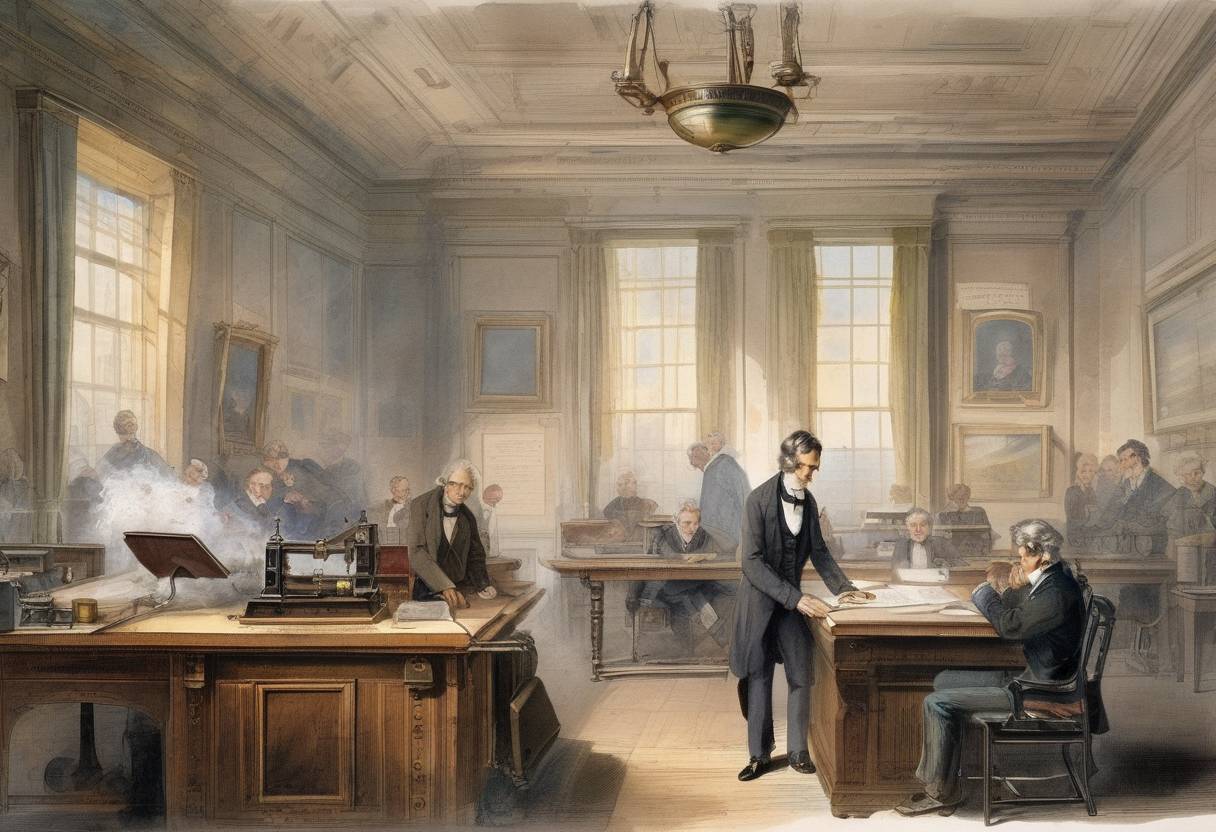
On June 20, 1840, Samuel Morse was granted U.S. Patent No. 1,647 for his invention of the telegraph system, a groundbreaking development in the field of communication technology. This event marked a significant turning point in how information was transmitted over long distances, laying the foundation for modern communication networks.
Before the telegraph, communication over long distances relied on physical means such as messengers, semaphore lines, or optical telegraphs, which were slow and limited in range. The need for a more efficient method of communication became increasingly apparent with the expansion of railroads and the growth of commerce in the early 19th century.
Samuel Morse, originally an artist and professor of art, became interested in telegraphy during a transatlantic voyage in 1832. Inspired by conversations about electromagnetism, Morse began developing a system that could transmit messages using electrical signals.
Morse’s telegraph system consisted of a single-wire setup that used electrical pulses to convey information. The key innovation was the Morse Code, a system of dots and dashes representing letters and numbers, which allowed for the efficient transmission of complex messages.
Morse collaborated with Alfred Vail, who contributed significant technical improvements to the system, including the development of a more practical recording device. Together, they demonstrated the telegraph’s potential in 1838 by sending messages over a two-mile wire.
The patent granted on June 20, 1840, secured Morse’s rights to his telegraph system, enabling him to commercialize the technology. However, it wasn’t until 1844, when Morse successfully transmitted the famous message “What hath God wrought” from Washington, D.C., to Baltimore, that the telegraph gained widespread attention and acceptance.
The telegraph revolutionized communication by allowing near-instantaneous transmission of information across vast distances. It played a crucial role in various sectors, including journalism, finance, and military operations, and facilitated the expansion of the railroads by improving coordination and safety.
The success of Morse’s telegraph system marked the beginning of the telecommunications era. It paved the way for future innovations, such as the telephone and the internet, fundamentally transforming how societies interact and conduct business.
The telegraph also had profound social and economic impacts, contributing to globalization by shrinking the perceived size of the world and enabling more efficient international communication and trade.
In summary, Samuel Morse’s patenting of the telegraph system on June 20, 1840, was a pivotal moment in history, setting the stage for the rapid advancement of communication technologies that continue to shape our world today.
Source: en.wikipedia.org