Establishment of the First Official Calendar in Japan
673 · Asuka, Japan
Emperor Tenmu of Japan decrees the establishment of the first official calendar in Japan, based on the Chinese lunisolar calendar.
June 10, 0671
Emperor Tenji of Japan introduces a water clock (clepsydra) called Rokoku, which marks the hours with the sound of a bell and drum.
Otsu, Japan | Imperial Court of Japan
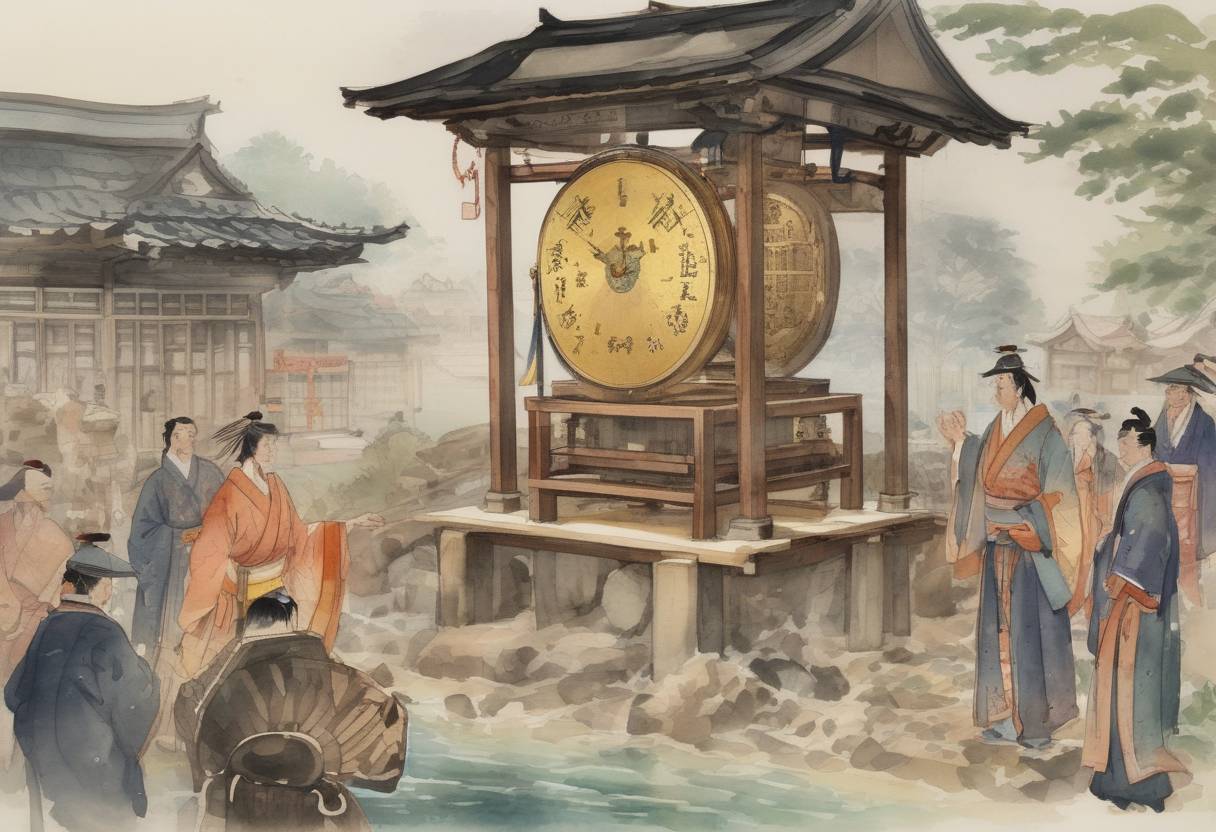
On June 10, 671, Emperor Tenji of Japan introduced a significant advancement in timekeeping technology with the installation of a water clock known as the Rokoku. This event marked a pivotal moment in the history of Japanese timekeeping and reflected the broader cultural and technological exchanges occurring in East Asia during this period.
Emperor Tenji’s Reign: Emperor Tenji, who reigned from 661 to 672, was known for his efforts to centralize and strengthen the imperial government. His reign was characterized by significant administrative reforms and the adoption of Chinese cultural and technological influences.
Cultural Exchange: During the 7th century, Japan was heavily influenced by Chinese culture, including its advancements in technology, governance, and philosophy. The introduction of the water clock was part of this broader trend of adopting Chinese innovations.
Design and Function: The Rokoku was a type of clepsydra, or water clock, which used the flow of water to measure time. It marked the hours with the sound of a bell and drum, providing an auditory signal of the passage of time.
Significance: The introduction of the Rokoku represented a significant technological advancement in Japan. It was one of the earliest known timekeeping devices in the country and demonstrated the influence of Chinese technology.
Administrative Reforms: The use of the Rokoku was part of Emperor Tenji’s broader efforts to reform and modernize the Japanese administration. Accurate timekeeping was essential for the efficient functioning of government and society.
Cultural Influence: The adoption of the water clock is an example of the cultural and technological exchanges between Japan and China during this period. It highlights the ways in which Japan selectively adopted and adapted foreign innovations to suit its own needs.
The introduction of the Rokoku water clock by Emperor Tenji on June 10, 671, was a landmark event in Japanese history. It not only improved timekeeping but also symbolized the broader cultural and technological exchanges between Japan and China. This event underscores the importance of cross-cultural interactions in the development of societies and the spread of technological innovations.
Source: en.wikipedia.org