Execution of Anne Boleyn: May 19, 1536
1536 · London, England
Anne Boleyn, the second wife of King Henry VIII of England, was executed on charges of adultery, treason, and incest.
August 23, 1305
Scottish leader William Wallace was executed for treason by Edward I of England.
London, England | English monarchy
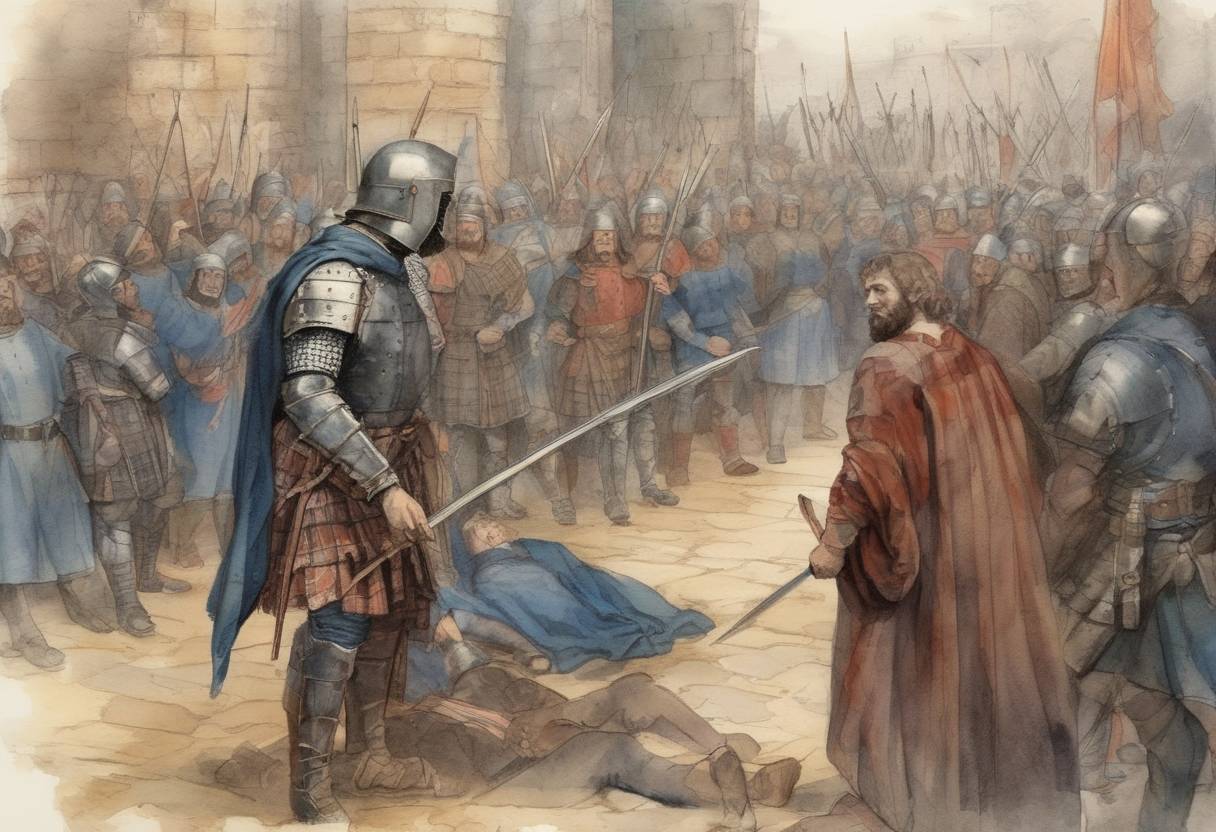
On August 23, 1305, William Wallace, a prominent figure in the Scottish Wars of Independence, was executed for treason by the English authorities under King Edward I. Wallace’s execution marked a pivotal moment in the struggle between Scotland and England during the late 13th and early 14th centuries.
William Wallace emerged as a key leader in the Scottish resistance against English rule following the death of the Scottish king, Alexander III, in 1286. The subsequent succession crisis led to King Edward I of England asserting his influence over Scotland, culminating in the English invasion of 1296. Wallace became renowned for his role in the Battle of Stirling Bridge in 1297, where his forces achieved a significant victory against the English.
Despite his successes, Wallace’s fortunes turned following the defeat at the Battle of Falkirk in 1298. He continued to resist English control but was eventually captured in 1305.
Wallace was betrayed and captured near Glasgow in August 1305. He was transported to London, where he was tried for treason. Wallace famously denied the charge, asserting that he could not be a traitor to Edward I, as he had never sworn allegiance to him.
On August 23, 1305, Wallace was executed in a brutal manner typical of the period for those convicted of treason. He was hanged, drawn, and quartered, a process involving hanging, disembowelment, and dismemberment. His body parts were displayed in various locations across England and Scotland as a warning to others who might resist English rule.
Wallace’s execution did not quell the Scottish desire for independence. His martyrdom became a rallying point for continued resistance, eventually leading to the successful campaigns of Robert the Bruce and the eventual recognition of Scottish independence with the Treaty of Edinburgh-Northampton in 1328.
William Wallace remains a symbol of Scottish nationalism and resistance. His life and legacy have been commemorated in various cultural works, most notably in the film “Braveheart,” albeit with significant artistic liberties.
Wallace’s execution underscored the intense conflict between Scotland and England during this period and highlighted the broader struggle for national sovereignty that characterized much of medieval European history.
Source: en.wikipedia.org