Proclamation of the People's Republic of China
1949 · Beijing, China
The People's Republic of China was officially proclaimed by Mao Zedong, marking the end of the Chinese Civil War and the beginning of communist rule in China.
September 28, 1949
The People's Republic of China announces its first Provincial Governor appointment, marking the establishment of new order under Communist rule.
Beijing, China | Communist Party of China
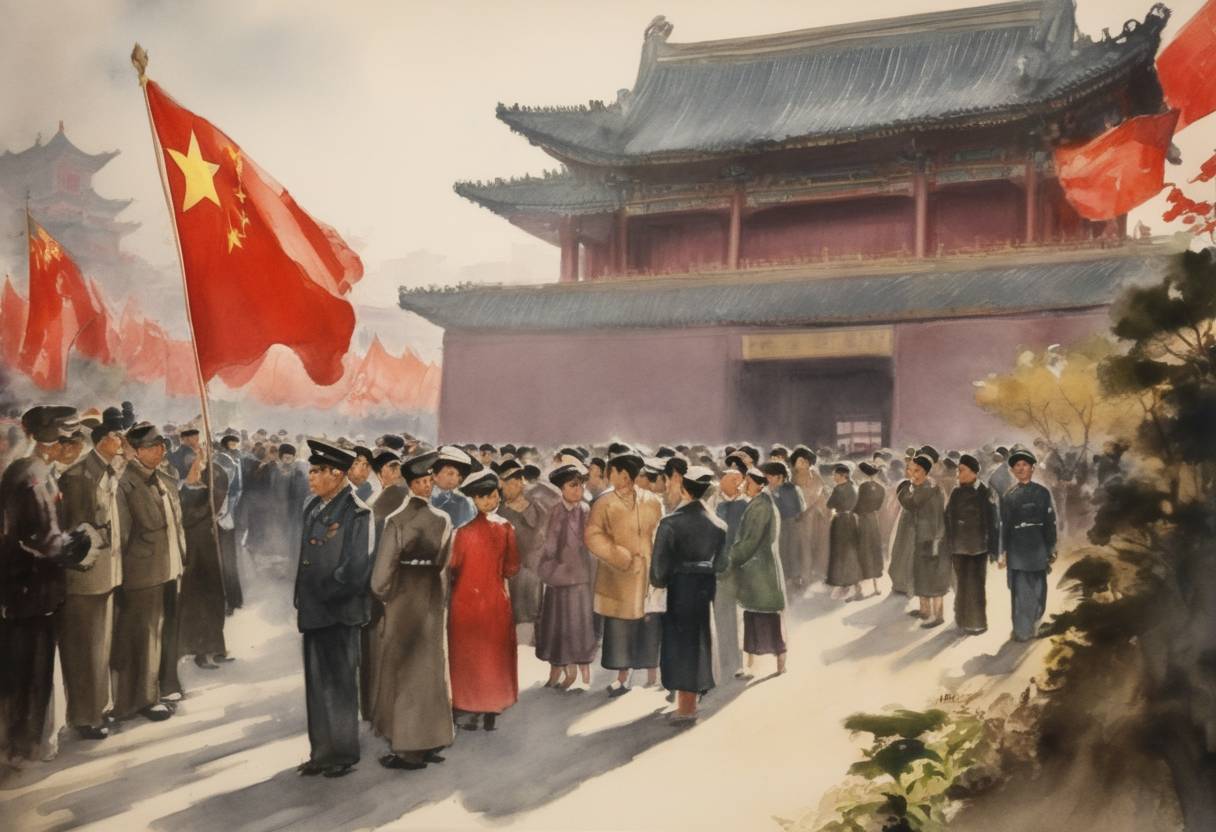
On September 28, 1949, the People’s Republic of China (PRC) took a crucial step in establishing its new governmental structure by appointing the first provincial governor under Communist rule. This appointment was part of the early organizational efforts following the culmination of the Chinese Civil War, a conflict that saw the Communist Party, led by Mao Zedong, emerge victorious over the Nationalist forces of the Kuomintang (KMT).
The Chinese Civil War, which began in the aftermath of World War II, was primarily a struggle between the Chinese Communist Party (CCP) and the Nationalist Party (Kuomintang or KMT). After years of conflict, including strategic battles and significant shifts in territorial control, the Communist Party occupied Beijing in early 1949. This victory paved the way for the establishment of the People’s Republic of China on October 1, 1949.
With their control solidified, the Communist government began the process of establishing a new administrative and political order. Appointing provincial governors was an essential step in this process, aiming to extend central authority across the vast regions of China.
The appointment marked the beginning of a new era in Chinese governance, as the Communist government sought to replace the existing provincial leadership that had been largely aligned with the KMT. The new governors were tasked with implementing Communist policies, maintaining order, and fostering the economic and social reforms that the CCP deemed necessary to construct a socialist state.
By placing trusted Communist officials in key provincial positions, the central government ensured that its directives would be followed at the local level, thereby strengthening its control over the entire nation. This move was critical in consolidating the CCP’s power and laying the groundwork for the various social and economic reforms that were to follow in the coming decades.
The appointment of provincial governors was a precursor to other significant changes that would define Communist China’s early years. These included land reforms, collectivization of agriculture, and various economic plans aimed at transforming the largely agrarian society into a modern socialist state.
This administrative reorganization helped stabilize the country after years of turmoil and set the stage for the PRC’s future development and expansion of Communist policies across China. The move also demonstrated the CCP’s commitment to establishing a new social order, which would continue to evolve throughout the 20th century. The appointed provincial governors played a crucial role in integrating Communist ideology with local governance, driving the national agenda, and transforming the political landscape of the country.
Source: www.britannica.com