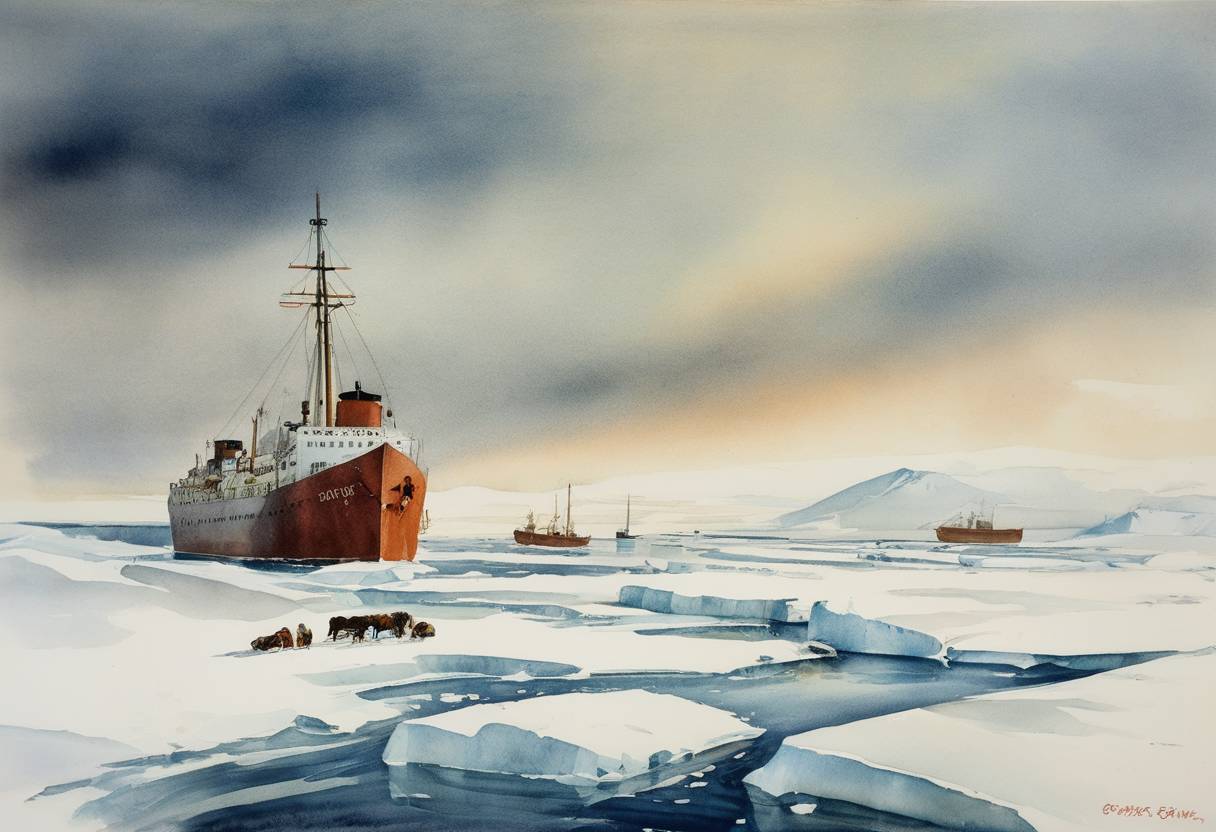
Establishment of North Pole-1: The First Soviet Arctic Drift Ice Station
On September 1, 1934, the Soviet Union initiated a groundbreaking venture with the establishment of “North Pole-1” (NP-1), the first Soviet Arctic drift ice station. This pioneering scientific effort marked a significant milestone in Arctic exploration and research, laying the groundwork for future studies in polar sciences.
Background and Context
The early 20th century witnessed growing interest in the Arctic region due to its strategic importance and scientific potential. The USSR, keen to expand its scientific boundaries and assert its presence in the polar regions, focused on developing research infrastructure in the Arctic. The plan to establish a drift station was rooted in the need to gather direct meteorological, oceanographic, and geographic data from the central Arctic basin.
Key Events Leading Up to NP-1
In the years preceding NP-1’s launch, the Soviet research community, under the auspices of the Chief Directorate of the Northern Sea Route, initiated intensive preparations. This included selecting a capable team of scientists and explorers led by meteorologist Ivan Papanin. With additional expertise from specialists like geophysicist Ernst Krenkel and oceanographer Pyotr Shirshov, the venture was poised for scientific success.
The Operation of North Pole-1
North Pole-1 officially commenced operations on September 1, 1934. The station was stationed on an ice floe, allowing it to drift naturally with the Arctic currents. This drift method was vital in collecting continuous observational data over months, covering various aspects such as meteorology, hydrology, and ice dynamics.
The team faced challenging conditions, enduring temperatures that plummeted to -40 degrees Celsius and navigating the perils posed by shifting ice. Despite these hardships, NP-1 delivered critical insights into the Arctic system, enriching scientific understanding and contributing to the Soviet Union’s broader geopolitical interests.
Aftermath and Consequences
North Pole-1 set a precedent for subsequent Soviet Arctic expeditions, establishing a model for future drift ice stations. These endeavors played an instrumental role in enhancing global knowledge of the polar regions, shaping climatic and environmental policy decisions.
By establishing NP-1, the Soviet Union pioneered long-term scientific observation in the Arctic, demonstrating the feasibility and value of establishing permanent research bases in one of Earth’s most extreme environments. This initiative not only fortified Soviet scientific prowess but also emboldened international interest and collaborative research efforts in the Arctic.
Broader Historical Significance
The success of NP-1 proved pivotal in advancing polar science. It underscored the strategic importance of the Arctic and laid the groundwork for international cooperation that continues, albeit with complexities, to this day. The legacy of North Pole-1 serves as a testament to the enduring spirit of exploration and discovery amidst the harshest of conditions.