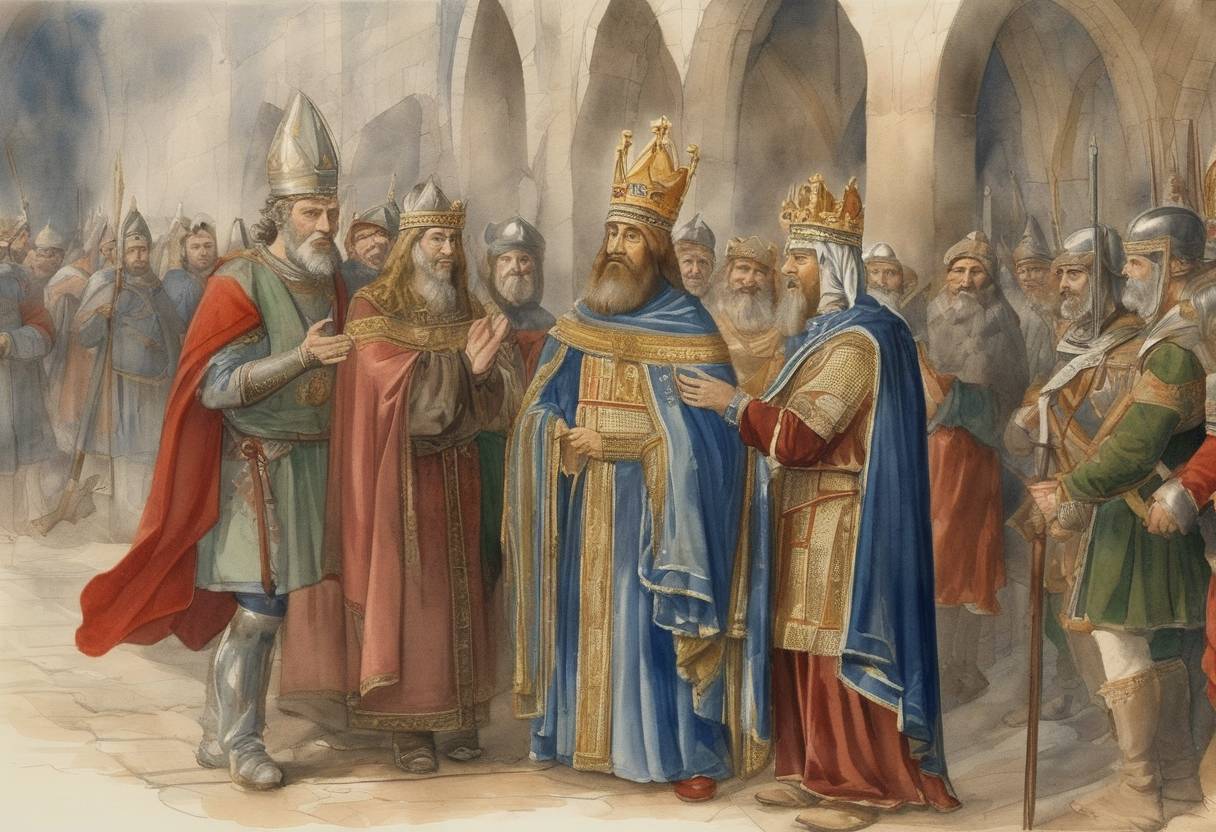
Clarification on Historical Inaccuracy Regarding Date
There appears to be a discrepancy regarding the specific historical date of November 29, 800, in relation to the events involving Charlemagne and the Saxon leader Widukind. The notable interactions and events tied to Charlemagne’s subjugation of the Saxons and Widukind’s submission and conversion occurred earlier, primarily between 777 and 785. Here are the key details surrounding these events:
Context
- Charlemagne, King of the Franks, engaged in a prolonged series of campaigns to subjugate the Saxons, a confederation of Germanic tribes.
- The Saxon Wars spanned from 772 to 804, involving multiple battles and rebellions against Frankish control.
Events Leading to Widukind’s Submission
- Widukind, a prominent Saxon leader, became the symbol of resistance against Charlemagne’s campaigns.
- Widukind fled to the Danish court during initial conflicts, returning to lead uprisings.
Significance of Widukind’s Submission
- The submission occurred around 785 at Attigny or possibly Paderborn, though not specifically on November 29, 800.
- Widukind’s capitulation marked the turning point in the Saxon Wars, as he agreed to be baptized, adopting Christianity officially as part of a peace settlement.
- His conversion was a strategic masterstroke by Charlemagne, as it not only pacified the Saxon threat but also facilitated the Christianization of the Saxon people under the Carolingian Empire.
Broader Historical Impact
- Widukind’s baptism represents a symbolic integration of the Saxons into the Carolingian realm, fostering both religious and political unity.
- This event reinforced Charlemagne’s position as a dominant Christian ruler in Western Europe, culminating in his coronation as Emperor on December 25, 800, by Pope Leo III.
- The ultimate subjugation of the Saxons and Charlemagne’s subsequent efforts to spread Christianity laid foundational aspects of the medieval European order.
Conclusion
While no specific actions involving Widukind and Charlemagne occurred on November 29, 800, the earlier events of Widukind’s submission and baptism effectively consolidated the Carolingian Empire’s power and broadened its Christian dominion. These actions contributed significantly to Charlemagne’s legacy as a shaper of medieval Europe.