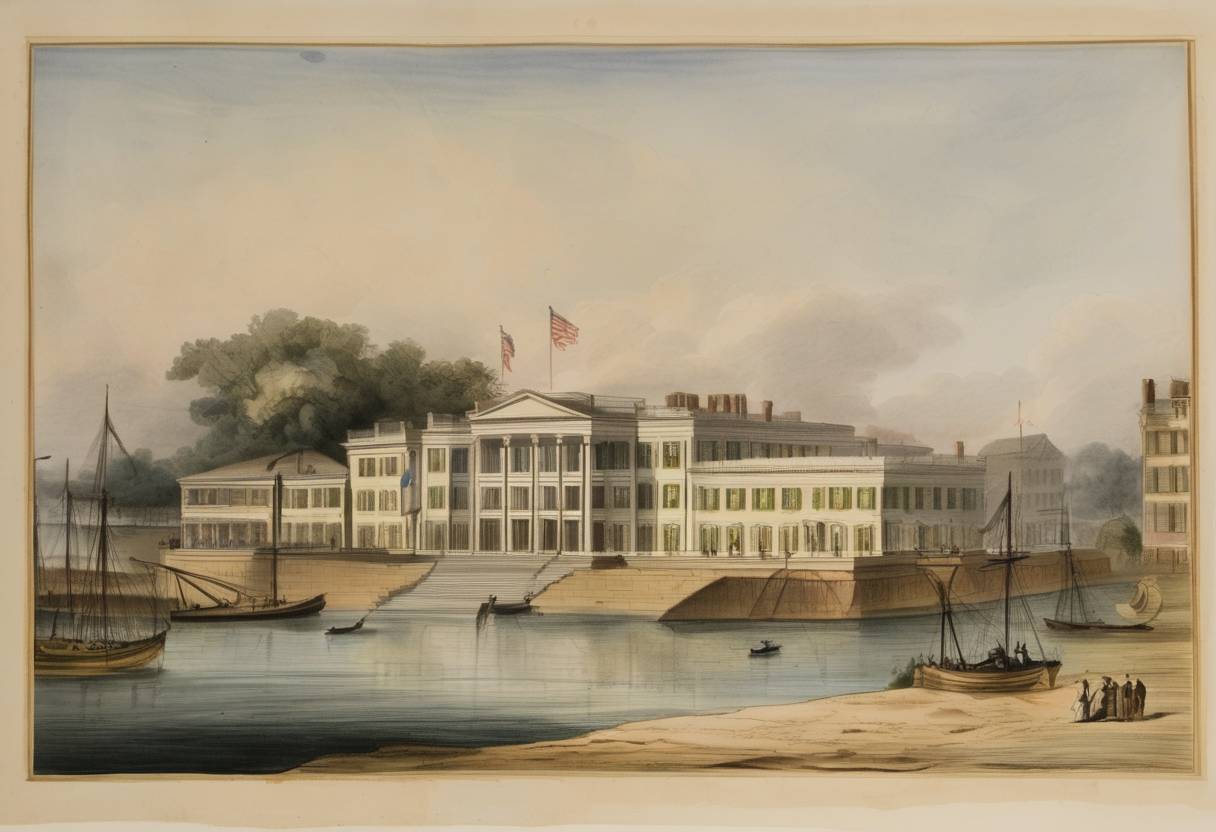
The South Carolina Exposition and Protest - December 19, 1828
On December 19, 1828, John C. Calhoun, who was serving as Vice President of the United States under President John Quincy Adams, played a pivotal role in the drafting of a significant document known as the “South Carolina Exposition and Protest.” This document was a formal protest against the Tariff of 1828, which was also referred to as the “Tariff of Abominations” by its Southern detractors due to its perceived favoritism toward Northern industrial interests at the expense of Southern economies.
Context Leading to the Document
The Tariff of 1828 was enacted by Congress earlier that year and aimed at protecting burgeoning industrial markets in the Northern United States by imposing high duties on imported goods. However, these protective tariffs increased the cost of imported goods for the Southern states, who relied heavily on trade and argued that the tariffs unfairly benefited Northern manufacturers. This disparity heightened sectional tensions between the North and the South, laying seeds for future conflicts regarding states’ rights and federal authority.
Key Elements of the Exposition
Calhoun’s “South Carolina Exposition and Protest” argued that the Constitution authorized tariffs solely for revenue generation and not to foster domestic industry at the cost of states’ economic interests. It posited that states had the right to declare federal laws unconstitutional if they overstepped their boundaries. This doctrine of “nullification” suggested that a state could nullify or invalidate any federal law deemed harmful or unconstitutional within its borders.
Broader Historical Significance
Calhoun’s exposition was a critical precursor to the later Nullification Crisis of the early 1830s, during which South Carolina attempted to nullify federal tariffs, leading to a standoff with the federal government under President Andrew Jackson. The ideas presented in the exposition planted early seeds for the concept of state sovereignty that would become central in the discourse leading up to the American Civil War.
The drafting of the “South Carolina Exposition and Protest” reflected the deepening divide in the United States over economic and political ideologies, indicating growing tensions between the interests of different regions. It also highlighted the complex interplay between state and federal powers that would continue to challenge the nation’s unity.
Aftermath
The protest by South Carolina eventually culminated in the Nullification Crisis, resolved temporarily by the Compromise Tariff of 1833 but kept the debate over states’ rights alive. Calhoun’s authorship of the “Exposition” marked one of his most significant contributions to American political thought and underscored his role as a staunch advocate for Southern interests and states’ rights, setting the stage for his later political endeavors.