Mahatma Gandhi's Arrest and the Quit India Movement
1942 · Bombay, India
Mahatma Gandhi is arrested in Bombay by British forces, marking the beginning of the Quit India Movement, a mass protest demanding an end to British rule in India.
September 20, 1932
Mahatma Gandhi begins his hunger strike in Bombay to protest against the British decision to separate India's electoral system by caste.
Bombay, India | Indian independence movement
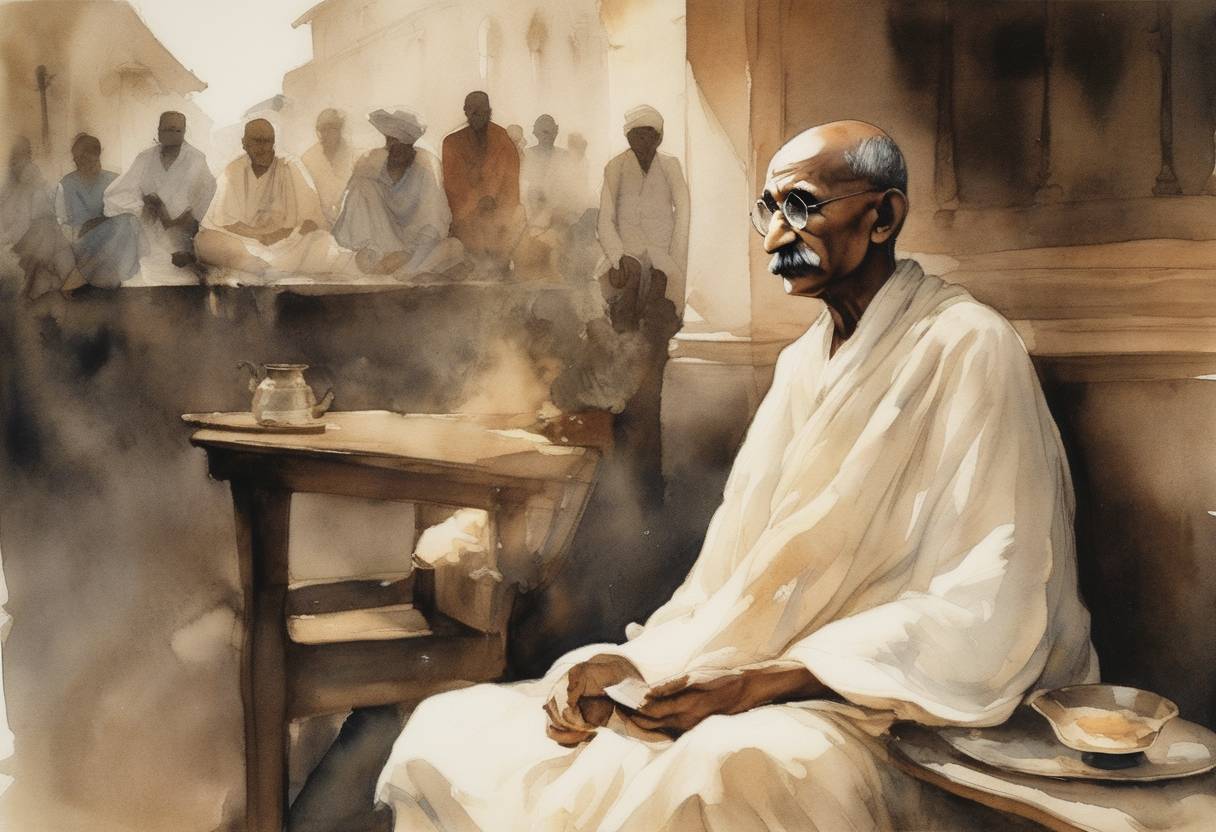
On September 20, 1932, Mohandas Karamchand Gandhi, commonly known as Mahatma Gandhi, commenced a hunger strike in Bombay (now Mumbai), India. This action was a protest against the British government’s decision to establish a separate electorate for the “Depressed Classes,” which were later known as the Dalits or “Untouchables,” based on the Communal Award by British Prime Minister Ramsay MacDonald.
The Communal Award, announced in August 1932, was part of Britain’s strategy of divide and rule in colonial India. It aimed to address the representation of minorities by granting separate electorates to different communities, including Muslims, Sikhs, Indian Christians, Anglo-Indians, and the Depressed Classes.
Gandhi vehemently opposed this decision as he believed that separate electorates would further entrench the caste divisions within Indian society, weakening the unity required for India’s freedom struggle. Gandhi’s principle was that India’s integrity as a nation should not be compromised by caste or class divisions. He argued that such a system would marginalize the Depressed Classes even further by segregating them politically, rather than integrating them into mainstream society.
Gandhi announced his decision to fast unto death as a form of non-violent protest on September 20, 1932. For Gandhi, who was already a globally recognized figure in non-violent resistance, this strike constituted a moral and ethical battle. By putting his life at risk, he aimed to galvanize a collective response both from political leaders and Indian society to reject the British-imposed division based on caste.
Gandhi’s fast drew widespread attention across India and internationally. It stirred compassion and urgency among various Indian political leaders and social reformers to find a solution. Dr. Bhimrao Ambedkar, a key political leader of the Depressed Classes and future architect of the Indian Constitution, was initially in support of the separate electorates as it promised better political representation.
After intense negotiations, an agreement known as the “Poona Pact” was reached on September 24, 1932. The pact provided for a single Hindu electorate, with reserved seats for the Depressed Classes, rather than separate electorates. This accord was seen as a significant compromise, addressing Gandhi’s concerns while ensuring enhanced representation for the Depressed Classes.
Gandhi’s hunger strike marked a pivotal moment in India’s struggle for independence. It not only highlighted the issue of social justice and equality within the Indian socio-political framework but also demonstrated the power of non-violent protest. The event underscored Gandhi’s profound influence in shaping India’s national narrative and highlighted the need for unity amidst diversity in the complex socio-political landscape of India. The resolution via the Poona Pact eventually laid the groundwork for more inclusive measures in the governance of India post-independence.
Source: www.biography.com