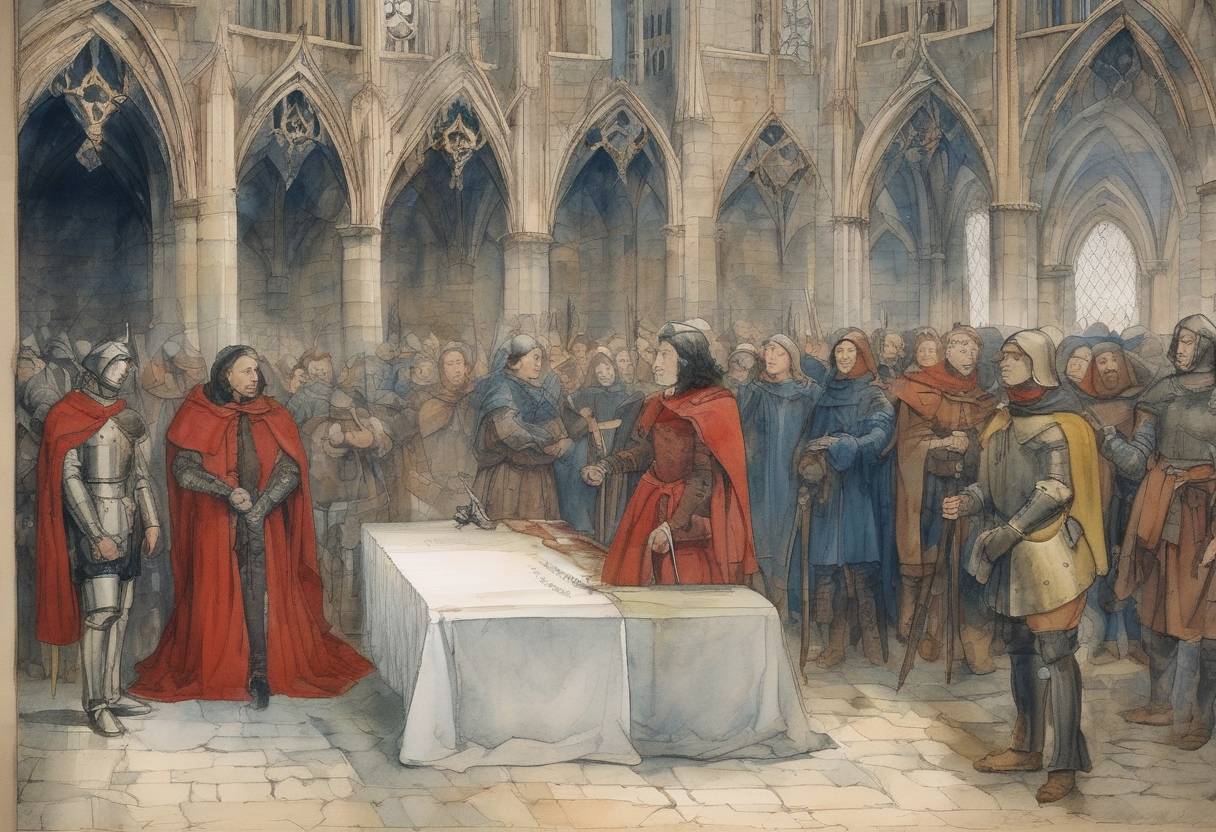
Judges’ Investigations for the Trial of Joan of Arc
On January 9, 1431, the ecclesiastical trial of Joan of Arc commenced in Rouen, France, marking the beginning of a significant and controversial chapter in medieval history. This trial was orchestrated by the English, who occupied northern France during the latter stages of the Hundred Years’ War, and aimed to discredit Joan, who had become a symbol of French resistance.
Context Leading to the Trial
Joan of Arc, a young peasant woman from Domrémy, claimed to have received visions from saints instructing her to support Charles VII and help expel the English from France. Her involvement was pivotal in lifting the Siege of Orléans in 1429, which bolstered French morale and led to Charles VII’s coronation at Reims. However, in May 1430, Joan was captured by the Burgundians, allies of the English, and subsequently sold to the English forces.
The Trial’s Proceedings
The trial was held in Rouen, the English headquarters in France, and was led by Bishop Pierre Cauchon, a staunch supporter of the English cause. The trial was not a straightforward legal proceeding but rather a politically motivated attempt to undermine Joan’s influence and legitimacy.
Key Aspects of the Investigation:
Charges: Joan faced numerous charges, including heresy, witchcraft, and cross-dressing. The latter charge was based on her wearing male military attire, which she argued was necessary for her safety among soldiers.
Interrogations: The trial involved extensive interrogations, where Joan was questioned about her visions, her actions, and her faith. Despite the pressure, she maintained her claims of divine guidance.
Legal Irregularities: The trial was marked by several procedural irregularities. Joan was denied legal counsel, and the trial was conducted in a manner that violated ecclesiastical court norms of the time.
Aftermath and Historical Significance
The trial concluded with Joan being found guilty of heresy. On May 30, 1431, she was executed by burning at the stake. Her death, however, did not diminish her legacy. In 1456, a posthumous retrial authorized by Pope Callixtus III overturned the original verdict, declaring her innocent and a martyr.
Joan of Arc’s trial and execution had lasting impacts on both French national identity and the Catholic Church. She was canonized as a saint in 1920, and her story continues to inspire as a symbol of courage and faith.
The trial of Joan of Arc remains a poignant example of how political and religious powers can intertwine, influencing justice and historical narratives.