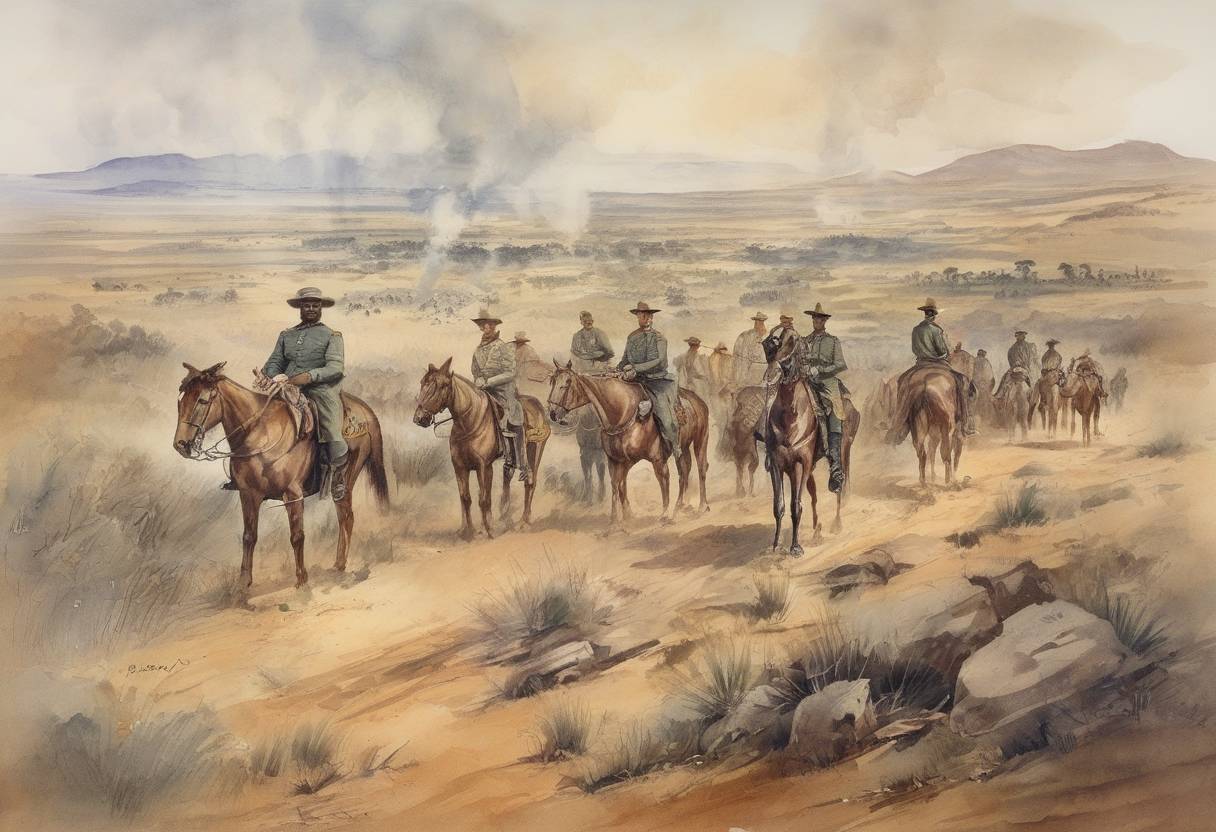
The Second Boer War Begins: October 11, 1899
The Second Boer War, also known as the Anglo-Boer War, commenced on October 11, 1899. This conflict was fought between the British Empire and two Boer states: the South African Republic (also known as the Transvaal) and the Orange Free State. The war was primarily driven by the British Empire’s desire to consolidate its influence in South Africa, particularly due to the region’s rich mineral resources, including gold and diamonds.
Background
The roots of the conflict can be traced back to the discovery of gold in the Witwatersrand area of the Transvaal in 1886. This discovery attracted a large influx of foreign prospectors and settlers, known as “Uitlanders,” who were primarily British. The Boer governments, wary of losing control over their territories, imposed restrictions on these newcomers, including denying them voting rights.
Tensions escalated as the British government, led by Colonial Secretary Joseph Chamberlain and High Commissioner Alfred Milner, sought to extend British influence and secure the rights of the Uitlanders. The Boers, under the leadership of President Paul Kruger of the South African Republic, resisted these pressures, leading to a diplomatic standoff.
Key Events Leading to the War
Jameson Raid (1895-1896): An ill-fated raid by British forces intended to incite an uprising among the Uitlanders against the Boer government. Its failure heightened tensions between the British and the Boers.
Bloemfontein Conference (May-June 1899): A last-ditch attempt to resolve the issues diplomatically. The conference ended without agreement, further straining relations.
Ultimatum and Declaration of War: On October 9, 1899, the South African Republic issued an ultimatum demanding the withdrawal of British troops from its borders. The British rejected the ultimatum, leading the Boers to declare war on October 11, 1899.
The War
The Second Boer War was characterized by several phases:
Initial Boer Successes (1899-1900): The Boers, utilizing guerrilla tactics and their knowledge of the terrain, initially achieved several victories against the British forces.
British Reinforcements and Counteroffensive (1900): The British, under leaders like Lord Roberts and Lord Kitchener, brought in substantial reinforcements and began to turn the tide with a series of successful campaigns.
Guerrilla Warfare (1900-1902): As the British captured major Boer cities, the conflict shifted to a guerrilla war, with the Boers conducting hit-and-run attacks.
Aftermath and Consequences
The war officially ended with the signing of the Treaty of Vereeniging on May 31, 1902. The treaty resulted in the annexation of the Boer republics into the British Empire, forming the Union of South Africa in 1910.
The Second Boer War had significant consequences:
Human Cost: The war resulted in heavy casualties on both sides, including civilian deaths in concentration camps established by the British.
Political Impact: The war exposed the weaknesses of the British military and led to reforms in the British Army.
Legacy: The war left a lasting legacy of bitterness and division in South Africa, influencing the region’s socio-political landscape for decades.
The Second Boer War remains a pivotal event in South African history, marking a significant moment in the broader narrative of British imperialism and the struggle for control over the region’s resources.