Napoleon's Retreat from Moscow: October 19, 1812
1812 · Moscow, Russia
Napoleon Bonaparte begins his retreat from Moscow after a failed invasion of Russia, marking a turning point in the Napoleonic Wars.
September 7, 1812
The Battle of Borodino was fought between Napoleon's Grande Armée and the Russian army, one of the bloodiest battles of the Napoleonic Wars.
Borodino, Russia | Napoleonic Wars
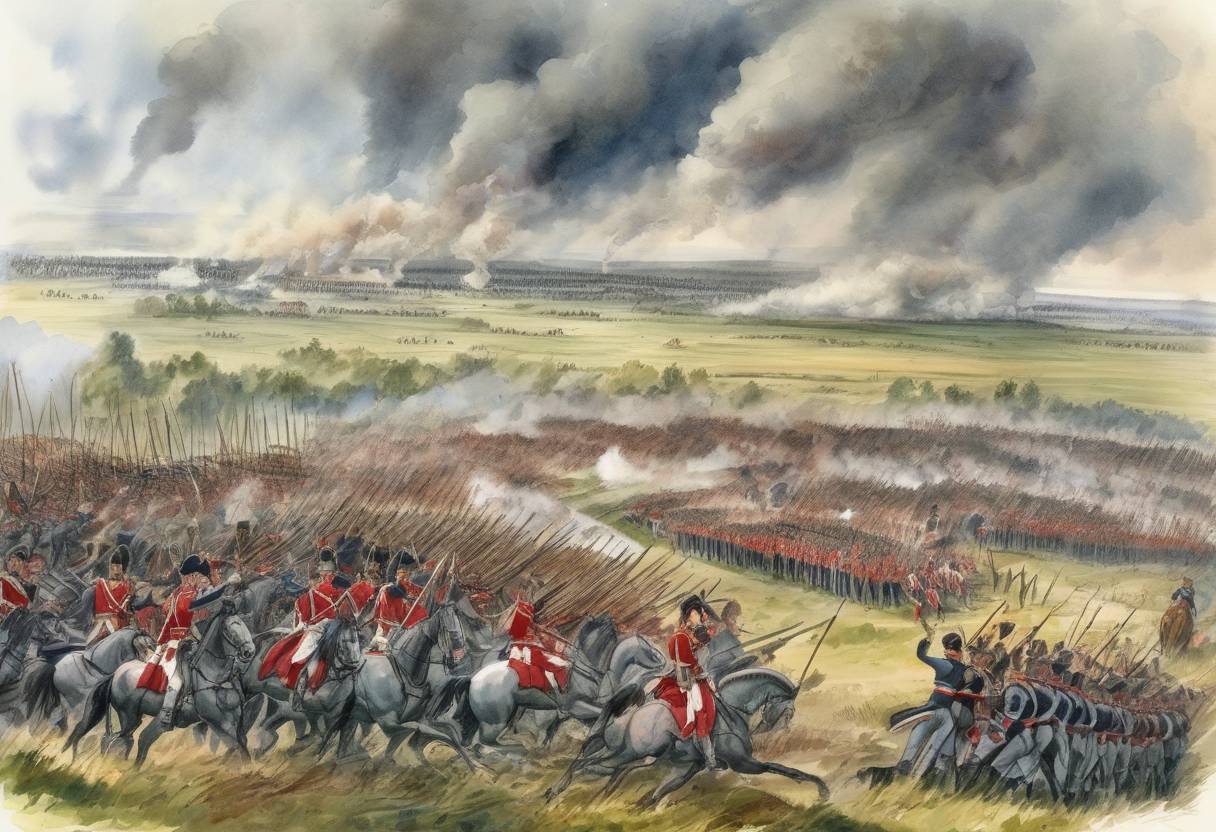
The Battle of Borodino, fought on September 7, 1812, stands as one of the most significant and bloodiest engagements of the Napoleonic Wars. This pivotal clash occurred during Napoleon Bonaparte’s invasion of Russia, a campaign that ultimately marked a turning point in his fortunes.
Napoleon’s Invasion of Russia: In June 1812, Napoleon launched his ambitious invasion of Russia with the Grande Armée, a massive force of over 600,000 troops. His objective was to compel Tsar Alexander I to cease trading with Britain and to enforce the Continental System, which aimed to weaken the British economy through a blockade.
Russian Strategy: The Russian army, under the command of General Mikhail Kutuzov, employed a scorched-earth policy, retreating deeper into Russian territory while destroying supplies and resources that could aid the French. This strategy aimed to stretch Napoleon’s supply lines and weaken his forces.
Location: The battle took place near the village of Borodino, approximately 70 miles west of Moscow. The site was strategically chosen by the Russians to defend the road to Moscow.
Forces Involved: Napoleon’s Grande Armée, though reduced by attrition and desertion, still numbered around 130,000 men. The Russian forces, commanded by Kutuzov, comprised approximately 120,000 troops.
Combat and Casualties: The battle began at dawn and raged throughout the day, characterized by intense and brutal fighting. Key positions, such as the Bagration flèches and the Raevsky Redoubt, saw particularly fierce combat. By the end of the day, the battle resulted in staggering casualties, with estimates of around 30,000 French and 45,000 Russian soldiers killed or wounded.
Tactical Outcome: Although the battle ended without a decisive victor, it was a strategic setback for Napoleon. The Russian army, though battered, managed to withdraw in good order, preserving its core strength for future engagements.
Napoleon’s Advance: Despite the heavy losses, Napoleon continued his advance towards Moscow, capturing the city on September 14, 1812. However, the occupation of Moscow did not bring the expected Russian capitulation.
Turning Point: The Battle of Borodino and the subsequent occupation of Moscow marked the high point of Napoleon’s Russian campaign. The harsh Russian winter, logistical challenges, and continued Russian resistance eventually forced Napoleon to retreat, leading to the catastrophic loss of the Grande Armée.
The Battle of Borodino is often cited as a turning point in the Napoleonic Wars. It demonstrated the resilience of the Russian army and foreshadowed the eventual downfall of Napoleon. The campaign’s failure significantly weakened French military power and contributed to the rise of a coalition against Napoleon, culminating in his eventual defeat and exile.
The battle remains a symbol of Russian tenacity and is commemorated in Russian culture and history, notably depicted in Leo Tolstoy’s epic novel “War and Peace.”
Source: en.wikipedia.org