The Treaty of The Hague (1701)
1701 · The Hague, Netherlands
The Treaty of The Hague was signed between England, the Holy Roman Empire, and the Dutch Republic to secure a mutual defense against France and Spain.
June 1, 1670
The Treaty of Dover is signed between King Charles II of England and King Louis XIV of France. This secret treaty obliged England to assist France in its war of conquest against the Dutch Republic and marked a significant political and military alliance.
Dover, England | Kingdom of England and Kingdom of France
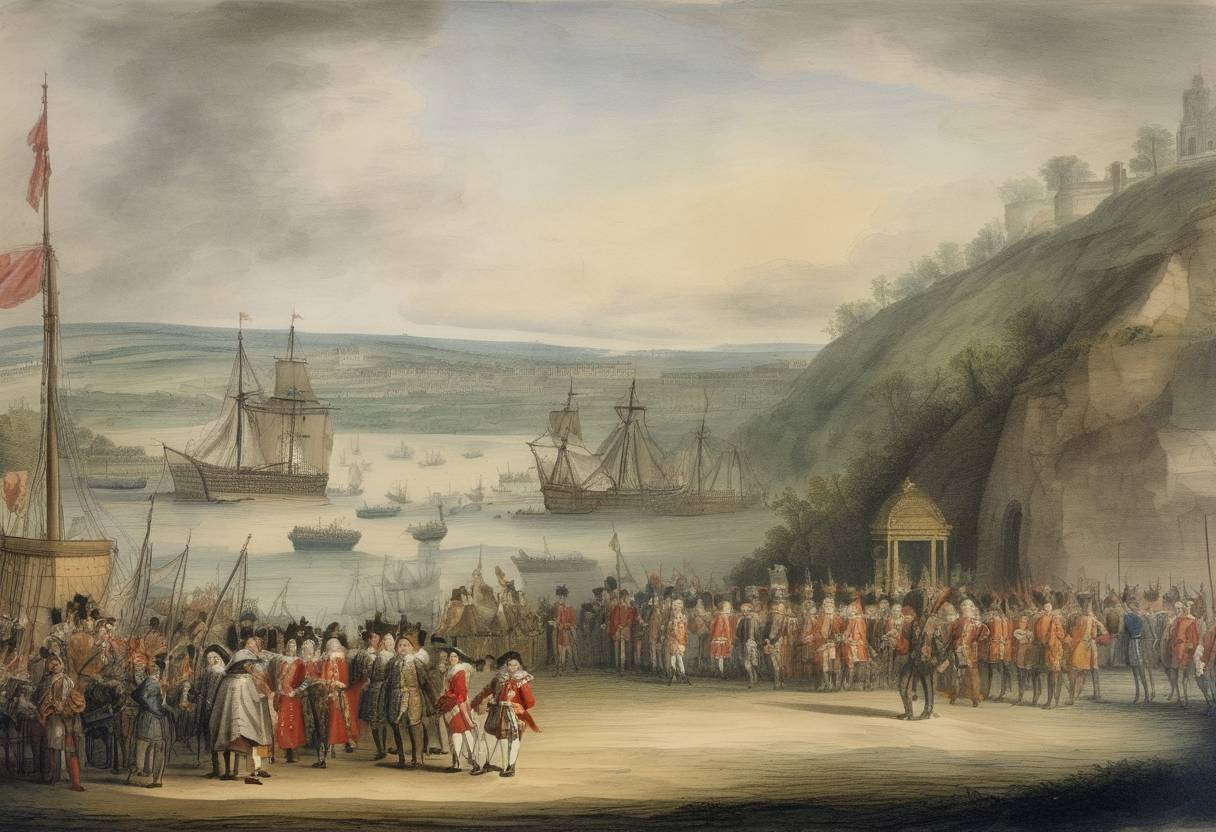
On June 1, 1670, the Treaty of Dover was clandestinely concluded between King Charles II of England and King Louis XIV of France. This secret treaty was a pivotal moment in European political history during the 17th century, significantly impacting the relations between major European powers.
During the late 17th century, the geopolitical landscape of Europe was dominated by intricate alliances and hostilities primarily driven by territorial conflicts and religious undercurrents. King Charles II, who restored the monarchy in England in 1660, faced numerous political and financial challenges. Charles II and his government were eager to stabilize their rule and augment financial resources. Simultaneously, Louis XIV sought to expand French territory and influence across Europe, particularly targeting the Dutch Republic.
The Treaty of Dover contained several key stipulations:
Military Alliance: England committed to aid France militarily in its campaign against the Dutch Republic. This mutual agreement was aimed at neutralizing the growing power and naval influence of the Dutch.
Financial Subsidy: In exchange for military support, France promised substantial subsidies to England. This financial aid was intended to assist Charles II in maintaining a stable regime while providing funds necessary for the campaign against the Dutch.
Religious Conversion Agreement: A controversial and secret clause involved Charles II’s commitment to publicly announce his conversion to Catholicism at an opportune moment, reflecting the continued tension between Protestant and Catholic states in Europe.
The Treaty of Dover represented a strategic pivot for England, aligning it with Catholic France against Protestant Dutch power. However, the treaty generated deep domestic suspicions and dissent due to its secretive nature and the contentious religious undertone regarding Charles II’s potential conversion to Catholicism.
Third Anglo-Dutch War: The immediate military consequence was England’s involvement in the Third Anglo-Dutch War (1672-1674), where England and France jointly attacked the Dutch Republic. Despite initial successes, the war strained England’s resources and was unpopular among the English public and Parliament.
Diplomatic Shifts: The treaty underscored the fragile nature of European alliances, with the balance of power constantly shifting as countries sought to counteract French ambitions. It also highlighted the continuing religious and political tensions that defined much of European politics during this era.
In essence, the Treaty of Dover exemplified the complex interplay of diplomacy, warfare, and intra-European rivalries that characterized the 17th-century geopolitical theater, marking a significant yet transient alliance between England and France.
Source: www.britannica.com