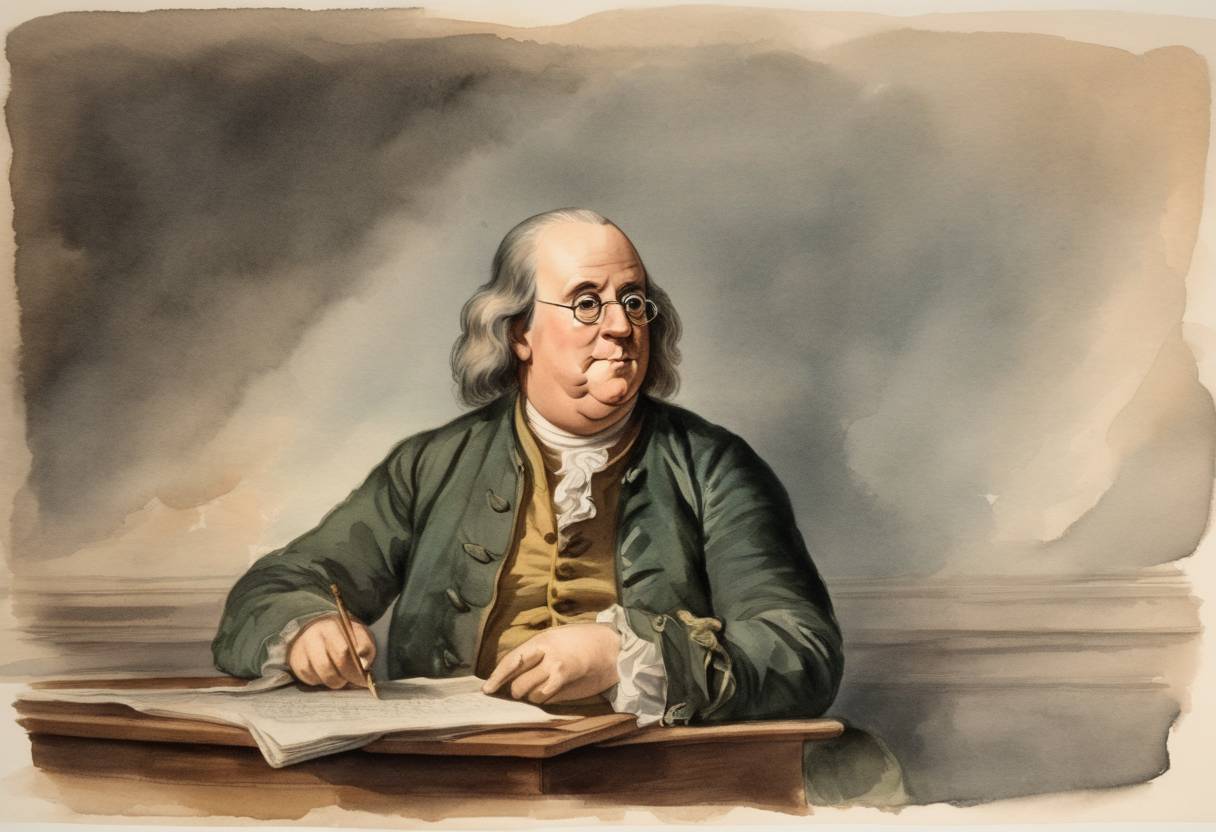
The Death of Benjamin Franklin on April 17, 1790
On April 17, 1790, Benjamin Franklin, one of the most prominent Founding Fathers of the United States, passed away at the age of 84 in Philadelphia, Pennsylvania. Franklin’s remarkable life and multifaceted career left an indelible mark on American history and the world.
Early Life and Career
Born on January 17, 1706, in Boston, Massachusetts Bay Colony, Franklin was one of the 17 children of Josiah Franklin, a candle and soap maker. Despite his formal education ending at the age of 10, Franklin was an avid reader and self-taught polymath. He apprenticed with his brother James, a printer, which paved the way for his later success in the printing business.
Contributions to Science and Literature
Franklin’s scientific endeavors brought him international acclaim. Perhaps most famously, his experiments with electricity, including the legendary kite experiment, demonstrated the electrical nature of lightning. His scientific achievements also include the invention of the lightning rod, bifocal glasses, and the Franklin stove.
In literature, Franklin’s writings, particularly “Poor Richard’s Almanack,” which he published under the pseudonym Richard Saunders, were immensely popular and influential, known for their wit and practical wisdom.
Role in the American Revolution
A fervent advocate for colonial unity, Franklin played a crucial role in the political arenas leading up to the American Revolution. As a diplomat, he was instrumental in securing the Franco-American alliance in 1778, which was vital for the success of the Revolution. He also contributed to drafting the Declaration of Independence in 1776 and later, the United States Constitution.
Legacy and Influence
Franklin’s legacy is evident not only in his scientific and literary contributions but also in his forward-thinking ideas on civil liberties, governance, and education. As a forward-thinking statesman, he left behind a legacy of principled service to the nation, and his influence persists in the many facets of American society he helped to shape.
Upon his death, he was mourned by both American citizens and admirers worldwide. His passing marked the end of an era, but his ideas and spirit continued to inspire future generations. Franklin was laid to rest in Christ Church Burial Ground in Philadelphia, which remains a site of homage for those honoring his life and achievements.