The Council of Troyes and the Knights Templar: January 14, 1129
1129 · Troyes, France
The Council of Troyes opens, during which the Knights Templar are officially recognized and given a rule by Bernard of Clairvaux.
November 19, 1095
At the Council of Clermont, Pope Urban II makes an influential speech calling for the First Crusade to reclaim the Holy Land from Muslim rule.
Clermont, France | Catholic Church
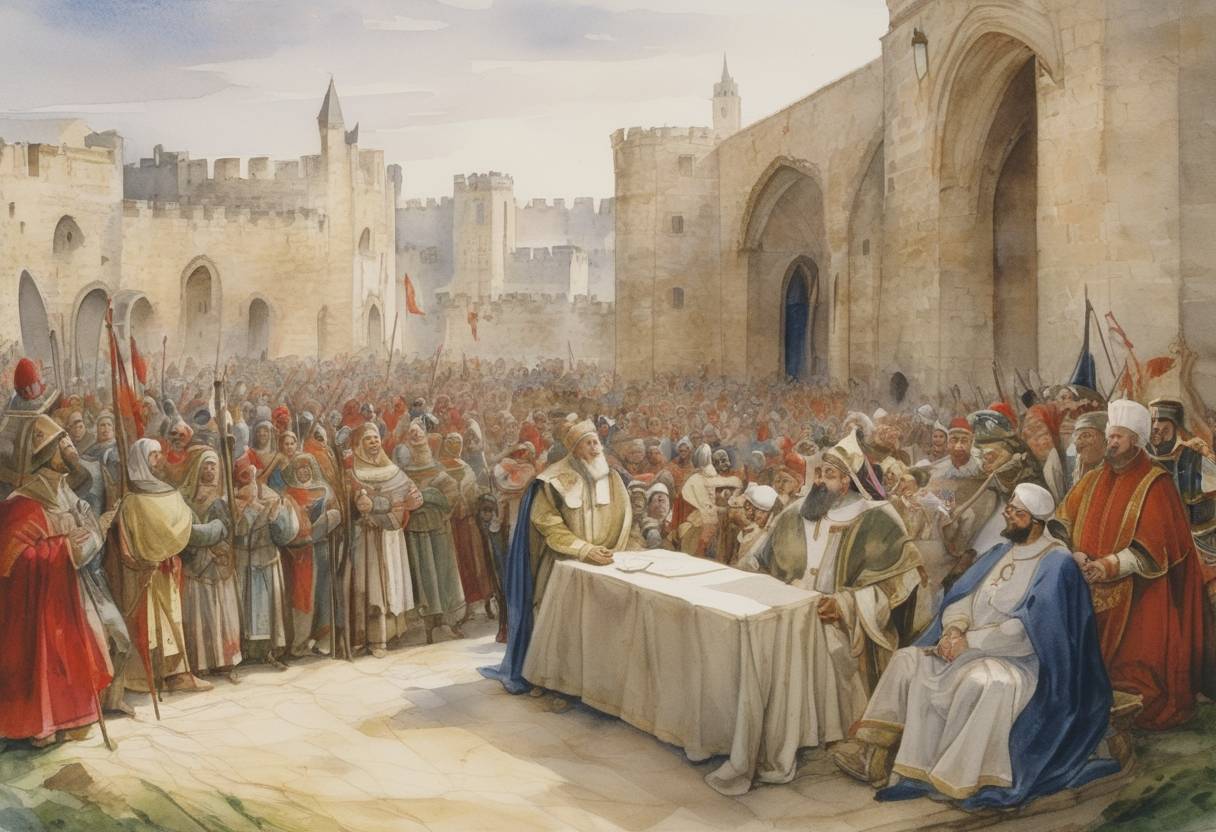
On November 19, 1095, the Council of Clermont commenced in the city of Clermont in Auvergne, now part of modern-day France. It was called by Pope Urban II, who was intent on addressing several ecclesiastical matters and the pressing issue of aiding the Byzantine Empire against Muslim Seljuk Turks. This council gained historical significance, primarily due to Pope Urban II’s call for the First Crusade during the assembly.
The period leading up to the Council of Clermont was marked by significant strife in the Byzantine Empire, particularly following the Battle of Manzikert in 1071, where the Byzantine forces suffered a devastating defeat at the hands of the Seljuk Turks. The subsequent loss of significant territory and the perceived threat to Constantinople prompted the Byzantine Emperor Alexios I Komnenos to seek military support from the West.
While records of the exact words used in Pope Urban II’s speech vary, its impact is indisputable. On November 27, 1095, just over a week after the start of the council, Urban delivered his impassioned plea to a gathered crowd of clergy and nobles. He highlighted the plight of Christians in the East and the desecration of holy sites. His oration is famously associated with the rallying cry “Deus Vult” or “God wills it,” though this phrase became popularized in the aftermath rather than being definitively recorded in contemporary accounts.
Urban’s speech aimed to unite Western Christendom under common cause: to aid their fellow Christians in the East and reclaim Jerusalem and other sacred sites then under Muslim control. The promise of spiritual rewards, such as remission of sins for those who undertook the pilgrimage with the intent of freeing the Holy Land, was a powerful motivator.
The speech generated an immediate and overwhelming response. Nobles, clergy, and commoners expressed their eagerness to take up the cross and embark on the arduous journey. The movement attracted a variety of people, from seasoned knights to peasants, united by religious zeal and, for some, the promise of adventure and potential wealth.
Pope Urban II’s call led to the formation of several armies, collectively known as the Peoples’ Crusade, which set out in the years following the council. Their departure marked the beginning of the First Crusade, a military campaign that would have enduring and complex repercussions on Christian-Muslim relations, the geopolitical landscape of the Middle East, and the religious and social structure of Europe.
The initiation of the First Crusade at the Council of Clermont had a lasting impact on history. It stimulated increased interactions between different cultures and ultimately led to centuries of conflict and exchange. It also solidified the Papacy’s influence over European rulers and expanded the concept of Christendom beyond Europe.
The call for the First Crusade exemplified the power of religious and ideological rhetoric in mobilizing large-scale efforts, setting a precedent for future ecclesiastical and secular campaigns throughout history.
Source: www.britannica.com