Sight of Antarctica by Captain Nathaniel Palmer
1820 · Palmer Land, Antarctica
Captain Nathaniel Palmer, an American seal hunter, sighted the continent of Antarctica.
January 28, 1820
The Antarctic continent was first discovered by the Russian expedition led by Fabian Gottlieb von Bellingshausen and Mikhail Lazarev on the ships Vostok and Mirny.
Antarctica, Antarctica | Russian Imperial Navy
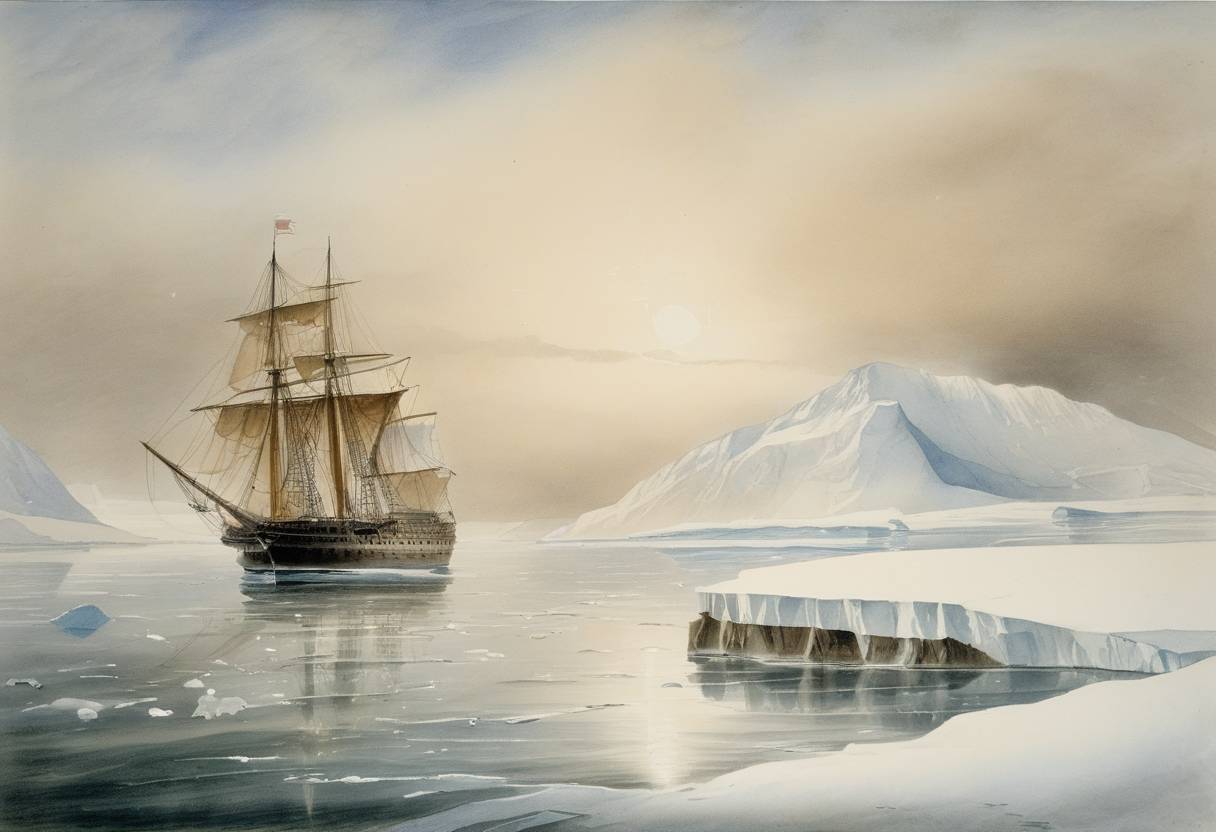
On January 28, 1820, the Antarctic continent was sighted for the first time by a Russian expedition commanded by Fabian Gottlieb von Bellingshausen and Mikhail Lazarev. This notable event marked a significant moment in the era of exploration, as the elusive southern continent had long been suspected but never verified.
The Russian Imperial Navy dispatched two vessels, the Vostok and the Mirny, on a circumnavigation and exploration mission. Captain Fabian Gottlieb von Bellingshausen commanded the journey, with Lieutenant Mikhail Lazarev as the captain of the Mirny. Tasked with exploring the high southern latitudes, they aimed to investigate the existence of land south of the known South Sandwich Islands.
On January 28, 1820, just before noon, Bellingshausen’s expedition approached the Antarctic continent, coming within 20 miles of the Fimbul Ice Shelf on the east coast of what is now known as Queen Maud Land. The sighting occurred at a latitude of approximately 69°21′28″ South and a longitude of 2°14′50″ West. The crew recorded observing an “icefield covered with small hillocks.”
The discovery was not immediately recognized as the first sighting of Antarctica because of the difficulty in navigating the hazardous icy waters and the limited technology of the time which hampered precise verification. However, Bellingshausen and Lazarev’s documentation provided credible evidence of their proximity to the continental landmass and firmly recorded their pioneering venture.
This expedition paved the way for further explorations, contributing significantly to the global understanding of the southernmost reaches of the Earth. It preceded similar sightings by British and American explorers later the same year, who also claimed the discovery. Yet, Bellingshausen’s sighting remains noteworthy for being a part of one of the earliest documented first-hand observations of the Antarctic mainland.
The discovery’s impact extended to future expeditions, encouraging scientific interest and aiding in the eventual detailing of Antarctic geography. Over time, this initiative helped chart the course for modern Antarctic exploration, establishing the continent as a subject of considerable scientific inquiry.
Source: www.britannica.com